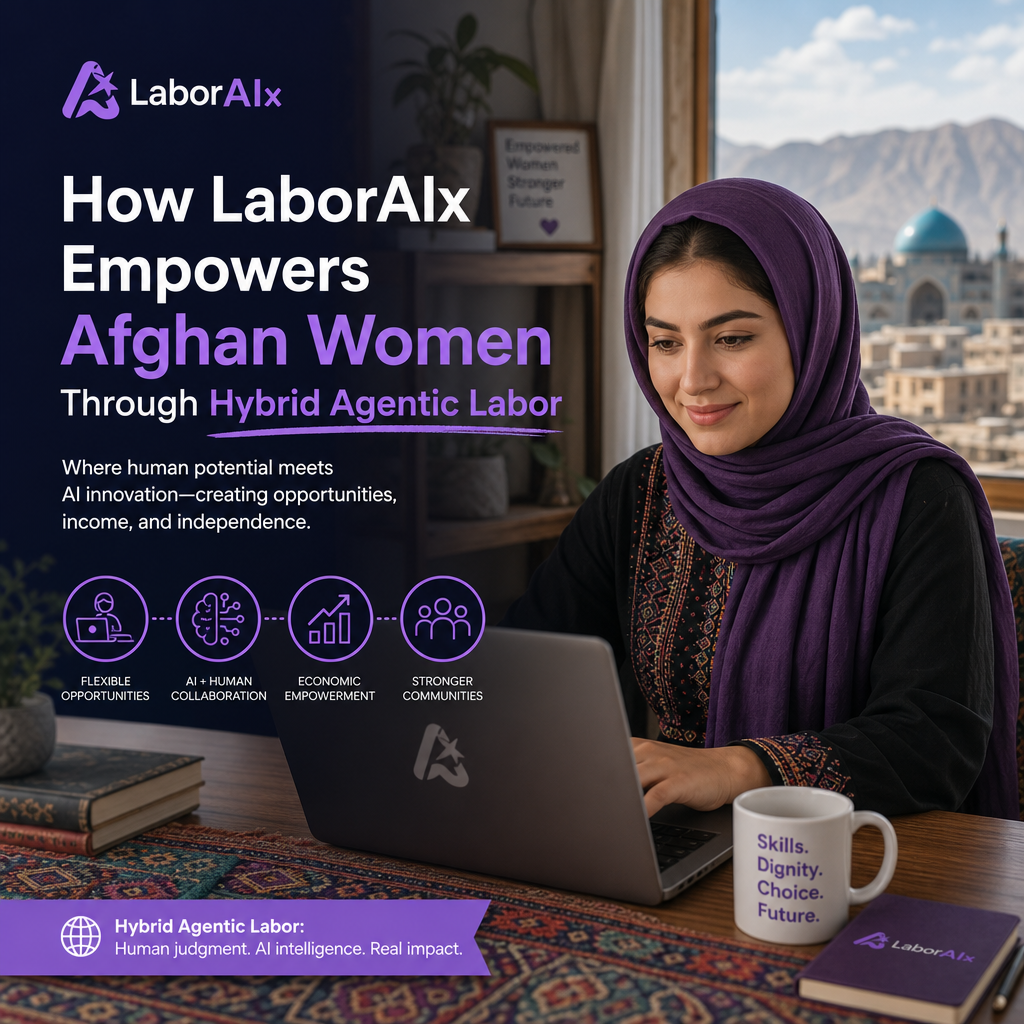
How LaborAIx Empowers Afghan Women Through Hybrid Agentic Labor
Liberating Opulence: How Hybrid Agentic Labor Empowers Afghan Women Through LaborAIx
For many Afghan women, the path to economic independence has been shaped by barriers that are both practical and profound. Restrictions on movement, limited access to formal employment, gaps in digital infrastructure, and social constraints have made traditional work opportunities difficult to reach. Yet amid these challenges, a new model is emerging—one that blends human judgment with AI support to create flexible, dignified, and income-generating work.
This is the promise of hybrid agentic labor through LaborAIx: a system where women can participate in meaningful digital work with the help of AI tools, while still retaining control, authorship, and agency over their contributions.

What Is Hybrid Agentic Labor?
Hybrid agentic labor is a work model that combines human intelligence with machine assistance. Rather than replacing people, AI supports them by handling repetitive tasks, organizing information, drafting content, translating material, or suggesting next steps.

The “agentic” part matters. It means the worker is not just following instructions blindly. She makes decisions, guides the process, reviews output, and brings her own expertise to the final result.
For Afghan women, this approach can open doors to work that is:

- Remote and flexible
- Skill-based rather than location-based
- Adaptable to different levels of access
- Safer than many forms of in-person employment
In this model, AI becomes a tool for empowerment—not a substitute for human value.
Why LaborAIx Matters for Afghan Women
LaborAIx represents a practical framework for connecting women to digital labor opportunities without requiring the same physical mobility or institutional access that traditional jobs demand. It can support a range of tasks such as:
- Data labeling and review
- Translation and transcription
- Content moderation
- Research assistance
- Customer support workflows
- Document summarization
- Creative drafting and editing
These jobs may seem modest on the surface, but they can be transformative. They create entry points into the digital economy, build experience, and generate income in ways that fit real-life constraints.
For women who have been excluded from stable employment, this is not just convenience. It is access.
Dignity Through Work, Not Dependency
One of the most powerful aspects of hybrid agentic labor is that it restores dignity through participation. It does not frame women as passive recipients of aid. Instead, it recognizes them as capable contributors to modern work.
That shift matters.
When women are paid for their judgment, language skills, attention to detail, and creativity, they gain more than income. They gain:
- Professional identity
- Confidence in digital skills
- A sense of ownership over their time
- Greater resilience for their families
Liberating opulence, in this context, is not about luxury in the conventional sense. It is about abundance of opportunity, autonomy, and possibility.
How AI Supports, Rather Than Replaces, Human Labor
A common concern about AI is that it will eliminate jobs. But in the right framework, AI can actually make labor more accessible.
For example, a woman working through LaborAIx might use AI to:
Draft Faster
AI can help generate a first version of text, saving time and reducing the stress of starting from scratch.
Translate and Refine
For multilingual work, AI can assist with translation, while the human worker ensures accuracy, tone, and cultural sensitivity.
Organize Complex Tasks
AI can sort information, summarize long documents, and identify patterns that help workers complete assignments more efficiently.
Expand Learning
By interacting with AI tools, women can build technical literacy and grow into more advanced digital roles over time.
The key is that the worker remains in control. AI assists the process; it does not own the outcome.
A Model Built for Real-World Constraints
What makes LaborAIx especially relevant is its adaptability. Many systems assume ideal conditions: stable broadband, full-time schedules, advanced degrees, and safe travel. But real life is rarely ideal.
A hybrid agentic labor platform can be designed to work within constraints by offering:
- Asynchronous tasks
- Mobile-friendly interfaces
- Micro-projects with clear instructions
- Low-bandwidth participation options
- Training that begins at the user’s current skill level
This kind of design is crucial for inclusion. It meets women where they are, rather than asking them to overcome every barrier before they can begin.
Building Long-Term Opportunity
The best part of hybrid agentic labor is that it can create a path, not just a paycheck. A woman who begins with simple digital tasks can gradually move into more complex roles as her confidence and skills grow.
Over time, she may develop expertise in:
- Virtual assistance
- Project coordination
- AI-assisted content production
- Quality assurance
- Online research
- Digital communication
This progression matters because it turns short-term access into long-term economic mobility.
The Bigger Picture
Empowering Afghan women through LaborAIx is not only about technology. It is about redesigning work so that it includes those who have historically been left out. It is about creating systems where intelligence, care, and discipline are valued regardless of geography or gender.
Hybrid agentic labor offers a new vision of participation: one where women can earn, learn, and lead on their own terms.
In a world often focused on automation alone, this approach reminds us that the future of work should still be human-centered. When AI is used to extend capability rather than erase agency, it can help unlock opportunities that once seemed out of reach.
That is the real meaning of liberating opulence: not excess, but access. Not dependency, but dignity. Not silence, but a voice in the digital economy.