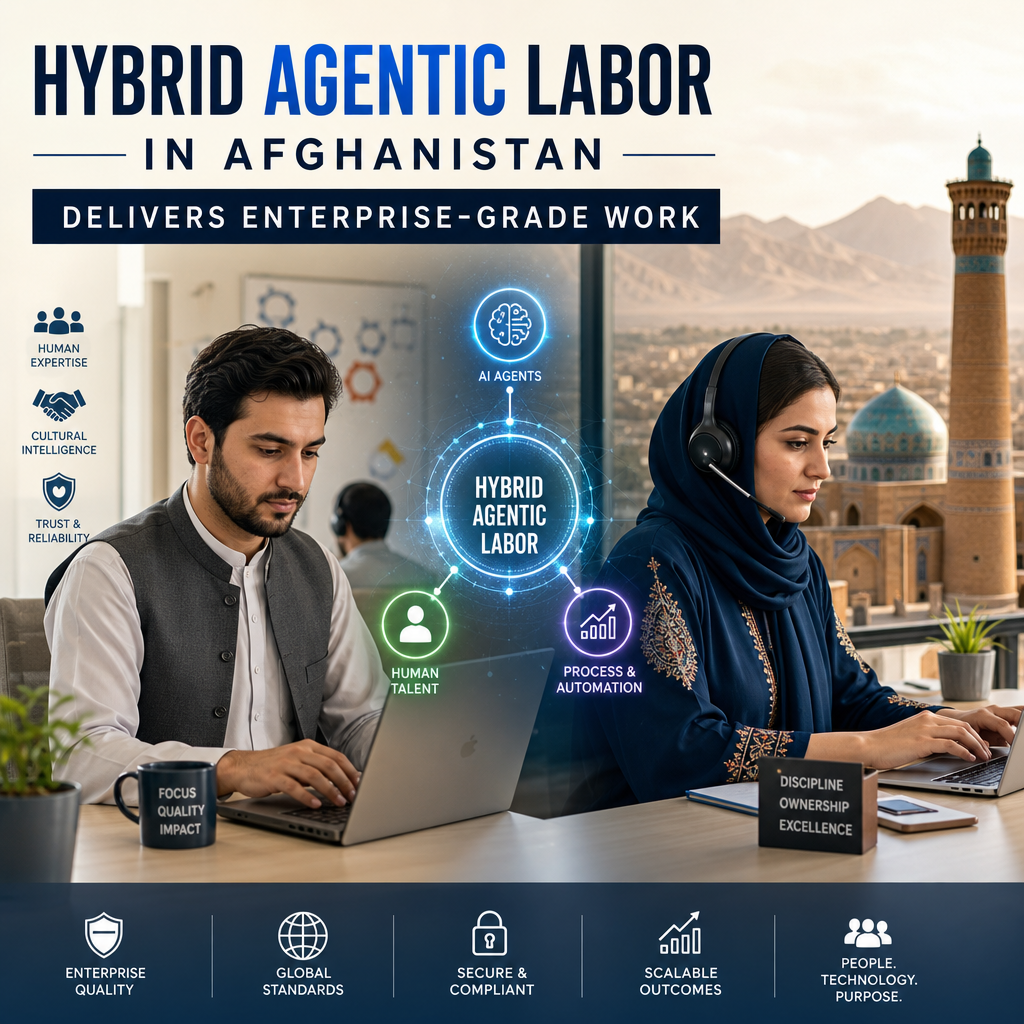
Hybrid Agentic Labor in Afghanistan Delivers Enterprise-Grade Work
Empowering Afghanistan: Hybrid Agentic Labor That Delivers Enterprise‑Grade Work and Real Impact
Afghanistan has long been described through the lens of challenge. But there is another story emerging—one shaped by resilience, talent, and the ability to participate in the global economy through modern work models. Hybrid agentic labor is one of the most promising of these models. It combines human judgment with AI-assisted workflows, creating a workforce that can deliver reliable, scalable, enterprise-grade outcomes while opening doors to meaningful economic opportunity.
This is not just about outsourcing tasks. It is about building a system where Afghan professionals can contribute to high-value work with the support of technology, structure, and global standards.

What Is Hybrid Agentic Labor?
Hybrid agentic labor is a work model in which people and AI tools collaborate to complete tasks more efficiently and accurately. The “agentic” part refers to systems that can take action, follow instructions, and move work forward. The “hybrid” part means humans remain at the center—reviewing outputs, making decisions, and handling nuance.

In practical terms, this can include:
- AI drafting first-pass content or analyzing data
- Human workers checking quality and context
- Teams using workflows to manage repetitive enterprise tasks
- Local talent handling communication, escalation, and final approval
The result is a more productive labor system that does not replace human workers. Instead, it helps them perform at a higher level.

Why Afghanistan Is Positioned for This Model
Afghanistan has a young population, a strong culture of adaptability, and a growing digital workforce. Many talented people are already looking for ways to contribute remotely, learn in-demand skills, and build stable careers despite local constraints.
Hybrid agentic labor offers a path forward because it lowers barriers to entry while still rewarding quality and commitment. Workers can begin with supported, well-defined tasks and grow into more complex roles over time.
Key advantages for Afghanistan include:
- Access to remote work without requiring heavy infrastructure
- Opportunities for English-language and digital skill development
- Faster entry into global labor markets
- A model that supports both individual income and community resilience
For many Afghan workers, this is not just a new kind of job. It is a new kind of economic possibility.
Enterprise-Grade Work Requires More Than Speed
Global companies do not just need work completed quickly. They need work done consistently, securely, and at a level that meets business standards. That is where hybrid agentic labor stands out.
By combining AI efficiency with human oversight, teams in Afghanistan can support enterprise processes such as:
- Customer support and ticket triage
- Market research and data labeling
- Operations documentation
- Back-office coordination
- Content review and localization
- Lead qualification and CRM updates
These tasks may seem routine, but they are essential to how enterprises function. When handled well, they create measurable value. When handled through a hybrid system, they can be delivered faster and at greater scale.
Real Impact Comes from Real Structure
To empower Afghanistan through hybrid agentic labor, the work model must be designed thoughtfully. It cannot depend on vague promises or informal gig arrangements alone. It needs structure, training, and quality control.
That means building systems that support:
1. Training and onboarding
Workers need clear guidance on how to use AI tools, follow workflows, and meet expectations. Good onboarding reduces errors and builds confidence.
2. Human-in-the-loop review
Every AI-assisted process should include human oversight. This ensures the final output reflects judgment, cultural understanding, and accountability.
3. Transparent performance standards
Clear metrics help workers know what success looks like. This is especially important in enterprise environments where consistency matters.
4. Continuous skill growth
The best programs help workers move from simple task execution to higher-value roles such as team leads, analysts, and workflow managers.
When these elements are in place, hybrid agentic labor becomes more than a labor model. It becomes a pathway for long-term economic development.
The Human Side of the Story
Technology alone does not empower people. People empower people, and technology helps them do it better.
For Afghan workers, hybrid agentic labor can mean:
- Earning income from meaningful work
- Building professional confidence
- Gaining exposure to global business standards
- Developing skills that remain valuable over time
It can also help local families and communities. A stable remote income can support education, health care, and household resilience. In that sense, each job creates a ripple effect far beyond the individual worker.
A Practical Path Forward
The future of work in Afghanistan will not be built overnight. But hybrid agentic labor offers a realistic starting point because it aligns opportunity with capability. It does not require waiting for perfect conditions. It works by using available talent, practical technology, and clear systems to deliver results now.
Organizations that invest in this model should focus on:
- Fair access to work opportunities
- Reliable digital infrastructure
- Training programs tailored to enterprise needs
- Partnerships that connect Afghan workers to global demand
With the right support, Afghanistan can become known not only for its challenges, but for the quality, diligence, and value of its workforce.
Conclusion
Hybrid agentic labor represents a powerful way to connect Afghan talent with enterprise-grade work and real-world impact. It blends human capability with AI support, creating a model that is efficient, scalable, and deeply practical. More importantly, it gives people in Afghanistan a chance to participate in the modern economy on their own terms.
Empowerment is not abstract. It is built through systems that create opportunity, deliver value, and respect human potential. Hybrid agentic labor does exactly that.