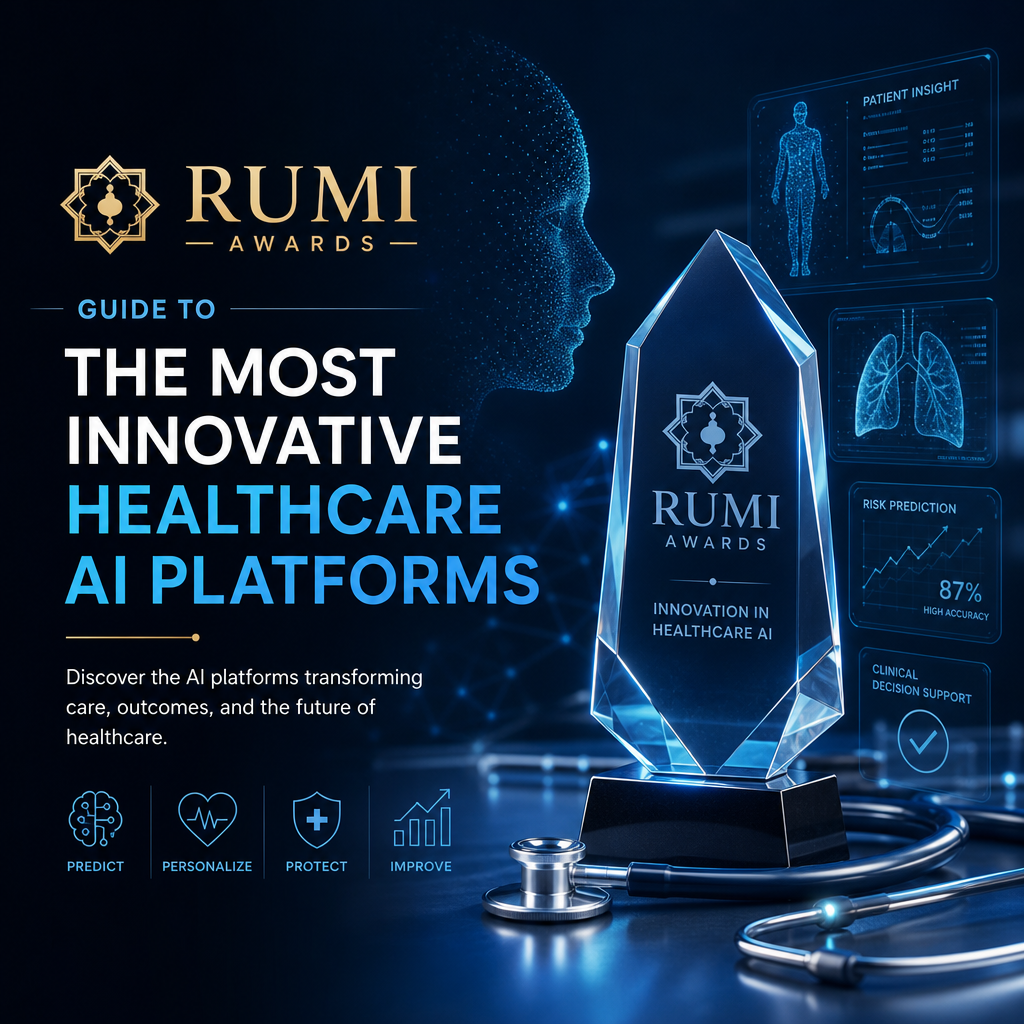
Rumi Awards Guide to the Most Innovative Healthcare AI Platforms
The Rumi Awards Guide to the Most Innovative Healthcare AI Platforms
Healthcare is changing fast, and artificial intelligence is at the center of that shift. From helping clinicians detect disease earlier to streamlining operations behind the scenes, AI is now shaping how care is delivered, managed, and improved. The Rumi Awards Guide to the Most Innovative Healthcare AI Platforms highlights the qualities that make certain platforms stand out in a crowded market.
Not every AI tool in healthcare is built the same way. Some focus on diagnostics, others on workflow automation, and some aim to improve patient engagement or population health. The best platforms combine practical value, clinical accuracy, strong data governance, and seamless integration into real-world care settings.

Why Healthcare AI Platforms Matter
Healthcare systems face constant pressure to do more with less. Staff shortages, rising costs, data overload, and increasing patient expectations all create demand for smarter tools.


Innovative AI platforms help by:
- Reducing administrative burden
- Supporting faster and more accurate decision-making
- Identifying risk earlier
- Improving care coordination
- Personalizing patient experiences
When used responsibly, AI can become a powerful partner for clinicians, administrators, and patients alike.

What Makes a Healthcare AI Platform Innovative?
Innovation in healthcare AI is not just about advanced algorithms. A truly strong platform must solve real problems and fit into clinical workflows without creating more complexity.
1. Clinical Relevance
The most valuable platforms focus on problems that matter in day-to-day care. These might include:
- Early disease detection
- Imaging analysis
- Risk prediction
- Triage support
- Documentation assistance
A platform is only useful if it improves outcomes or saves time in a measurable way.
2. Accuracy and Reliability
Healthcare decisions can affect lives, so performance matters. Innovative platforms should demonstrate strong validation, transparent testing, and evidence of real-world effectiveness.
A reliable AI system should:
- Minimize false positives and false negatives
- Show consistent performance across patient groups
- Be validated with clinical data
- Offer explainable outputs when possible
3. Workflow Integration
Even the smartest AI tool fails if clinicians cannot use it easily. Platforms that integrate into electronic health records, imaging systems, and hospital workflows are more likely to be adopted successfully.
Look for solutions that reduce friction rather than adding another disconnected system.
4. Data Security and Compliance
Healthcare data is sensitive. The best AI platforms prioritize privacy, encryption, access control, and regulatory compliance. Strong governance is essential for building trust among providers and patients.
Categories of Leading Healthcare AI Platforms
The Rumi Awards Guide to the Most Innovative Healthcare AI Platforms often recognizes solutions across several key categories. Each category serves a different part of the care journey.
Diagnostic AI
Diagnostic AI tools analyze medical images, lab results, or clinical notes to identify patterns that may be missed by the human eye. These platforms are especially valuable in radiology, pathology, and dermatology.
Common benefits include:
- Faster image review
- Earlier detection of abnormalities
- More consistent interpretation
- Support for overworked specialists
Predictive Analytics Platforms
These platforms use patient data to forecast outcomes such as readmission risk, disease progression, or treatment response. Predictive tools help care teams act before a problem becomes urgent.
They are especially useful for:
- Chronic disease management
- Hospital resource planning
- Population health programs
- Preventive care initiatives
Administrative Automation Tools
A surprising amount of healthcare time is lost to paperwork, scheduling, prior authorization, billing, and documentation. AI platforms that automate routine tasks can dramatically improve efficiency.
These tools often help with:
- Clinical note generation
- Appointment scheduling
- Claims processing
- Coding assistance
- Inbox management
Patient Engagement Platforms
Some of the most innovative AI platforms are designed to improve communication with patients. They offer chat support, symptom checking, reminders, and personalized education.
Done well, these tools can improve adherence, reduce no-shows, and help patients feel more informed and supported.
How to Evaluate a Healthcare AI Platform
If you are comparing healthcare AI solutions, it helps to use a clear evaluation framework. A platform may look impressive in a demo, but long-term value depends on how well it performs in practice.
Ask These Questions
- Does it solve a real clinical or operational problem?
- Has it been validated with relevant data?
- Can it integrate with existing systems?
- Is it secure and compliant?
- Will staff actually use it?
- Does it improve efficiency, accuracy, or outcomes?
Watch for Red Flags
Some tools overpromise and underdeliver. Be cautious if a platform:
- Lacks clinical evidence
- Cannot explain its results
- Requires major workflow changes
- Has poor interoperability
- Offers limited support or training
Innovation should feel useful, not disruptive for the wrong reasons.
The Future of Healthcare AI
Healthcare AI is moving toward more personalized, more transparent, and more collaborative systems. Future platforms will likely combine multiple functions, such as diagnostics, predictions, and automation, in a single ecosystem.
We can also expect greater attention to:
- Bias reduction
- Human-in-the-loop design
- Multimodal data analysis
- Patient-centered interfaces
- Ethical AI governance
The strongest platforms will not replace healthcare professionals. Instead, they will extend human expertise, helping teams work faster, see more clearly, and make better decisions.
Final Thoughts
The Rumi Awards Guide to the Most Innovative Healthcare AI Platforms is ultimately about more than technology. It is about identifying solutions that create real impact in real healthcare environments. The best platforms are those that improve care, support clinicians, and make systems more efficient without sacrificing trust or quality.
As AI continues to evolve, the healthcare organizations that choose wisely will be better positioned to deliver smarter, safer, and more responsive care.