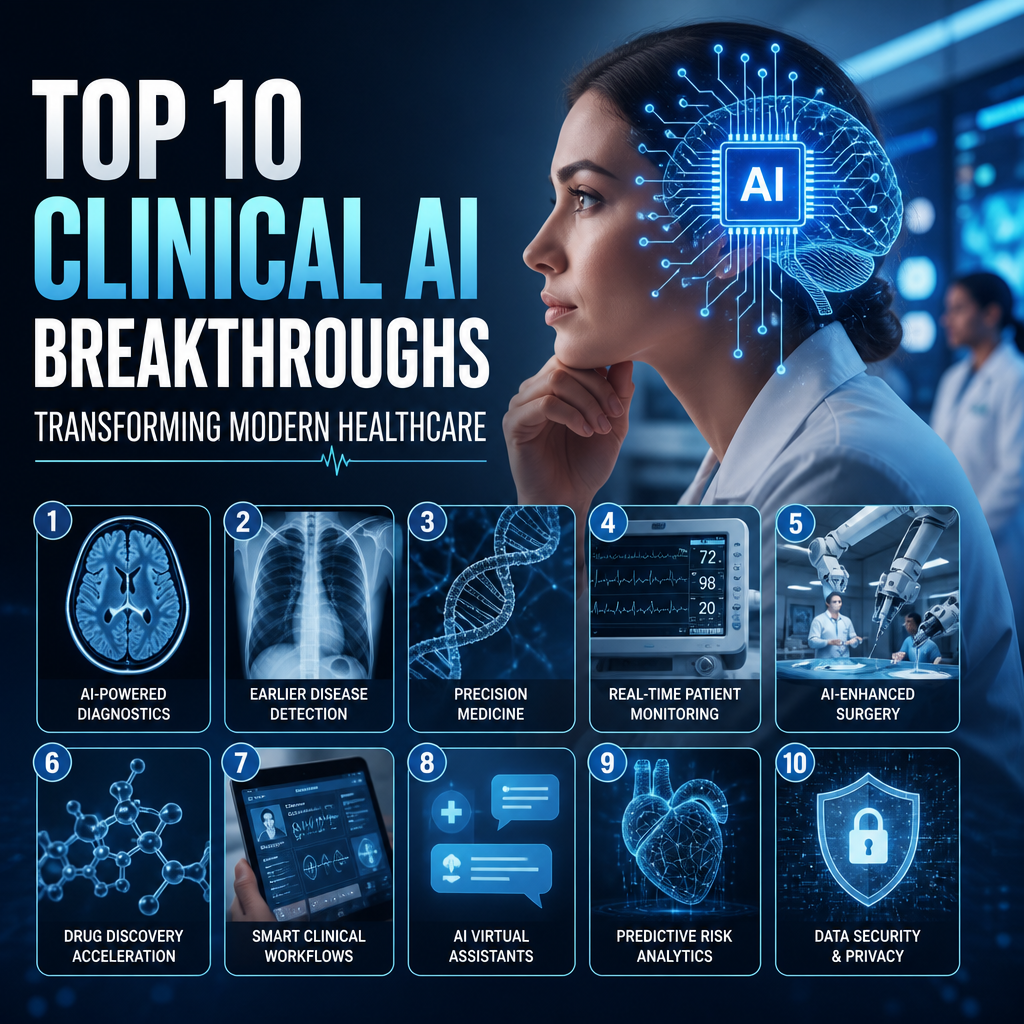
Top 10 Clinical AI Breakthroughs Transforming Modern Healthcare
Top Ten Clinical AI Breakthroughs Revolutionizing Modern Healthcare
Artificial intelligence is no longer a futuristic concept in medicine. It is already changing how doctors diagnose illness, plan treatment, and monitor patients. From analyzing scans in seconds to predicting health risks before symptoms appear, clinical AI breakthroughs are helping healthcare teams work faster, make better decisions, and improve patient outcomes.
Below are ten of the most important advances shaping modern healthcare today.

1. AI-Powered Medical Imaging
One of the biggest clinical AI breakthroughs is the use of AI in radiology and imaging. Algorithms can review X-rays, CT scans, MRIs, and mammograms with remarkable speed and accuracy.

Why it matters
- Detects tumors, fractures, and other abnormalities earlier
- Reduces the chance of missed findings
- Helps radiologists prioritize urgent cases
Instead of replacing specialists, AI acts as a second set of eyes, improving confidence and efficiency.
2. Early Disease Detection
AI can spot patterns in patient data that humans may overlook. By analyzing lab results, imaging, genetics, and medical history, it can identify signs of disease before symptoms become severe.

This is especially useful for:
- Cancer detection
- Heart disease risk prediction
- Diabetic complications
- Neurological disorders
Earlier detection often leads to earlier treatment, which can dramatically improve outcomes.
3. Clinical Decision Support Systems
Doctors make thousands of decisions every day. AI-based clinical decision support tools help by suggesting diagnoses, flagging dangerous drug interactions, and recommending next steps based on current evidence.
These systems can:
- Compare patient data with large medical databases
- Highlight unusual results
- Offer treatment suggestions aligned with guidelines
The result is more informed, data-driven care at the point of decision.
4. Personalized Treatment Planning
No two patients are exactly alike, and AI is making medicine more personalized. By studying large amounts of clinical and genetic data, AI can help tailor treatments to individual patients.
Examples include:
- Choosing the most effective cancer therapy
- Matching medications to a patient’s genetic profile
- Adjusting treatment based on age, lifestyle, and risk factors
This move toward precision medicine is one of the most promising clinical AI breakthroughs in modern healthcare.
5. Predictive Analytics for Hospital Care
Hospitals are using AI to predict which patients are likely to deteriorate, be readmitted, or develop complications. These models can analyze real-time data from electronic health records and monitor vital trends.
Benefits include:
- Faster response to high-risk patients
- Better bed and resource management
- Reduced readmission rates
- Improved care coordination
Predictive tools help healthcare teams act before problems become emergencies.
6. AI in Pathology
Pathology is another area being transformed by AI. Digital pathology systems can scan slides and identify cancer cells, abnormalities, or patterns linked to specific diseases.
AI can assist by:
- Counting cells more accurately
- Detecting microscopic changes
- Speeding up review times
- Supporting complex diagnostic cases
This is especially valuable in settings with high workloads or limited access to expert pathologists.
7. Virtual Health Assistants and Chatbots
AI-driven virtual assistants are becoming common in healthcare settings. They can answer basic medical questions, schedule appointments, remind patients to take medication, and guide users to the right level of care.
What they improve
- Patient engagement
- Appointment adherence
- Follow-up care
- Access to basic health information
While they are not a substitute for clinical judgment, they help reduce administrative burden and improve access to care.
8. Drug Discovery and Development
Creating new medicines is expensive and time-consuming. AI is speeding up the process by identifying promising drug candidates, predicting how molecules will behave, and reducing the need for trial-and-error research.
This breakthrough can:
- Cut research timelines
- Lower development costs
- Improve the chance of success
- Support faster response to emerging diseases
AI is helping bring new therapies to patients sooner than traditional methods allow.
9. Remote Patient Monitoring
Wearables and connected devices now collect continuous patient data, and AI helps make sense of it. This is especially useful for people with chronic conditions such as diabetes, heart disease, or respiratory illness.
AI can monitor:
- Heart rate
- Blood sugar levels
- Oxygen saturation
- Sleep and activity patterns
When unusual changes appear, alerts can be sent to care teams, allowing earlier intervention and better long-term management.
10. Surgical Assistance and Robotics
AI is also improving surgery through robotic systems and computer-guided tools. These technologies help surgeons perform precise, minimally invasive procedures with greater control.
Advantages include:
- Smaller incisions
- Less blood loss
- Faster recovery
- Improved surgical accuracy
In complex procedures, AI-guided robotics can enhance safety and support better outcomes.
The Future of AI in Healthcare
The rise of clinical AI is not about replacing healthcare professionals. It is about giving them better tools. As these technologies become more advanced, they will continue to support earlier diagnosis, smarter treatment, and more efficient care delivery.
The most successful healthcare systems will be those that combine human expertise with intelligent technology. In that partnership, patients stand to benefit the most.
As innovation continues, these clinical AI breakthroughs will likely become a standard part of everyday medical practice, reshaping healthcare for years to come.