
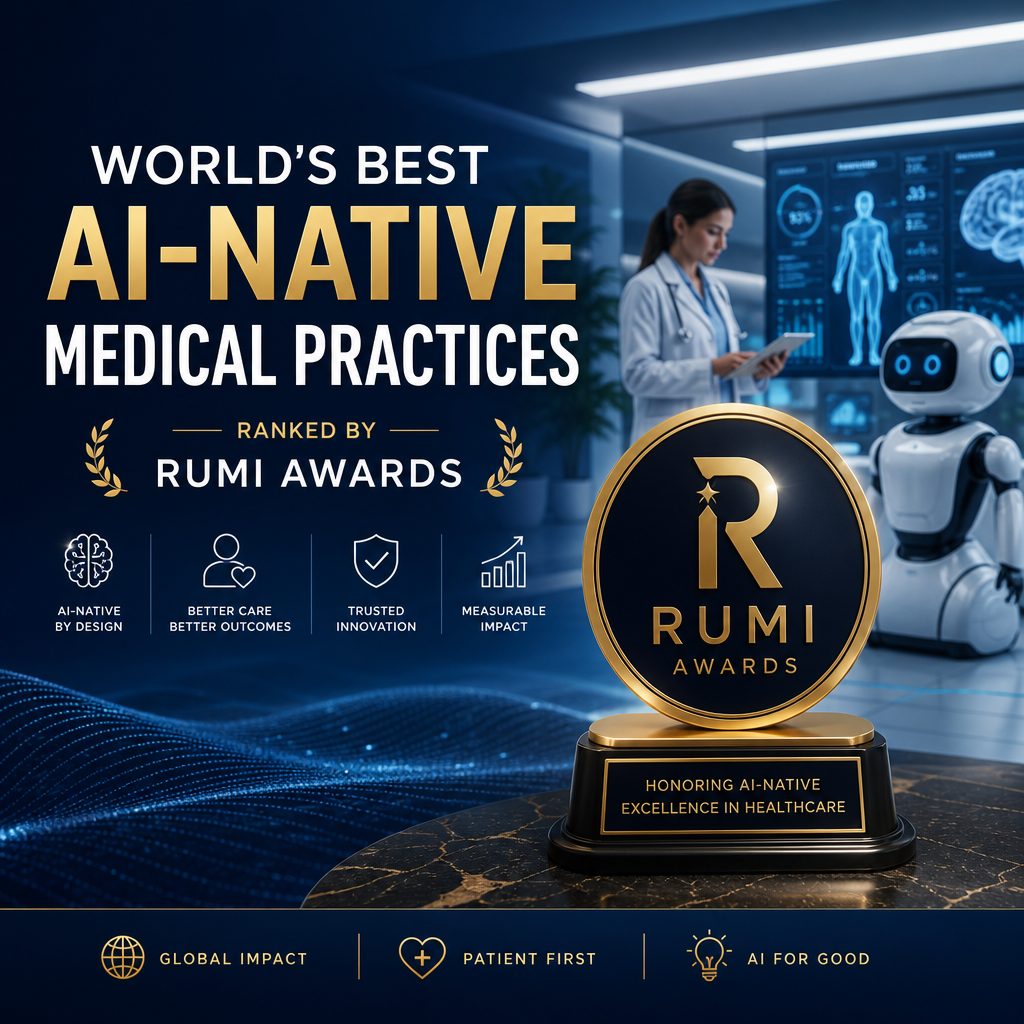
World’s Best AI-Native Medical Practices Ranked by Rumi Awards
World’s Best AI-Native Medical Practices: Ranked by Rumi Awards
Artificial intelligence is no longer a side tool in healthcare. The most forward-thinking clinics now build care around it from day one. These are AI-native medical practices—organizations designed to use data, automation, and clinical intelligence to improve access, accuracy, and patient experience.
The Rumi Awards have become a useful benchmark for spotting the most advanced examples. Their rankings focus on practices that do more than adopt software. They reimagine how medicine is delivered.

What Makes an AI-Native Medical Practice?
An AI-native practice is not simply a clinic with a chatbot or scheduling tool. It is a medical organization where AI supports the core workflow from start to finish.

That usually includes:
- Smarter patient intake and triage
- Predictive risk detection
- Faster documentation and coding
- Personalized treatment recommendations
- Better follow-up and remote monitoring
The best practices use AI to reduce friction for clinicians while making care more responsive for patients.

How the Rumi Awards Rank the Best
The Rumi Awards look beyond hype. Their rankings tend to reward practices that show real-world impact in several areas:
1. Clinical quality
Does AI help clinicians make better decisions? Does it improve outcomes?
2. Patient experience
Is care easier to access, faster to navigate, and more personalized?
3. Operational efficiency
Are teams spending less time on admin and more time on care?
4. Ethical use of AI
Is the practice transparent, secure, and careful with patient data?
5. Scalability
Can the model grow without losing quality?
Using those criteria, the world’s best AI-native medical practices stand out for more than their technology. They stand out for measurable value.
Ranked: The Strongest AI-Native Practice Models
1. Prevention-First Primary Care
At the top of the list are primary care practices built around early intervention. These clinics use AI to identify health risks before they become expensive or dangerous.
They often combine:
- Predictive analytics for chronic disease
- Automated outreach for overdue screenings
- Personalized wellness plans
- Continuous monitoring for high-risk patients
Why they rank so highly: they reduce hospitalizations, improve long-term health, and make primary care more proactive.
2. AI-Enhanced Virtual Care Networks
Second-ranked practices are virtual-first or hybrid networks that use AI to triage symptoms, route patients, and shorten wait times. These models are especially effective for routine issues, follow-ups, and care navigation.
Their strengths include:
- Fast digital intake
- Smart symptom triage
- 24/7 patient support
- Seamless referral pathways
Why they rank so highly: they expand access while keeping clinical attention focused where it matters most.
3. Specialty Clinics With Precision AI
Some of the most impressive AI-native medical practices are in specialties such as dermatology, radiology, fertility, and cardiology. In these settings, AI can support pattern recognition, risk scoring, and treatment planning.
Typical benefits include:
- More accurate image interpretation
- Better prioritization of urgent cases
- Customized care pathways
- Reduced diagnostic delays
Why they rank so highly: they combine deep clinical expertise with machine-level speed and consistency.
4. Chronic Care Management Practices
Managing diabetes, hypertension, obesity, and other chronic conditions requires ongoing attention. The best AI-native practices in this category use automated tracking and predictive alerts to keep patients on course.
They often provide:
- Remote patient monitoring
- Medication adherence reminders
- Early warnings for deterioration
- Personalized coaching at scale
Why they rank so highly: they turn reactive care into steady, continuous support.
5. Administrative-First AI Clinics
Some clinics earn recognition by transforming the business side of medicine. These AI-native practices use automation to cut paperwork, simplify billing, and improve scheduling.
Common capabilities include:
- AI-assisted charting
- Prior authorization support
- Claims optimization
- Smarter appointment management
Why they rank so highly: they free clinicians from administrative burden and improve practice sustainability.
Why These Rankings Matter
The point of the Rumi Awards is not just to crown the most tech-savvy practice. It is to spotlight models that are changing healthcare in practical ways.
The best AI-native medical practices tend to share a few traits:
- They save time without sacrificing trust
- They use data to support, not replace, clinicians
- They design around the patient journey
- They measure outcomes, not just adoption
In other words, AI becomes part of the care experience, not an extra layer on top of it.
The Future of AI-Native Medicine
The next wave of healthcare will likely belong to practices that can blend human judgment with intelligent automation. Patients want faster answers, easier access, and more personalized care. Clinicians want tools that reduce burnout and improve decision-making.
That is why the world’s best AI-native medical practices are so important. Ranked by the Rumi Awards or any serious benchmark, they offer a preview of what modern medicine can become: more efficient, more precise, and more centered on the patient.
As AI continues to mature, the real winners will be the practices that use it thoughtfully—building care systems that are both highly intelligent and deeply human.