
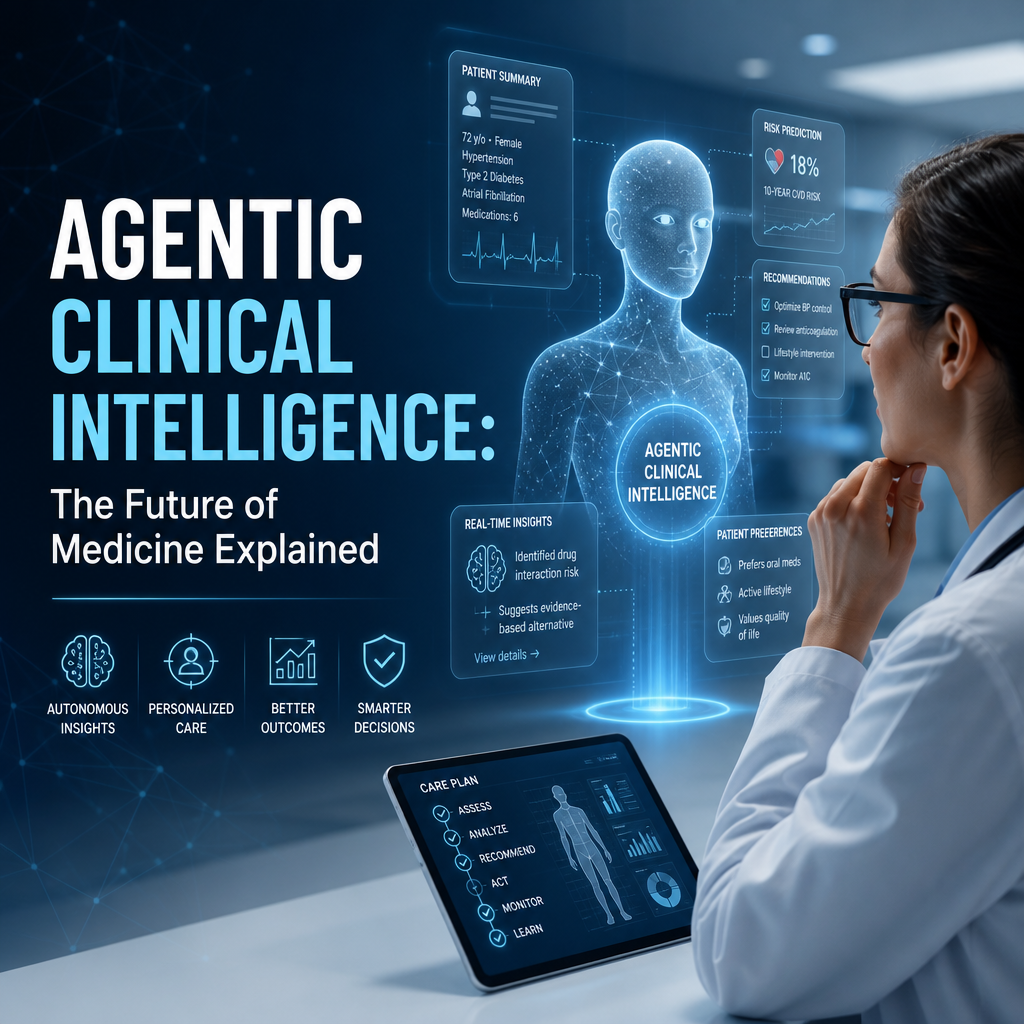
Agentic Clinical Intelligence: The Future of Medicine Explained
The Future of Medicine: Agentic Clinical Intelligence Explained
Medicine is entering a new era. For decades, healthcare technology focused on storing records, digitizing paperwork, and helping clinicians search for information faster. Now a new model is emerging: agentic clinical intelligence. This approach goes beyond passive software and into systems that can reason, act, and support care in more proactive ways.
In simple terms, agentic clinical intelligence refers to AI-enabled systems that do more than analyze data. They can help identify problems, recommend next steps, coordinate tasks, and adapt to changing clinical situations. Rather than serving only as a dashboard or search tool, these systems behave more like intelligent assistants with a goal: improve patient care and reduce clinician burden.

What Is Agentic Clinical Intelligence?
Traditional clinical software mostly reacts to user input. A clinician enters information, and the system displays results. Agentic systems are different. They can:

- observe relevant patient data
- recognize patterns and risks
- propose actions
- trigger workflows
- learn from outcomes over time
This does not mean AI replaces doctors. Instead, it supports them by handling repetitive or time-sensitive tasks, surfacing important insights, and helping teams respond faster.
The word “agentic” matters here. It suggests a system that can take initiative within clearly defined boundaries. In medicine, that could mean flagging a deterioration risk, preparing a discharge summary, or coordinating follow-up tasks before a patient leaves the hospital.

Why It Matters for Healthcare
Healthcare is complex, fragmented, and overloaded with information. Clinicians often spend more time navigating systems than talking to patients. Missed signals, delayed documentation, and administrative backlog can all affect care quality.
Agentic clinical intelligence aims to solve some of these problems by making healthcare systems more responsive. Its value lies in three major areas:
1. Better decision support
AI can help clinicians interpret large amounts of structured and unstructured data, from lab values and imaging reports to notes and medication histories. By synthesizing this information, agentic systems can highlight trends that may otherwise be missed.
2. Reduced administrative burden
Documentation, prior authorizations, care coordination, and follow-up reminders consume huge amounts of time. Intelligent agents can automate parts of this work, allowing clinicians to focus more on patients and less on clerical tasks.
3. Faster, more coordinated care
In modern medicine, delays often happen because information is scattered across departments and systems. Agentic tools can help connect the dots, making it easier to move from detection to action.
Real-World Use Cases
The future of medicine will likely include agentic systems in many settings. Some early use cases are especially promising.
Clinical triage
An AI agent can monitor incoming patient messages, vital sign data, or emergency department intake forms and prioritize cases based on urgency. This helps care teams respond to the most critical situations first.
Hospital operations
Agentic systems can assist with bed management, discharge planning, staffing alerts, and transfer coordination. These tasks may seem administrative, but they strongly affect patient flow and outcomes.
Chronic disease management
For patients with diabetes, heart failure, or hypertension, AI agents could track trends, identify worsening patterns, and prompt intervention before a crisis occurs. This kind of proactive support could reduce hospitalizations and improve long-term outcomes.
Documentation support
Clinical notes can be drafted, summarized, or checked for missing information. An agent may prepare a note from encounter data, then allow the clinician to review and approve it. This saves time while maintaining human oversight.
Benefits and Risks
Like any major innovation, agentic clinical intelligence brings both opportunity and caution.
Potential benefits
- improved efficiency
- earlier detection of risk
- less burnout for clinicians
- more personalized care
- stronger coordination across teams
Important risks
- incorrect recommendations
- overreliance on automation
- bias in training data
- privacy and security concerns
- unclear accountability if something goes wrong
These risks are serious. Medicine demands high trust, and AI systems must be safe, transparent, and carefully governed. An agent that acts independently must still operate under human supervision, clinical protocols, and ethical standards.
The Human Role Will Still Be Central
Despite the growing power of AI, medicine will remain a human profession. Patients want empathy, judgment, and trust. Clinicians bring context that no machine can fully replicate.
Agentic clinical intelligence should be seen as a partner to healthcare professionals, not a replacement. The best future is one where AI handles the routine and the repetitive, while humans focus on diagnosis, communication, compassion, and complex decision-making.
That balance is essential. If used well, these tools can give clinicians back time, improve safety, and make care more responsive.
What the Future May Look Like
Over the next few years, we can expect agentic systems to become more integrated into daily healthcare workflows. Instead of separate tools for chart review, scheduling, documentation, and analytics, clinicians may use unified systems that understand context and act across tasks.
A future hospital might have AI agents that:
- monitor patient status continuously
- draft care updates for the team
- alert staff to emerging risks
- coordinate discharge and follow-up plans
- support patients after they leave the hospital
This vision is powerful, but it will require careful design, regulation, and testing. The goal is not to create fully autonomous medicine. The goal is to build smarter systems that help humans deliver better care.
Conclusion
The future of medicine is not just digital; it is intelligent, adaptive, and increasingly agentic. Agentic clinical intelligence represents a shift from passive software to active support systems that can reason, assist, and coordinate care.
If developed responsibly, this technology could reduce burnout, improve outcomes, and make healthcare more proactive. The next chapter of medicine may not be about replacing clinicians, but about giving them better tools to do what they do best: care for people.