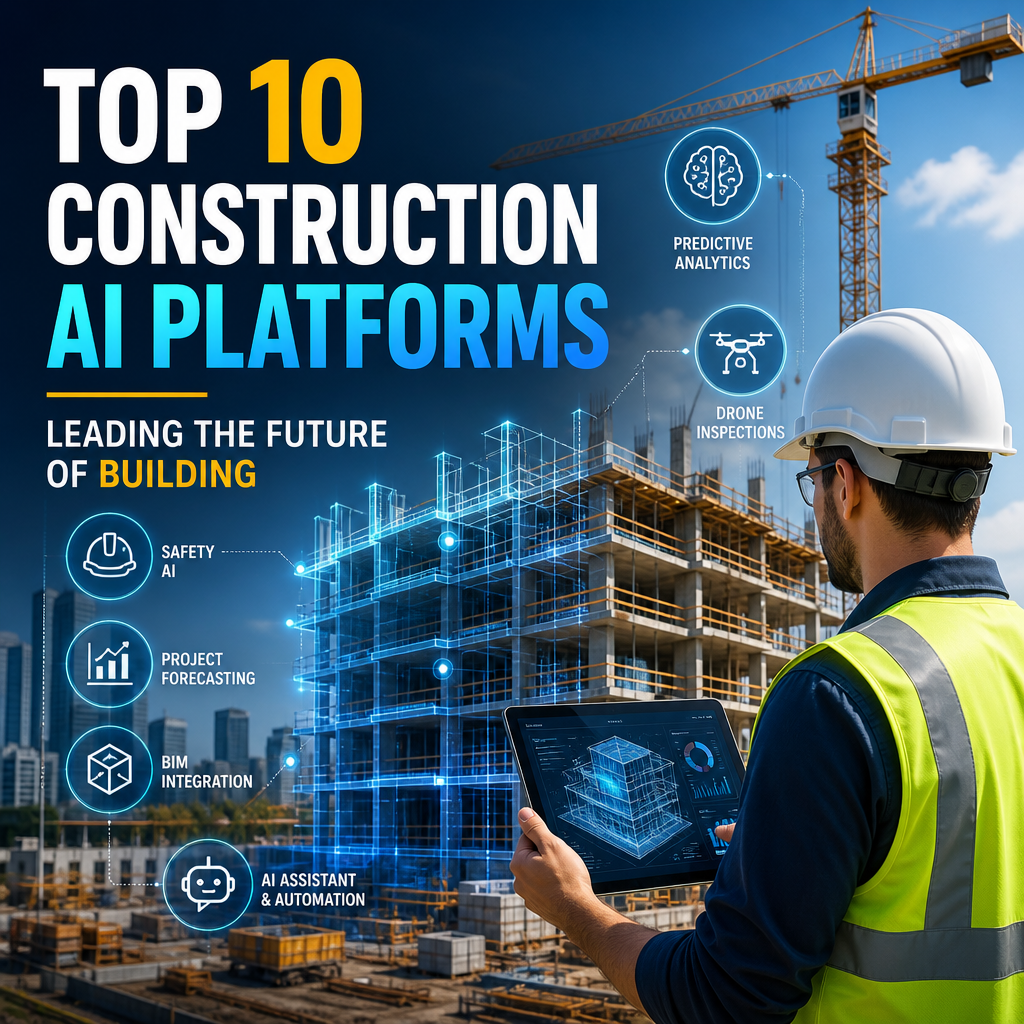
Top 10 Construction AI Platforms Leading the Future of Building
Top Ten Construction AI Platforms Leading the Future of Building
Construction is changing fast. From planning and design to safety, scheduling, and project delivery, artificial intelligence is helping teams work smarter and reduce costly mistakes. The best construction AI platforms are now doing far more than automating paperwork. They are improving productivity, predicting risk, and helping builders make better decisions in real time.
Whether you are a contractor, project manager, estimator, or developer, knowing which platforms are shaping the industry can give you a real advantage. Below are ten construction AI platforms that are leading the future of building.

1. Procore
Procore is one of the most widely used construction management platforms, and its AI features are helping teams streamline projects from start to finish.

It supports document control, project tracking, financial management, and field communication. AI tools help identify patterns in project data, improve forecasting, and reduce rework by keeping information organized and accessible.
Why it stands out
- Strong all-in-one project management
- Useful analytics and reporting
- Good for large and complex builds
2. Autodesk Construction Cloud
Autodesk Construction Cloud combines design, collaboration, and project management in one ecosystem. It is especially powerful for teams already using Autodesk design software.

Its AI-driven features help with risk identification, model coordination, and issue tracking. By connecting office and field workflows, it gives teams better visibility across the project lifecycle.
Why it stands out
- Excellent integration with design tools
- Strong BIM and model-based workflows
- Valuable for design-build and enterprise projects
3. Bentley OpenBuildings
Bentley’s construction and infrastructure tools are known for advanced modeling and digital twin capabilities. OpenBuildings uses AI to support smarter design and performance analysis.
It is especially useful for complex infrastructure, commercial buildings, and large-scale developments where precision matters. Teams can use it to optimize building systems and improve lifecycle planning.
Why it stands out
- Great for infrastructure and engineering-heavy projects
- Strong digital twin support
- Ideal for performance-driven design
4. Alice Technologies
Alice Technologies focuses on construction scheduling and simulation. It uses AI to generate thousands of schedule scenarios and identify the best path forward.
This makes it one of the most interesting construction AI platforms for planners and project controls teams. Instead of manually testing schedule changes, users can compare alternatives quickly and choose a more efficient plan.
Why it stands out
- Advanced schedule optimization
- Helps reduce delays and conflicts
- Useful for complex project sequencing
5. Buildots
Buildots uses AI and computer vision to track construction progress automatically. By comparing site imagery with the project plan, it can detect delays and highlight areas that need attention.
This is especially helpful for general contractors and owners who need accurate progress data without relying only on manual reporting.
Why it stands out
- Automated progress tracking
- Better visibility into site performance
- Helps reduce schedule drift
6. DroneDeploy
DroneDeploy brings AI-powered aerial data collection to construction sites. It uses drones, imagery, and analytics to create site maps, inspect progress, and monitor changes over time.
For earthwork, site surveys, and large job sites, this platform can save time and improve accuracy. It also helps teams document conditions safely and efficiently.
Why it stands out
- Fast site documentation
- Strong for surveying and progress monitoring
- Reduces the need for manual site walks
7. ALICE Technologies
ALICE Technologies is another platform focused on schedule optimization and construction simulation. It uses generative AI to help teams plan work more efficiently and avoid bottlenecks.
By testing different construction methods and sequences, users can improve cost control and make better decisions before work begins.
Why it stands out
- AI-based construction planning
- Supports faster decision-making
- Useful for optimizing labor and equipment use
8. Fieldwire
Fieldwire is a field management platform built for foremen, superintendents, and project teams working on site. Its AI capabilities help organize tasks, drawings, punch lists, and communications.
It is designed to keep crews aligned and reduce confusion in the field. For teams that need a practical, mobile-first solution, it is a strong option.
Why it stands out
- Easy to use on mobile devices
- Strong field coordination tools
- Great for task and issue management
9. Cority
Cority is known for environmental, health, and safety management. In construction, its AI tools help teams monitor compliance, manage incidents, and improve worker safety.
As safety remains a top priority on every job site, platforms like Cority are becoming more important. They help companies identify risks earlier and create safer working environments.
Why it stands out
- Strong safety and compliance focus
- Helps track incidents and corrective actions
- Valuable for large contractors and safety teams
10. Versatile
Versatile is an AI platform designed to improve project controls through jobsite intelligence. It uses data from multiple sources to help teams monitor production, identify inefficiencies, and improve performance.
Its goal is to give leaders a clearer picture of what is happening in the field so they can act faster and with more confidence.
Why it stands out
- Focused on operational insight
- Helps improve productivity
- Strong for performance tracking
Why Construction AI Matters
The construction industry has always depended on coordination, timing, and accuracy. AI is making all three easier to manage.
Here are some of the biggest benefits:
- Better scheduling and forecasting
- Improved safety and compliance
- Faster progress tracking
- Lower risk of rework
- Smarter use of labor and materials
As more companies adopt construction AI platforms, the gap between traditional project delivery and intelligent, data-driven building will continue to grow.
The Future of Building Is Data-Driven
AI is no longer a distant idea in construction. It is already helping teams design better, build faster, and manage risk more effectively. The platforms leading this shift are setting a new standard for how projects are planned and delivered.
For companies that want to stay competitive, investing in the right technology is becoming just as important as investing in equipment or talent. The future of building belongs to teams that can combine hands-on expertise with smart digital tools.