The Agentic Construction Revolution: Building Smarter Cities Today
The Agentic Construction Revolution: Smart Cities Start Here
Cities are changing fast. Population growth, climate pressure, aging infrastructure, and rising expectations are pushing urban development into a new era. At the center of this shift is the Agentic Construction Revolution, a smarter, more adaptive way to plan, build, and manage the places where people live and work.
This transformation is not just about using better tools. It is about construction systems that can sense, decide, and act with far more autonomy than traditional methods allow. In other words, smart cities do not begin with sensors on streetlights or apps on phones. They begin at the construction stage, where intelligence is built into the foundation of the city itself.

What Makes Construction “Agentic”?
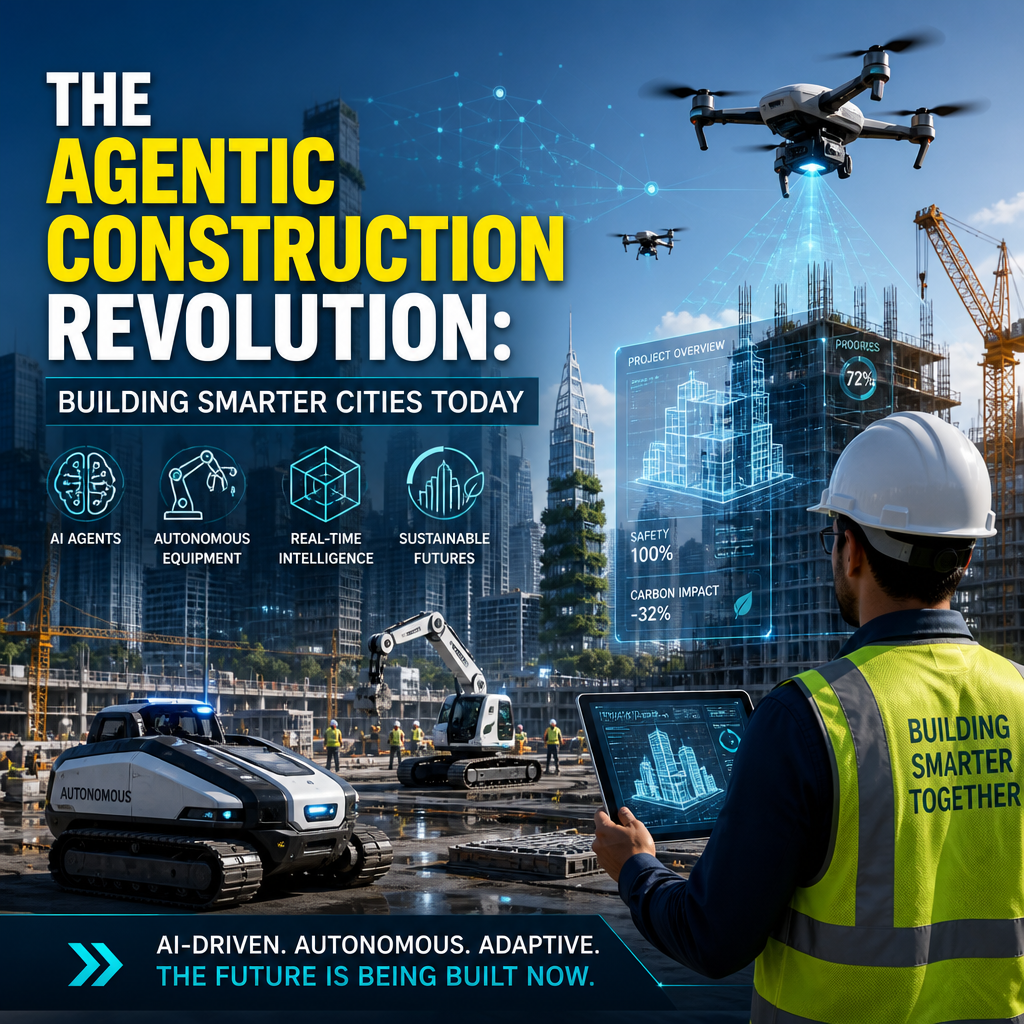
Agentic construction refers to the use of connected technologies, automation, AI, and data-driven systems that can support or independently carry out construction decisions and actions. Instead of relying only on manual scheduling, static plans, and reactive problem-solving, these systems can respond in real time to changing conditions.

Core features of agentic construction include:
- AI-powered planning that adapts to site conditions and project risks
- Autonomous equipment that improves speed and precision
- Digital twins that simulate city assets before they are built
- Connected supply chains that reduce delays and waste
- Predictive maintenance that helps structures stay efficient over time
Together, these tools create construction environments that are more responsive, efficient, and resilient.
Why Smart Cities Need a New Construction Model
Smart cities are often discussed in terms of digital services, mobility apps, and connected infrastructure. But no city can become truly smart if the physical environment is built using outdated processes. Traditional construction is often fragmented, slow, and costly. It struggles with labor shortages, material waste, and project overruns.

The Agentic Construction Revolution addresses these problems by making construction more intelligent from the ground up. That matters because the buildings, roads, water systems, and transit networks created today will shape urban life for decades.
When construction becomes more adaptive, cities gain:
- Faster project delivery
- Lower lifecycle costs
- Better use of materials and energy
- Improved safety for workers and residents
- Stronger resilience against future disruption
This is why smart cities start here, at the point where physical infrastructure is conceived and built.
How Agentic Construction Changes the Urban Landscape
1. Smarter planning from the beginning
Urban projects are complex. They involve zoning laws, environmental reviews, traffic impact studies, utility coordination, and public expectations. Agentic systems can process large amounts of data and identify better design choices earlier in the process.
That means planners can test multiple scenarios before breaking ground. They can see how a transit hub affects congestion, how a high-rise impacts energy demand, or how a drainage system responds to heavy rainfall. This reduces expensive redesigns later.
2. More efficient job sites
Construction sites are becoming more connected and automated. Drones can monitor progress. Robotics can handle repetitive tasks. AI can flag schedule conflicts before they cause delays. These improvements help teams work more safely and productively.
Instead of waiting for problems to appear, managers can act proactively. Materials arrive when needed. Equipment is deployed more effectively. Workers spend less time on low-value tasks and more time on skilled, essential work.
3. Infrastructure that keeps learning
The agentic model does not stop when construction ends. Smart infrastructure continues to generate data long after a project is complete. Bridges can report stress patterns. Buildings can adjust energy use. Water systems can detect leaks early.
This creates a feedback loop. Cities learn from how assets perform in real life and use that insight to improve future projects. Over time, the whole urban system becomes more intelligent.
The Human Side of the Revolution
Although the technology is advanced, the goal is deeply human. Better construction means safer streets, cleaner air, reduced emissions, and more reliable public services. It means homes that are more comfortable, transit systems that work better, and neighborhoods that are more resilient.
Agentic construction also changes the role of professionals. Architects, engineers, contractors, and city planners are not replaced; they are empowered. They gain better tools for decision-making and more time to focus on creativity, strategy, and community impact.
This shift is important. The smartest cities will not be built by machines alone. They will be built by people using intelligent systems to make better choices at every stage.
Challenges Still Ahead
The promise is strong, but adoption is not automatic. Cities and construction firms must address several challenges:
- High upfront investment in digital infrastructure
- Interoperability between old and new systems
- Data privacy and cybersecurity concerns
- Workforce training and change management
- Clear governance for AI-driven decisions
These issues are real, but they are not barriers to progress. They are the conditions that must be managed carefully if the Agentic Construction Revolution is to scale responsibly.
The Future Starts on the Job Site
The future of smart cities will not be defined only by apps, analytics dashboards, or connected devices. It will be defined by the physical systems that make those technologies possible. Roads, buildings, utilities, and public spaces must be constructed in ways that are flexible, efficient, and intelligent.
That is why the Agentic Construction Revolution matters. It offers a path toward cities that can grow without losing livability, respond without chaos, and innovate without wasting resources.
Smart cities start here: with construction that thinks ahead.