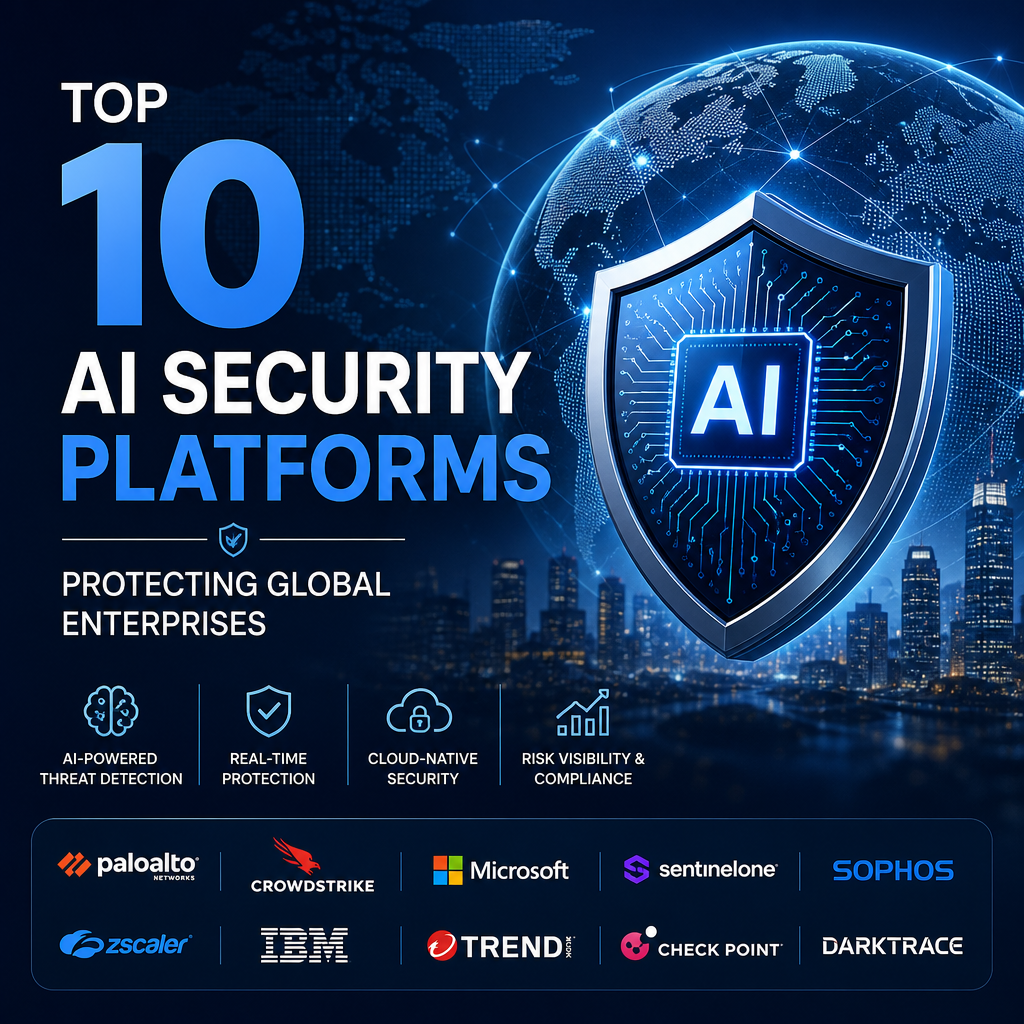
Top 10 AI Security Platforms Protecting Global Enterprises
Top Ten AI Security Platforms Protecting Global Enterprises
Artificial intelligence is changing how global enterprises defend themselves against cyber threats. As attacks become faster, more automated, and harder to detect, traditional security tools are no longer enough on their own. This is where Top Ten AI Security Platforms Protecting Global Enterprises comes into focus: solutions that use machine learning, behavioral analytics, and automation to stop threats before they spread.
These platforms help security teams detect unusual activity, prioritize alerts, reduce response time, and protect large, distributed environments. Below is a practical look at ten leading AI-driven security platforms shaping enterprise defense today.

Why AI Security Platforms Matter
Global enterprises face a wide attack surface: cloud apps, remote workers, IoT devices, third-party vendors, and multiple endpoints across regions. Human analysts can’t manually review every alert or trace every anomaly in time.

AI security platforms help by:
- Detecting suspicious behavior in real time
- Automating routine investigation tasks
- Reducing false positives
- Learning from threat patterns across large datasets
- Supporting faster incident response
For organizations managing complex infrastructure, these capabilities can make the difference between a blocked attempt and a major breach.

1. CrowdStrike Falcon
CrowdStrike Falcon is one of the most widely recognized AI-powered endpoint security platforms. Its cloud-native design and threat intelligence engine help enterprises spot advanced threats across devices and workloads.
It is especially strong in:
- Endpoint detection and response
- Threat hunting
- Behavioral analytics
- Real-time remediation
2. Microsoft Defender for Endpoint
Microsoft Defender for Endpoint integrates AI-driven protection directly into the Microsoft ecosystem. For enterprises already using Microsoft 365, Azure, or Windows environments, it offers seamless visibility and control.
Key strengths include:
- Automated attack disruption
- Risk-based alert prioritization
- Identity and endpoint correlation
- Native integration with Microsoft security tools
3. Palo Alto Networks Cortex XDR
Cortex XDR combines data from endpoints, networks, and cloud systems to identify coordinated attacks. Its AI and analytics capabilities help security teams connect the dots across complex incidents.
It is valued for:
- Cross-layer threat detection
- Incident correlation
- Advanced analytics
- Threat prevention across environments
4. Darktrace
Darktrace is known for its self-learning AI that models normal behavior and flags deviations in real time. This makes it especially effective for spotting novel threats and insider risks.
Enterprises use it for:
- Network detection and response
- Email threat detection
- Cloud security monitoring
- Autonomous response actions
5. SentinelOne Singularity
SentinelOne uses machine learning to detect, prevent, and respond to threats across endpoints, containers, and cloud workloads. Its automated remediation features are a major advantage for lean security teams.
Highlights include:
- Autonomous threat response
- Endpoint and cloud protection
- Behavioral AI
- Strong ransomware defense
6. IBM Security QRadar Suite
IBM’s QRadar Suite combines SIEM, SOAR, and AI-powered analytics to help enterprises manage high volumes of security data. It is designed for organizations that need centralized visibility and scalable incident response.
Useful capabilities include:
- Threat correlation
- Log analysis
- Automated workflows
- Advanced investigation tools
7. Check Point Infinity
Check Point Infinity provides a unified security architecture with AI-enhanced threat prevention across network, cloud, endpoint, and mobile environments. It is built for organizations that want broad protection under one platform.
Notable features:
- Threat intelligence integration
- Zero-day attack protection
- Cloud workload security
- Centralized policy management
8. Trellix
Trellix focuses on extended detection and response, using AI to analyze security telemetry from multiple sources. It helps enterprises detect complex threats faster and simplify their security operations.
It offers:
- XDR capabilities
- Threat analytics
- Automated investigation
- Endpoint and email protection
9. Splunk Enterprise Security
Splunk Enterprise Security combines powerful data analytics with AI-assisted threat detection. It is especially useful for enterprises that need to turn massive logs and telemetry into actionable security insights.
Its core advantages are:
- Security data correlation
- Custom alerting and dashboards
- Threat hunting support
- Scalable analytics across environments
10. Palo Alto Networks Prisma Cloud
Prisma Cloud is a leading AI-driven cloud security platform that helps enterprises secure infrastructure, applications, and data across hybrid and multi-cloud environments.
It supports:
- Cloud posture management
- Workload protection
- Identity risk detection
- Compliance monitoring
How to Choose the Right Platform
Selecting the best AI security platform depends on your environment, risk profile, and operational maturity. A global enterprise should consider:
- Coverage across endpoint, cloud, identity, and network layers
- Integration with existing security tools
- Automation and orchestration features
- False-positive reduction
- Scalability across regions and business units
The right choice is not always the most feature-heavy platform. It is the one that fits your security architecture and helps your team respond faster with less manual effort.
Final Thoughts
The rise of AI has changed both sides of cybersecurity. Attackers are using automation, and defenders must do the same. The Top Ten AI Security Platforms Protecting Global Enterprises listed above show how modern organizations can strengthen resilience, improve visibility, and respond to threats with greater speed and intelligence.
For enterprises operating at global scale, investing in AI-driven security is no longer optional. It is a necessary step toward staying ahead of evolving threats and protecting critical assets in a fast-moving digital world.