
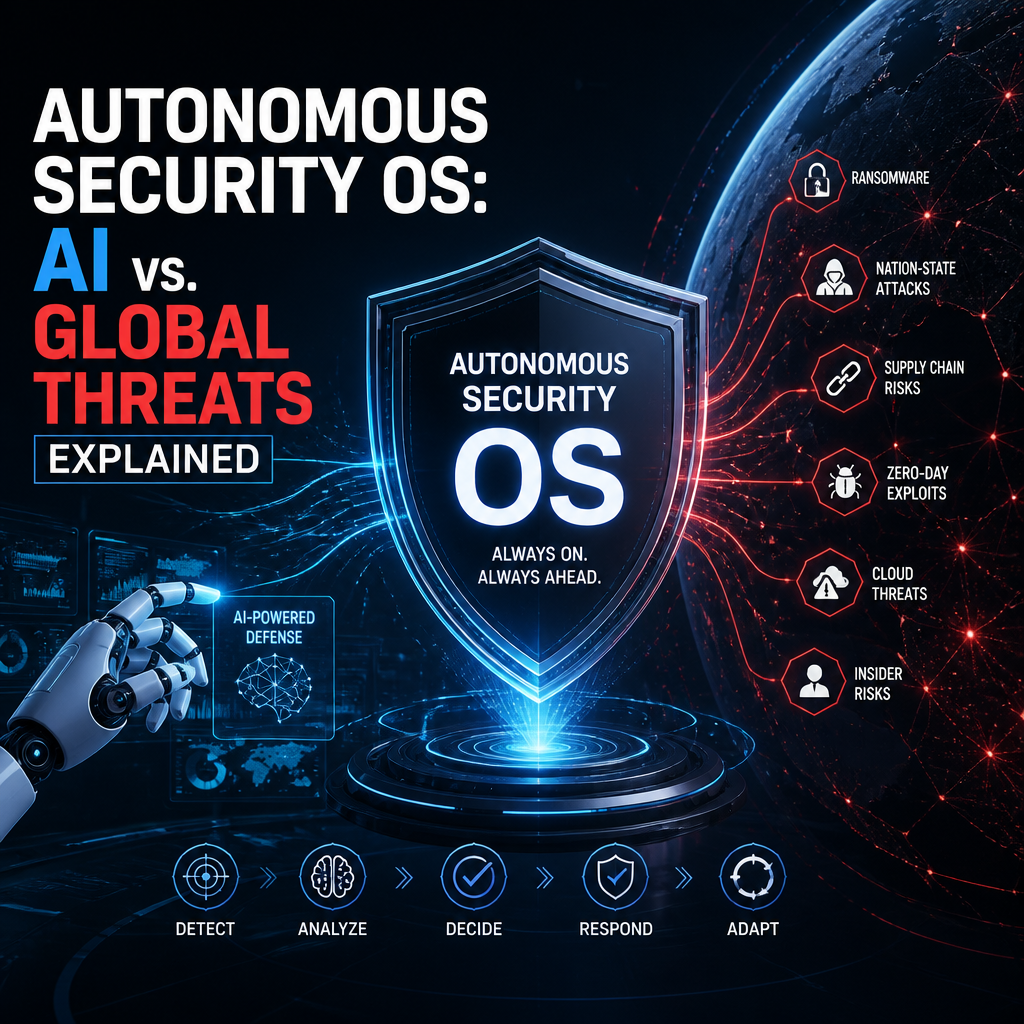
Autonomous Security OS: AI vs. Global Threats Explained
The Autonomous Security OS: AI vs. Global Threats
Cyber threats no longer move in slow, predictable patterns. They spread across cloud systems, remote endpoints, supply chains, and public infrastructure at machine speed. Traditional defenses often struggle to keep up. This is where The Autonomous Security OS enters the conversation: a new security model powered by AI that can detect, respond to, and sometimes prevent attacks with minimal human intervention.
In a world where digital risk is global and constant, security can no longer rely only on alerts and manual response. It needs to be adaptive, continuous, and intelligent.

What Is an Autonomous Security OS?
An Autonomous Security OS is not a single product. It is a security operating model that uses AI, automation, and live threat intelligence to coordinate defenses across an entire environment.

Instead of treating each tool as an isolated layer, it connects them into a responsive system. It can:
- monitor behavior in real time
- identify suspicious patterns faster than human analysts
- prioritize threats by impact and likelihood
- trigger containment actions automatically
- learn from every incident to improve future decisions
The result is a security framework that behaves more like a living system than a static control panel.

Why Global Threats Need AI-Driven Defense
Global threats are more complex than ever. Attackers use phishing, ransomware, identity theft, cloud exploits, and supply chain compromise to target organizations of every size. Many of these attacks are coordinated across regions and time zones, which makes human-only response too slow.
AI helps bridge that gap by analyzing enormous volumes of data at high speed. It can spot subtle anomalies that might be missed by a human team, such as:
- unusual login behavior
- lateral movement inside a network
- data exfiltration patterns
- suspicious API activity
- changes in device or user trust scores
This matters because the first few minutes of an attack are often the most important. A delay in response can turn a small intrusion into a full-scale breach.
How the Autonomous Security OS Works
The strength of the model lies in its ability to combine detection, decision-making, and action.
1. Continuous visibility
The system gathers signals from endpoints, identity platforms, cloud workloads, email, network traffic, and third-party tools. This creates a broader view of the threat landscape.
2. AI-based analysis
Machine learning models compare incoming activity against historical behavior, threat intelligence, and known attack techniques. Instead of waiting for a signature match, the system looks for patterns that suggest risk.
3. Automated response
If a threat crosses a defined threshold, the system can take immediate action. That may include isolating a device, disabling a compromised account, blocking a malicious domain, or opening a high-priority incident for review.
4. Feedback and learning
Each response feeds new data back into the system. Over time, the Autonomous Security OS becomes more accurate and better tuned to the organization’s environment.
Benefits Beyond Speed
Speed is the most obvious advantage, but it is not the only one. An AI-powered security model also improves consistency and scalability.
Reduced alert fatigue
Security teams are often overwhelmed by too many notifications. By filtering noise and ranking the most important events, AI helps analysts focus on genuine risk instead of chasing false positives.
Better use of human expertise
Autonomous systems handle repetitive tasks, while human defenders focus on strategy, investigation, and complex cases. This creates a more efficient security operation overall.
Stronger resilience
Because the system responds in real time, it can limit damage even when an attack succeeds initially. That resilience is crucial in distributed environments where one compromised asset can affect many others.
Challenges and Limits
No AI system is perfect. An Autonomous Security OS must still be designed carefully to avoid overreliance on automation. If the logic is too aggressive, it may disrupt normal activity. If it is too cautious, it may fail to stop an attack in time.
There are also important concerns around:
- data privacy
- model transparency
- bias in threat scoring
- adversarial attacks against AI systems
- the need for human oversight in critical decisions
For this reason, the best approach is not full replacement of security teams, but a partnership between human judgment and machine intelligence.
The Future of Security Is Autonomous and Human-Guided
The future of cyber defense will likely belong to systems that can think and act faster than attackers, while still keeping humans in control of policy and escalation. The Autonomous Security OS represents this shift. It does not eliminate the need for analysts, engineers, or incident responders. Instead, it amplifies their ability to protect complex environments at global scale.
As threats continue to evolve, organizations will need more than visibility. They will need intelligence, coordination, and rapid action. AI is becoming the engine that makes that possible.
In the battle against global threats, security can no longer afford to be passive. The next generation of defense will be autonomous, adaptive, and always learning.