
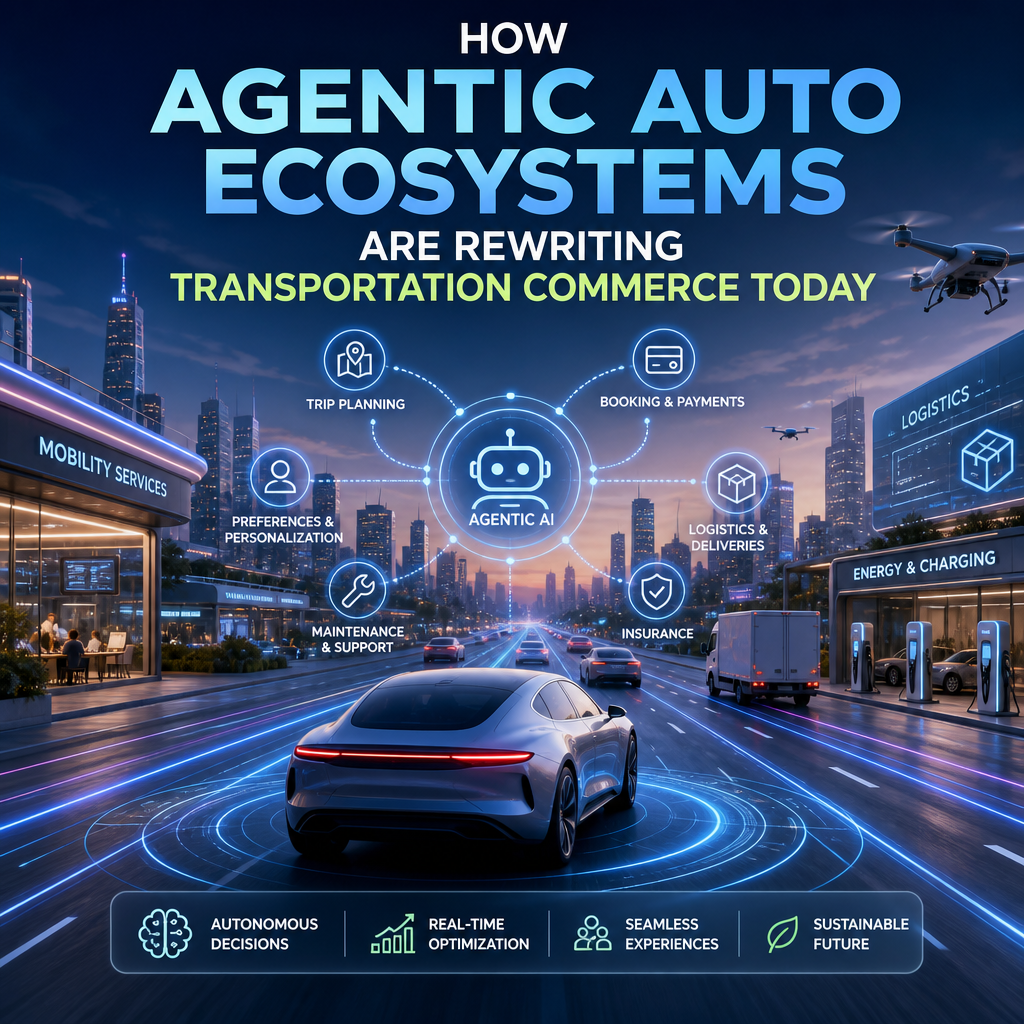
How Agentic Auto Ecosystems Are Rewriting Transportation Commerce Today
How Agentic Auto Ecosystems Are Rewriting Transportation Commerce
Transportation is no longer just about moving people and goods from one place to another. It is becoming a digital marketplace where vehicles, software, data, payments, and services interact in real time. At the center of this shift are agentic auto ecosystems—networks of connected vehicles and intelligent agents that can make decisions, coordinate actions, and complete transactions with minimal human input.
This is not a distant future trend. It is already changing how consumers buy, maintain, insure, charge, and use transportation. The result is a new kind of commerce: more automated, more personalized, and more deeply embedded in the mobility experience.

What Are Agentic Auto Ecosystems?
An agentic auto ecosystem is a transportation environment where vehicles and connected platforms act like intelligent participants rather than passive assets. These systems use AI-powered agents to interpret data, respond to conditions, and trigger actions such as:

- Booking a service appointment
- Paying tolls or charging fees automatically
- Reordering maintenance supplies
- Comparing insurance or fuel options
- Coordinating fleet routes and delivery timing
In simple terms, the vehicle is no longer just a product. It becomes a commerce node.
From Ownership to Orchestration
Traditionally, transportation commerce revolved around ownership, dealerships, service centers, and insurers. Customers made most decisions manually, often after something went wrong. Agentic systems change that by continuously monitoring vehicle health, usage patterns, and market conditions.

Instead of waiting for a breakdown, the car might detect a battery issue, find the nearest available service slot, and schedule the appointment. Instead of requiring a driver to search for the cheapest charging station, the system can identify the best option based on location, pricing, and battery status.
That shift from reactive to proactive commerce is what makes the ecosystem “agentic.”
How Commerce Is Changing in Real Time
Agentic auto ecosystems are rewriting transportation commerce by collapsing friction across the entire mobility journey.
1. Transactions Become Invisible
The most obvious change is that many transactions disappear from the user’s view. Payments, renewals, reservations, and recommendations happen automatically in the background. This creates a smoother user experience and reduces the number of steps between need and fulfillment.
For example, a fleet vehicle may autonomously:
- Pay for charging
- Update route planning
- Request roadside assistance
- Notify the operator when tire wear crosses a threshold
Each of these actions is commercial, but none requires a traditional checkout flow.
2. Pricing Becomes Dynamic
Agentic systems can compare offers across multiple providers instantly. That means transportation commerce is moving toward real-time pricing models that change based on demand, vehicle condition, location, and usage behavior.
This affects everything from:
- Ride-hailing
- EV charging
- Auto insurance
- Maintenance packages
- Fleet leasing
For consumers, this can mean better deals and more relevant offers. For businesses, it means more competition and thinner margins unless they deliver exceptional value and integration.
3. The Vehicle Becomes a Sales Channel
A connected vehicle can now recommend services, upgrades, and subscriptions directly to the driver or fleet manager. Instead of seeing ads on a website, users may receive context-aware offers from the vehicle itself.
Examples include:
- Premium navigation upgrades
- Extended warranty options
- In-car entertainment subscriptions
- Seasonal tire packages
- Partner offers for roadside help or parking
This changes the role of the car from a product sold once to a platform that can generate revenue throughout its lifecycle.
Why Businesses Are Paying Attention
Companies across automotive, logistics, insurance, energy, and retail are moving quickly because agentic auto ecosystems unlock new revenue streams and better data visibility.
Better Customer Retention
When a platform anticipates needs before users ask, satisfaction rises. A vehicle that quietly handles maintenance reminders, service scheduling, and payment processing reduces hassle and increases loyalty.
More Efficient Operations
For fleet operators, agentic systems improve uptime, reduce waste, and cut administrative overhead. Intelligent automation helps with route optimization, predictive maintenance, and inventory management.
Deeper Data Insights
The ecosystem generates valuable data about usage patterns, service preferences, charging behavior, and purchase triggers. This helps businesses refine pricing, design better offers, and personalize experiences more accurately.
The Challenges Ahead
Despite the promise, agentic auto ecosystems also raise important questions.
Trust and Transparency
If a vehicle is making decisions on behalf of a user, people need to know how and why those decisions are made. Clear consent, explainable logic, and user controls are essential.
Data Privacy
These ecosystems rely on constant data exchange. That makes privacy protections and cybersecurity non-negotiable. A system that handles payments, location, and behavior data must be built with strong safeguards.
Interoperability
For the ecosystem to work well, automakers, software providers, charging networks, insurers, and service partners need shared standards. Without interoperability, the experience becomes fragmented again.
The Future of Transportation Commerce
The biggest change introduced by agentic auto ecosystems is not just automation. It is the redefinition of commerce itself. Transportation is becoming a continuous service layer where decisions, transactions, and experiences are connected.
In the near future, we may not think of buying fuel, scheduling repairs, or renewing vehicle services as separate tasks. Instead, the mobility system will manage them as part of an ongoing commercial relationship.
That means transportation commerce will be less about one-time transactions and more about intelligent, always-on coordination.
Conclusion
Agentic auto ecosystems are rewriting transportation commerce by making vehicles active participants in the marketplace. They reduce friction, personalize offers, automate routine transactions, and create new business models across the mobility stack.
For consumers, this means convenience and responsiveness. For businesses, it means opportunity and disruption. And for the transportation industry as a whole, it marks the beginning of a commerce model that is smarter, faster, and far more connected than anything that came before.