Building Multi-Industry Agentic Workflows with AppCloudAI and ZAMZILLA
Building Multi‑Industry Agentic Workflows with AppCloudAI and ZAMZILLA
Agentic workflows are changing how businesses automate decisions, coordinate tasks, and respond to customer needs. Instead of relying on rigid, single-purpose automations, organizations now want systems that can reason, adapt, and act across multiple steps. That shift is especially important for companies serving more than one industry.
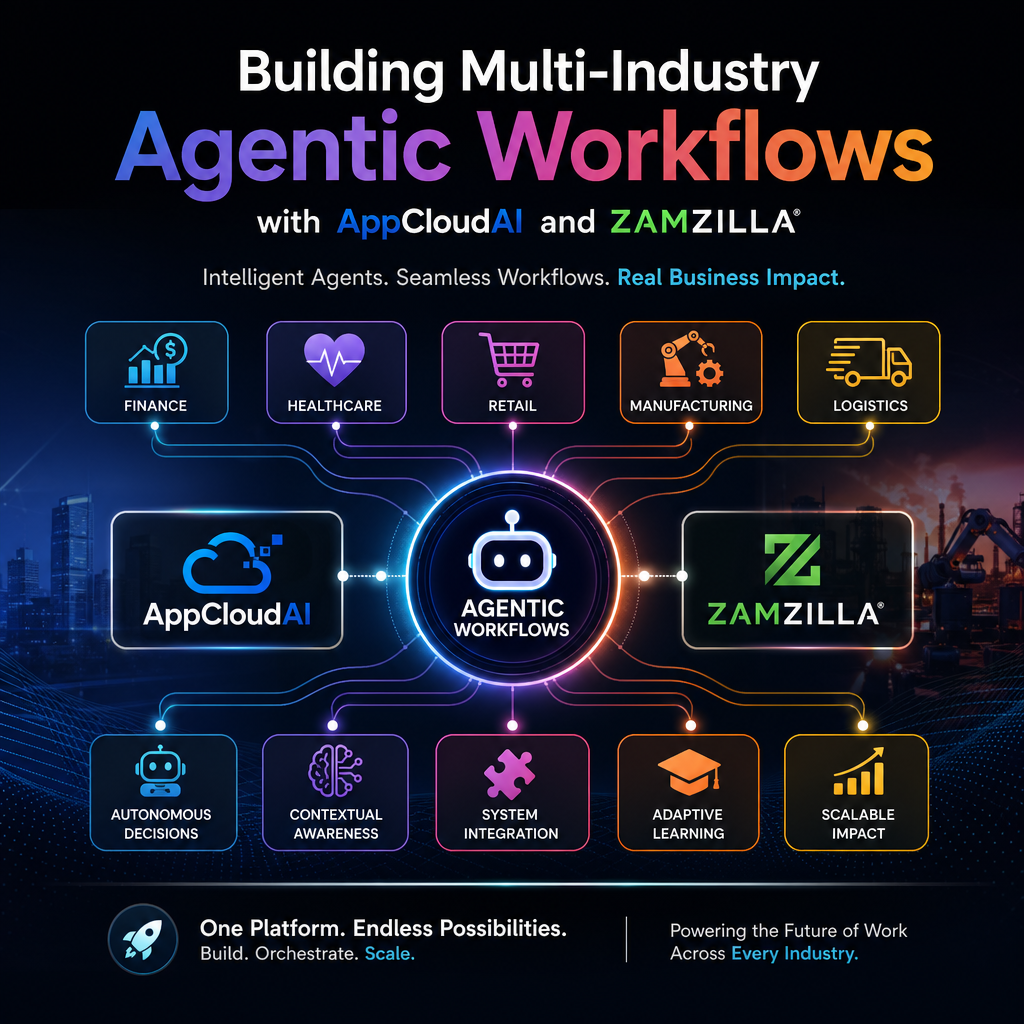
Building multi-industry agentic workflows with AppCloudAI and ZAMZILLA gives teams a practical way to create intelligent, reusable automation that works across healthcare, retail, finance, logistics, and beyond. The result is a more flexible operating model that scales without forcing every process into a separate tool or custom build.

Why Multi-Industry Workflows Need a New Approach
Traditional automation works well when the process is simple and predictable. But once workflows involve decisions, exceptions, customer context, or changing business rules, simple if-then logic starts to break down.

Multi-industry organizations face even more complexity:
- Different compliance requirements
- Different customer journeys
- Different data formats and systems
- Different service-level expectations
- Different terminology and operational rules
A workflow that makes sense for a pharmacy, for example, may need to be adapted significantly for an insurance provider or a retail support team. The challenge is not just automation. It is orchestration, reasoning, and adaptability.

That is where agentic workflows come in.
What Makes an Agentic Workflow Different
An agentic workflow does more than trigger actions. It can evaluate context, choose the next best step, and coordinate with other tools or agents to complete a task.
In practical terms, an agentic system can:
- Interpret requests in natural language
- Break goals into smaller actions
- Pull relevant data from connected systems
- Decide when human approval is needed
- Recover from errors or missing information
- Adapt to different industry rules and priorities
With AppCloudAI and ZAMZILLA, this becomes especially powerful because teams can design workflows that are modular, reusable, and adaptable across sectors.
How AppCloudAI and ZAMZILLA Work Together
AppCloudAI provides the environment for building and managing intelligent workflows. It helps teams connect data, define logic, and coordinate AI-powered actions across applications. ZAMZILLA complements that by helping structure workflow components into reusable agentic patterns that can be deployed across different business domains.
Together, they support a model where businesses can build once and adapt many times.
Key advantages include:
-
Reusable workflow blocks
Core tasks such as intake, routing, validation, escalation, and reporting can be reused across industries. -
Context-aware decisioning
Workflows can adjust based on industry-specific rules, customer type, or operational state. -
Scalable orchestration
Teams can manage multiple agents and systems without manually stitching everything together. -
Faster deployment
New use cases can be launched more quickly because the foundation already exists. -
Better human-AI collaboration
People stay in the loop for exceptions, approvals, and high-stakes decisions.
Real-World Use Cases Across Industries
One of the biggest strengths of this approach is versatility. A single agentic architecture can support different business lines with minimal redesign.
Healthcare
In healthcare, workflows can handle patient intake, appointment scheduling, eligibility checks, and claim follow-up. An agent can route requests based on urgency, flag missing documentation, and escalate cases that require human review.
Retail
Retail teams can use agentic workflows for order support, inventory monitoring, returns, and personalized customer service. If a shipment is delayed, the workflow can notify the customer, check inventory alternatives, and propose next steps automatically.
Finance
Financial services require accuracy, traceability, and compliance. Agentic workflows can assist with onboarding, document verification, fraud signals, and customer inquiries while maintaining approval checkpoints and audit trails.
Logistics
In logistics, speed and coordination matter. Agents can track shipments, detect delays, update stakeholders, and reroute tasks based on changing conditions such as weather, capacity, or customs status.
Best Practices for Designing Multi-Industry Agentic Workflows
To get the most value from AppCloudAI and ZAMZILLA, it helps to think in layers rather than one giant process.
Start with a shared core
Identify the steps that are common across industries, such as intake, validation, decision routing, and reporting. Build these once and make them configurable.
Separate logic from policy
Keep industry-specific rules, compliance requirements, and approval thresholds outside the core workflow when possible. This makes updates easier and reduces duplication.
Design for exceptions
A good agentic workflow should not only handle the happy path. It should know what to do when data is missing, a service is unavailable, or a human must intervene.
Keep humans involved where it matters
Automation should support people, not replace judgment in high-impact scenarios. Human review points improve trust and reduce risk.
Measure outcomes continuously
Track metrics such as resolution time, accuracy, escalation rate, and customer satisfaction. These signals help refine the workflow over time.
The Bigger Opportunity
The real promise of multi-industry agentic workflows is not just automation. It is consistency with flexibility. Businesses can standardize their operating model while still respecting the unique requirements of each industry they serve.
That matters in a world where customers expect faster responses, regulatory expectations continue to evolve, and teams need to do more with less. AppCloudAI and ZAMZILLA offer a path toward workflows that are smarter, more reusable, and more resilient.
Final Thoughts
Building multi-industry agentic workflows with AppCloudAI and ZAMZILLA is about creating intelligent systems that can think through tasks, adapt to context, and support different business needs without starting from scratch each time. For organizations that operate across sectors, this approach can unlock faster delivery, better service, and stronger operational control.
The future of automation is not one workflow for one department. It is a flexible network of agents that can work across industries and grow with the business.