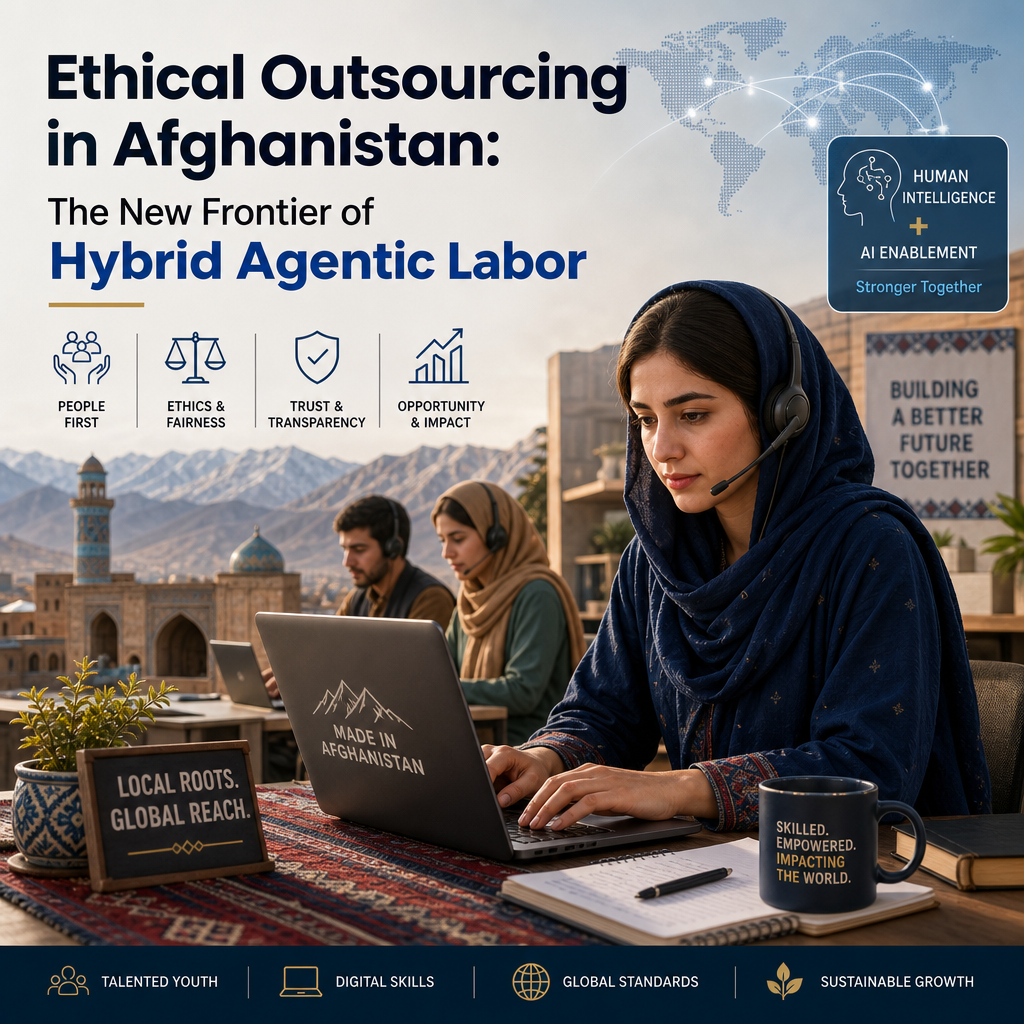
Ethical Outsourcing in Afghanistan: The New Frontier of Hybrid Agentic Labor
The New Frontier of Ethical Outsourcing: Hybrid Agentic Labor for Afghanistan
Outsourcing is changing fast. What once meant shifting repetitive tasks to lower-cost labor markets is now evolving into something more complex, more flexible, and potentially more humane. At the center of this shift is hybrid agentic labor: a model where human workers and AI tools collaborate on outsourced work in a way that boosts productivity without removing human agency.
For Afghanistan, this model could open a new economic frontier. In a country where many people face limited formal employment, disrupted infrastructure, and restricted access to global markets, ethical outsourcing may offer a path toward income, skills, and participation in the digital economy.

What Is Hybrid Agentic Labor?
Hybrid agentic labor combines human judgment with machine assistance. In practical terms, it means a worker does not simply perform tasks manually or get replaced by software. Instead, they use AI systems to support their work.

Examples include:
- A content moderator using AI to flag risky material
- A translator refining machine-generated drafts
- A data labeler checking and correcting model outputs
- A customer support agent using AI to suggest responses
The “agentic” part matters because the worker is still making decisions. They are not just executing instructions; they are directing tools, reviewing outputs, and applying human context. That makes the model more ethical than purely extractive outsourcing, where workers are treated as invisible labor at the far edge of the supply chain.

Why Afghanistan Needs a New Outsourcing Model
Afghanistan has a young population, high unemployment, and a growing need for remote, flexible income opportunities. Traditional employment pathways are limited by political instability, sanctions, infrastructure gaps, and movement restrictions. In that environment, digital work can be one of the few scalable ways to connect talent with global demand.
But outsourcing only helps if it is designed responsibly.
A cheap-labor model that depends on low wages, unstable contracts, and no skills development would repeat the worst patterns of global labor extraction. Ethical outsourcing must do better. It should create:
- fair pay
- transparent working conditions
- skill-building opportunities
- pathways to advancement
- respect for local realities
Hybrid agentic labor is promising because it can make workers more productive while also enabling them to participate in higher-value tasks over time.
The Ethical Advantage of Human-AI Collaboration
One of the biggest risks in outsourcing is commoditizing people. Workers become interchangeable, and their labor is valued only by speed and cost. Hybrid agentic labor offers a better alternative.
When workers are paired with AI tools, several things happen:
1. Productivity rises without eliminating human oversight
AI can handle first drafts, sorting, tagging, or summarizing. Humans can then verify, refine, and contextualize. This reduces busywork and improves quality.
2. Skills can grow faster
Workers learn by using AI systems, not just by repeating simple tasks. Over time, they develop digital literacy, quality control habits, and domain expertise.
3. Work becomes more adaptable
In uncertain environments, flexible remote work is especially valuable. Hybrid systems allow projects to continue even when internet access, schedules, or staffing are inconsistent.
4. The value of human judgment is preserved
In sensitive fields like moderation, translation, and research support, cultural understanding and ethical reasoning matter. AI alone cannot replace those qualities.
What Ethical Outsourcing Should Look Like in Practice
For hybrid agentic labor to work in Afghanistan, companies and platforms need to design with care. Ethical outsourcing is not just about where work is done. It is about how work is organized.
Key principles should include:
- Fair compensation: pay that reflects skill, not just local cost advantage
- Transparent task design: clear expectations, deadlines, and quality standards
- Worker autonomy: room to make decisions rather than blindly follow scripts
- Training and onboarding: support for using AI tools effectively
- Data protection: strong privacy and security practices
- Long-term opportunity: pathways from task-based work to specialized roles
This matters because remote labor markets can easily become race-to-the-bottom systems. Ethical outsourcing must avoid building a pipeline of disposable digital workers.
Opportunities for Afghanistan’s Digital Workforce
Several sectors are especially well suited to hybrid agentic labor in Afghanistan:
Content and language services
Translation, transcription, editing, and localization can all benefit from AI-assisted workflows.
Data operations
Labeling, classification, quality assurance, and document review are natural fits for human-AI collaboration.
Customer support
AI can help draft responses, while human agents handle nuance, trust, and conflict resolution.
Research support
Workers can assist with information gathering, fact-checking, and organizing data for teams abroad.
These jobs are not only income sources. They can become stepping stones toward more advanced digital careers, including project management, prompt design, QA, and operations support.
Building the Future Responsibly
The promise of hybrid agentic labor for Afghanistan depends on intentional design. Global companies, NGOs, and local entrepreneurs all have a role to play. If they want this model to succeed, they must invest in infrastructure, training, and fair labor standards—not just efficiency.
Ethical outsourcing should not mean using AI to squeeze more output from vulnerable workers. It should mean using AI to expand opportunity, improve dignity, and create better work.
That is the real new frontier: not outsourcing as a way to cut corners, but outsourcing as a way to share value more fairly. For Afghanistan, hybrid agentic labor could become a practical model for resilience, inclusion, and economic participation in a digital world.