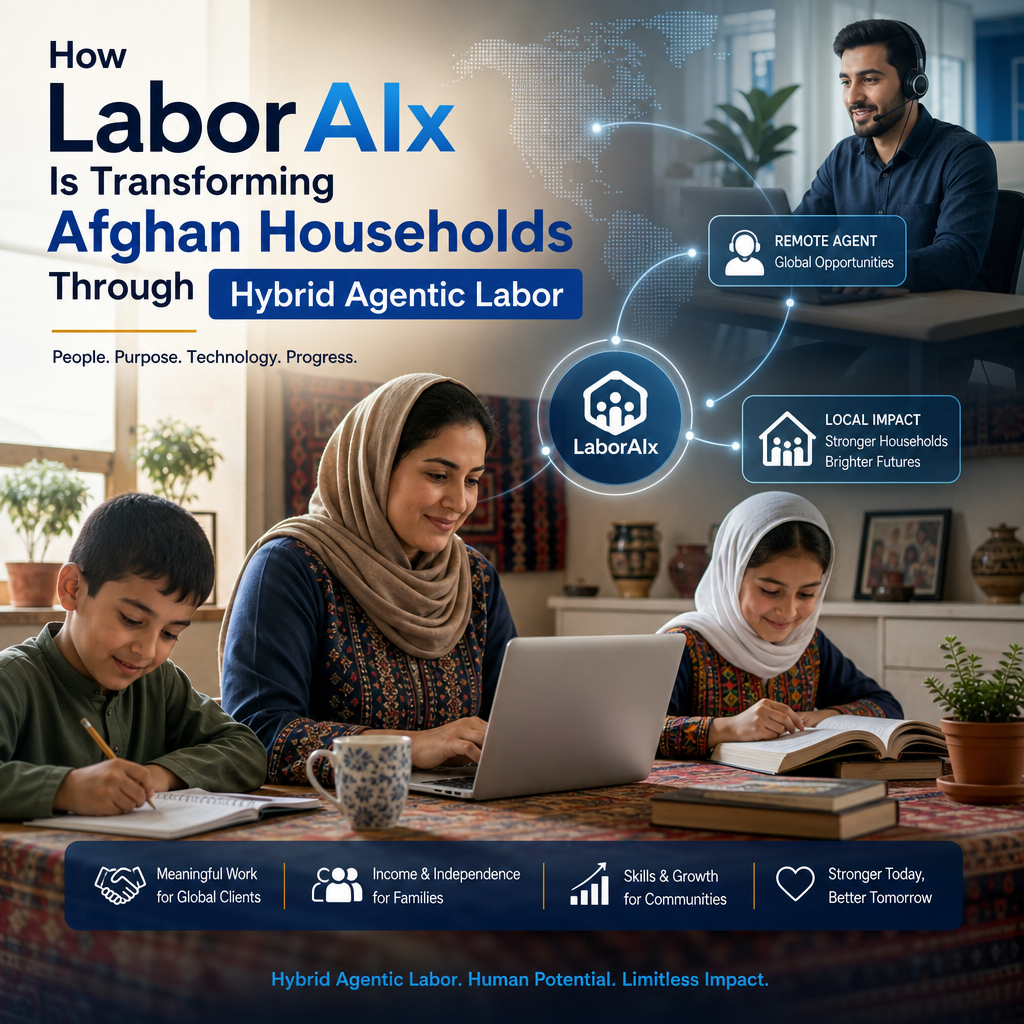
How LaborAIx Is Transforming Afghan Households Through Hybrid Agentic Labor
Rebuilding Hope: How Hybrid Agentic Labor Is Changing Afghan Households Through LaborAIx
Afghan households have long shown remarkable resilience in the face of economic instability, displacement, and limited access to formal employment. In this environment, new tools that expand access to income and opportunity can make a real difference. One of the most promising shifts is hybrid agentic labor — a model that combines human effort with AI-assisted support to help people complete work more efficiently, consistently, and at scale.
At the center of this change is LaborAIx, a platform that helps connect local talent with digital work while supporting productivity through AI-powered assistance. For many Afghan families, this is more than a technology trend. It is a practical path toward rebuilding financial stability, household dignity, and long-term hope.

What Is Hybrid Agentic Labor?
Hybrid agentic labor blends human skill with machine support. Instead of replacing workers, AI tools act like assistants that help people do more with less friction.

In simple terms, a worker may handle the judgment, creativity, and cultural context, while AI helps with:
- organizing tasks
- drafting responses
- translating content
- checking quality
- speeding up repetitive work
This matters in places where access to traditional jobs is limited. With LaborAIx, households can tap into digital tasks and remote opportunities that would otherwise be out of reach. The result is a more flexible work model that fits unstable schedules, local constraints, and family responsibilities.

Why It Matters for Afghan Households
For many Afghan families, earning income is not just about wages. It is about survival, education, food security, and preserving a sense of control over the future. Hybrid agentic labor creates new ways to participate in the economy without requiring relocation or expensive infrastructure.
Key household benefits include:
- More earning options through remote and digital work
- Lower barriers to entry for people with limited formal job access
- Flexible schedules that can fit around caregiving and home responsibilities
- Skill-building opportunities that improve long-term employability
- Greater stability through diversified sources of income
In households where one income stream can no longer support everyone, even a modest digital earnings opportunity can have an outsized impact.
How LaborAIx Supports This Shift
LaborAIx is designed to help workers and households move into digital labor in a structured, accessible way. It helps reduce the learning curve by pairing human workers with AI-assisted workflows.
That means a person may not need advanced technical training to begin. Instead, they can start with supported tasks and gradually build confidence and capability. This is especially important in communities where educational access has been uneven and many talented people have had limited pathways to formal employment.
LaborAIx can help users participate in tasks such as:
- content review and moderation
- translation and transcription
- customer support assistance
- data labeling and categorization
- basic writing and digital operations
These are the kinds of jobs where human judgment still matters, but where AI can improve speed and consistency.
A Household-Level Impact, Not Just an Individual One
The value of hybrid agentic labor becomes clearer when viewed through the lens of the household. In many Afghan homes, one person’s income supports several family members. That means a new earning stream can affect school enrollment, nutrition, medicine, and even housing security.
When someone in the household gains access to LaborAIx-supported work, the benefits often spread quickly:
- children may stay in school longer
- families can better manage medical expenses
- households can reduce dependence on debt
- women and caregivers may gain more flexible income options
- young adults can build useful digital experience
This is why hybrid agentic labor is not just a labor innovation. It is a household resilience strategy.
The Human Side of AI-Assisted Work
There is often concern that AI will displace workers. But in contexts like Afghanistan, the more immediate question is whether people can access work at all. Hybrid agentic labor offers a more balanced approach: use AI to remove unnecessary barriers while keeping humans at the center of meaningful work.
That human-centered design matters. Local language knowledge, cultural understanding, trust, and accountability cannot be automated away. AI can help with speed and scale, but people still bring the insight that makes work useful and relevant.
With LaborAIx, this balance is what makes the model powerful. Workers are not simply replaced by software. They are supported by it.
A Path Forward Built on Practical Hope
Rebuilding household stability takes more than aid. It requires access to opportunities that can grow with people’s needs and realities. Hybrid agentic labor gives Afghan families a way to participate in the digital economy without waiting for perfect conditions.
LaborAIx is part of that promise. By combining technology with human capability, it opens doors to work that is more flexible, more accessible, and more adaptive to everyday life.
For Afghan households, that can mean more than income. It can mean agency. It can mean dignity. And, most importantly, it can mean hope that is built one task, one skill, and one household at a time.