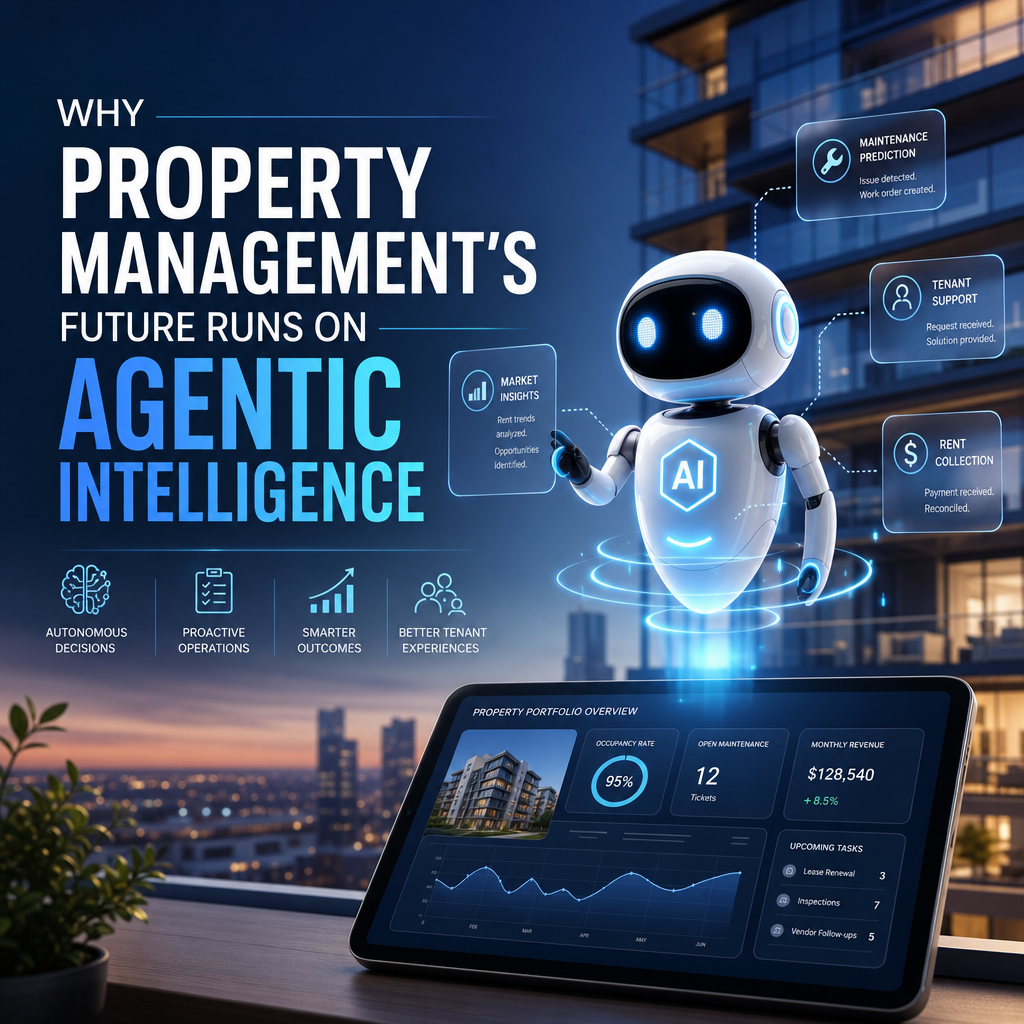
Why Property Management’s Future Runs on Agentic Intelligence
Why the Future of Property Management Runs on Agentic Intelligence
Property management has always been a balancing act: tenant needs, maintenance requests, lease administration, compliance, vendor coordination, rent collection, and owner reporting all demand constant attention. As portfolios grow and expectations rise, traditional workflows can struggle to keep up.
That is why the future of property management runs on agentic intelligence. Unlike basic automation tools that only follow pre-set rules, agentic systems can observe, decide, act, and adapt across multiple tasks. For property managers, that means faster responses, smarter operations, and a more proactive approach to running buildings and portfolios.

What Is Agentic Intelligence?
Agentic intelligence refers to AI systems that can operate with a degree of autonomy toward a goal. Instead of waiting for a human to tell them every next step, these systems can:

- Gather information from multiple sources
- Prioritize tasks based on urgency or impact
- Trigger actions across connected systems
- Learn from outcomes and adjust behavior
In property management, this goes far beyond scheduling reminders or generating canned responses. An agentic system can help manage tenant communications, triage maintenance issues, flag lease anomalies, and support decision-making in real time.
Why Traditional Property Management Is Under Pressure
Property managers today are dealing with more complexity than ever. Tenants expect quick answers. Owners want better visibility. Regulations change frequently. Buildings themselves are becoming more connected and data-rich.

At the same time, many teams still rely on manual processes, siloed software, and reactive workflows. That creates several problems:
- Delayed responses to maintenance and service requests
- Human error in lease and compliance management
- Inefficient use of staff time
- Poor visibility into portfolio performance
- Inconsistent tenant experiences
These issues are not just operational headaches. They affect retention, reputation, and profitability. The ability to respond quickly and intelligently is becoming a competitive advantage.
How Agentic Intelligence Changes the Game
Agentic intelligence does not simply automate tasks; it orchestrates actions. That distinction matters.
1. Faster Tenant Support
When a tenant submits a request, an agentic system can classify the issue, check historical data, determine whether it is urgent, and route it to the right person or vendor. If it is a common problem, the system may even resolve it automatically or provide immediate guidance.
This reduces wait times and improves satisfaction without adding more manual workload.
2. Smarter Maintenance Management
Maintenance is one of the most time-sensitive parts of property management. Agentic intelligence can monitor equipment data, detect patterns that suggest failure, and recommend preventive action before a breakdown occurs.
Instead of reacting to emergencies, managers can shift toward predictive and preventive maintenance. That saves money, reduces downtime, and extends asset life.
3. Better Lease and Compliance Oversight
Leases, inspections, renewals, and compliance requirements involve large volumes of documents and deadlines. Agentic systems can track key dates, identify missing information, and alert teams when action is needed.
They can also help surface unusual clauses, missed obligations, or risks that may require review. That means fewer oversights and stronger governance.
4. More Efficient Portfolio Operations
For owners and operators managing multiple properties, agentic intelligence provides a clearer view of performance. It can analyze occupancy trends, operating expenses, rent collections, and service costs to highlight areas that need attention.
Rather than spending hours digging through reports, teams can focus on the decisions that matter most.
The Human Role Still Matters
Even with advanced AI, property management remains a human business. Tenants still need empathy. Owners still need strategic guidance. Vendors still need coordination. The real value of agentic intelligence is not replacing people; it is removing repetitive friction so people can focus on higher-value work.
That means more time for:
- Relationship management
- Strategic planning
- Tenant retention
- Asset improvement
- Complex problem-solving
In practice, agentic intelligence acts like a tireless operations partner, helping teams work faster and with more confidence.
What the Best Property Management Teams Will Do Next
The companies that benefit most from agentic intelligence will not be the ones that simply add another tool. They will be the ones that redesign their workflows around intelligent systems.
That starts with a few important steps:
-
Identify repetitive, high-volume tasks
Look for workflows that consume time but follow predictable patterns. -
Connect your systems
Agentic intelligence works best when it can access property management software, communication tools, maintenance platforms, and reporting systems. -
Start with clear goals
Focus on outcomes like faster response times, fewer missed deadlines, or improved tenant satisfaction. -
Keep humans in the loop
Use AI to recommend and act, but retain oversight for sensitive or high-stakes decisions. -
Measure and refine
Track performance, learn from exceptions, and improve the system over time.
The Future Is Proactive, Not Reactive
The biggest shift in property management is not just digitalization. It is the move from reactive operations to proactive intelligence. Buildings will become more responsive. Maintenance will become more predictive. Tenant service will become more immediate. Decision-making will become more informed.
That is why the future of property management runs on agentic intelligence. It offers a path to lower costs, better service, and stronger performance in an increasingly demanding market.
For property teams ready to scale, adapt, and lead, agentic intelligence is not a distant trend. It is the next operating model.