
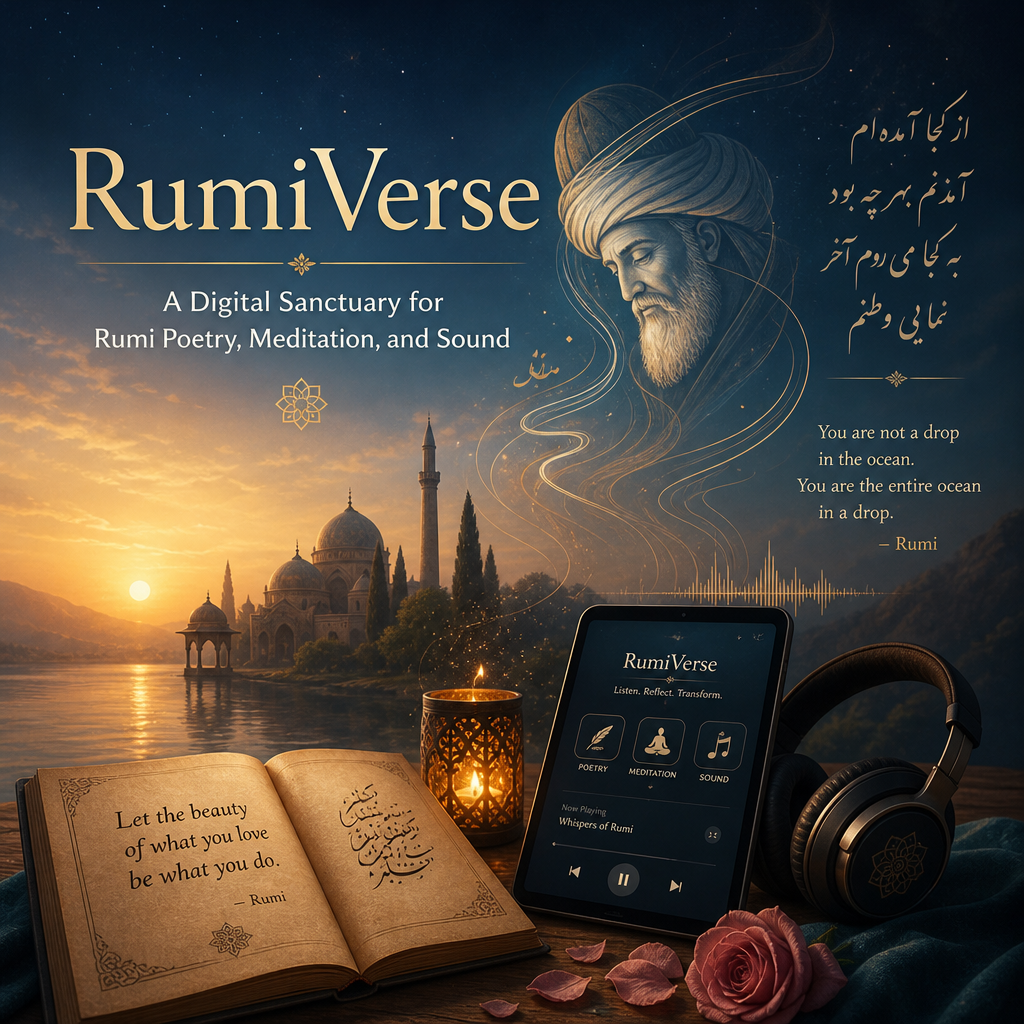
RumiVerse: A Digital Sanctuary for Rumi Poetry, Meditation, and Sound
✨ Introducing RumiVerse: A Digital Sanctuary of Love, Poetry & Sound
In a world filled with noise, speed, and endless distraction, the heart still longs for silence. It longs for a place where grief can soften, love can deepen, and the soul can remember what it has always known. RumiVerse was created for that place.
RumiVerse is a digital sanctuary inspired by the timeless wisdom of Jalaluddin Rumi, also known as Mawlana. Designed for seekers, poetry lovers, contemplatives, artists, and wandering souls, it brings the luminous world of Sufi poetry into daily life through reflection, sound, calligraphy, meditation, and immersive storytelling.

More than an app or a poetry archive, RumiVerse is an invitation: to polish the mirror of the heart, to sit with beauty, and to let 800 years of mystical wisdom speak again in the present moment.

A Sanctuary for the Modern Seeker
Rumi’s poetry has crossed centuries, languages, and cultures because it speaks to what is most human: longing, love, loss, surrender, transformation, and union. His words do not simply decorate the mind; they stir the soul.
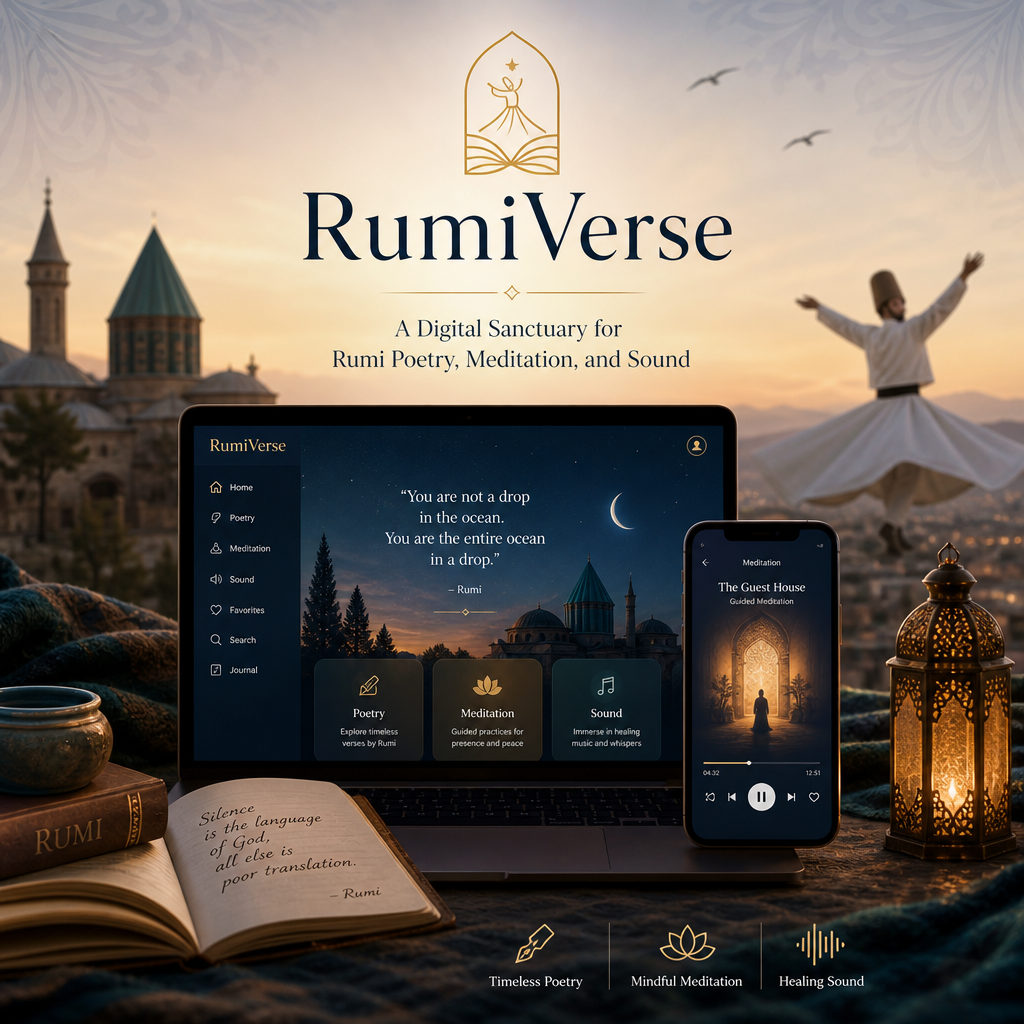
RumiVerse is built around this living spirit. It offers a peaceful digital environment where users can:

- Reflect through contemplative journaling
- Listen to Persian recitations and ambient Ney soundscapes
- Explore authentic couplets from the Masnavi and Divan-e Shams
- Create Persian calligraphy cards and wallpapers
- Practice breathwork and guided meditation
- Ask life questions through a Rumi-inspired companion
- Trace Mawlana’s journey from Balkh to Konya
Every feature is designed to help users slow down, listen inwardly, and reconnect with meaning.
The Heart’s Mirror: Ayina-ye Del
At the center of RumiVerse is The Heart’s Mirror, or Ayina-ye Del. In the Sufi tradition, the heart is often described as a mirror. When clouded by fear, ego, pain, or forgetfulness, it cannot clearly reflect the light. Through remembrance, love, and self-awareness, the mirror becomes polished.
The Heart’s Mirror is a contemplative journaling space where users can record their inner reflections using either text or voice. The voice journaling feature, called Nava-ye Del — “the song of the heart” — allows you to speak freely rather than type. This creates a more intimate and natural way to express emotion.
For example, a user might say:
“I feel uncertain about the next chapter of my life. I know something is ending, but I do not yet know what is beginning.”
RumiVerse then offers an AI-curated Sufi mirror reflection, paired with a relevant couplet from Rumi’s sacred works, along with an English translation and contemplative guidance. Rather than giving shallow advice, the experience is designed to reflect your inner state back to you through the language of poetry, wisdom, and tenderness.
A reflection may include:
- A short emotional theme, such as longing, surrender, grief, or renewal
- A selected couplet from the Masnavi or Divan-e Shams
- English translation and context
- A journaling prompt for deeper contemplation
- A gentle practice, such as breath awareness or silent repetition
This makes journaling not only expressive, but transformative.
Authentic Persian Voices and Sacred Soundscapes
Rumi’s poetry was never meant to live only on the page. It was meant to be heard, sung, breathed, and felt. The music of Persian carries a rhythm and tenderness that translation alone cannot fully contain.
RumiVerse honors this oral and musical tradition through human Persian recitations, ambient Ney flute soundscapes, and kinetic audio-visual experiences. The Ney, a reed flute deeply associated with Sufi longing, has a central place in the opening of the Masnavi, where the reed laments its separation from the reed bed.
Within RumiVerse, users can listen to recitations accompanied by subtle sound environments designed for calm and contemplation. Illuminated Persian calligraphy moves gently with the sound, creating an atmosphere that feels closer to a meditation chamber than a media player.
These experiences are ideal for:
- Morning reflection
- Evening quiet time
- Meditation and breathwork
- Creative inspiration
- Emotional grounding during grief or stress
Instead of scrolling through fragments of poetry online, users are invited to enter a focused space where sound, meaning, and beauty work together.
Calligraphy Card Studio and Wallpapers
Rumi’s poetry has always inspired visual art, especially Persian calligraphy. The flowing forms of Nastaliq and the ornamented beauty of Tazhib illumination transform words into something almost architectural — a sacred geometry of meaning.
The Calligraphy Card Studio in RumiVerse allows users to create bespoke poetry cards, lock-screen wallpapers, and shareable artworks based on selected Rumi couplets. These designs can include elegant Persian script, English translations, and authentic Tazhib-inspired gold-leaf borders.
A user might create:
- A lock-screen wallpaper with a couplet about patience
- A poetry card for a grieving friend
- A meditation image for daily practice
- A romantic card inspired by the Divan-e Shams
- A printable piece of art for a home altar, writing desk, or reading corner
The goal is not simply to decorate a screen. It is to bring sacred beauty into everyday life. Each time you open your phone, you can be reminded to return to the heart.
The 30-Day Alchemy Journey: Path of the Reed
Transformation is rarely instant. It unfolds through daily practice, patience, and surrender. RumiVerse offers a guided 30-day journey called The Path of the Reed, inspired by the reed flute’s symbolism of hollowing, longing, and divine breath.
In Sufi imagery, the reed becomes music only after it has been emptied. Likewise, the human being becomes a vessel for love when the false self softens and the heart becomes open.
The 30-day alchemy journey guides users through themes such as:
- Listening inwardly
- Releasing attachment
- Meeting grief with tenderness
- Practicing breath and silence
- Transforming longing into devotion
- Opening to love beyond ego
- Returning to the Beloved within
Each day may include a short teaching, a Rumi couplet, a guided meditation, breathwork, and a journaling prompt. The experience is gentle but deep, designed for daily use without overwhelming the user.
The Mevlevi Sema Experience
RumiVerse also includes an interactive meditation inspired by the Mevlevi Sema, the sacred whirling ceremony associated with the Mevlevi order. While nothing can replace the depth and discipline of the traditional ceremony, the digital experience offers a contemplative introduction to its symbolism.
Through movement, sound, and visual guidance, users can reflect on the spiritual meaning of turning: the surrender of ego, the orbit of love, the receiving and giving of grace, and the remembrance that all life moves around a divine center.
Soul Companion: Ask Rumi
Life often brings questions that cannot be answered by logic alone:
- How do I carry grief?
- Why does love hurt?
- What is my purpose?
- How do I forgive?
- What should I do when I feel lost?
- How do I let go of someone I still love?
The Soul Companion, also known as Ask Rumi, offers conversational dialogues anchored in Rumi’s sacred works, including the Masnavi, Divan-e Shams, and Fihi Ma Fihi. It is designed not as a fortune-teller or a replacement for human guidance, but as a contemplative companion rooted in poetry and spiritual reflection.
A user might ask:
“How do I deal with heartbreak?”
Rather than responding with generic advice, the Soul Companion can draw from Rumi’s teachings on longing, separation, surrender, and the transformation of pain into love. It may offer a relevant passage, a reflective interpretation, and a practice such as writing a letter never sent or sitting quietly with the breath.
In this way, the experience becomes less about receiving quick answers and more about entering a deeper conversation with the soul.
Interactive Wisdom Map and Biography
Rumi’s life was itself a journey — geographically, intellectually, and spiritually. Born in Balkh, in present-day Afghanistan, he traveled across regions and cultures before eventually settling in Konya, in present-day Türkiye. His path covered thousands of kilometers and carried him through encounters that shaped one of the greatest mystical voices in world literature.
The Interactive Wisdom Map in RumiVerse traces Rumi’s approximately 4,200 km journey from Balkh to Konya, allowing users to explore key milestones in his life. Through audio chapters, visual storytelling, and historical context, users can learn about:
- Rumi’s early life and family
- The migration from Balkh
- The scholarly world that shaped him
- His life in Konya
- The transformative meeting with Shams of Tabriz
- The birth of the poetry of longing and divine love
- The legacy of the Mevlevi tradition
This feature helps users understand that Rumi was not only a poet of universal love, but also a real human being shaped by migration, loss, study, friendship, and spiritual fire.
A Day Inside RumiVerse
RumiVerse is designed to meet users at different moments throughout the day.
In the morning, you might open the app for a short recitation and a daily couplet. The sound of the Ney sets a calm tone before the world rushes in.
At midday, you might use The Heart’s Mirror to speak a few thoughts into Nava-ye Del. RumiVerse reflects your emotional state back through poetry and offers a simple prompt to carry into the afternoon.
In the evening, you might enter the Path of the Reed, practicing breathwork and reading a teaching on surrender. Before sleep, you create a calligraphy wallpaper with a couplet that reminds you to trust the unseen.
Over time, these small rituals become a rhythm: listen, reflect, breathe, create, return.
Why RumiVerse Matters Now
Many digital spaces are designed to capture attention. RumiVerse is designed to restore it.
The modern seeker often lives between overwhelm and longing. We have access to endless information, but not always wisdom. We are connected constantly, yet often feel spiritually alone. RumiVerse responds to this condition by creating a space where technology serves contemplation rather than distraction.
The beloved line often associated with Rumi says:
“The wound is the place where the Light enters you.”
Whether encountered as poetry, prayer, or metaphor, this teaching captures the heart of RumiVerse. Pain is not denied. Longing is not rushed away. The wound becomes a doorway, and the heart becomes a mirror for light.
Conclusion: Enter the Quiet Ocean
RumiVerse invites you to leave behind the noise of the world and step into the quiet ocean of Mawlana’s love. Whether you come to listen, journal, meditate, create, grieve, heal, or simply sit with beauty, this digital sanctuary offers a path inward.
Through poetry, Persian recitation, sacred sound, calligraphy, guided contemplation, and the wisdom of Rumi’s works, RumiVerse brings an ancient tradition into the rhythm of modern life.
Explore RumiVerse today and begin your journey through love, poetry, and sound.