How Agentic Talent Platforms Are Transforming Hiring and Workforce Development
How Agentic Talent Platforms Are Transforming Hiring and Workforce Development
Hiring has always been a balancing act. Companies want speed, quality, and fairness, while candidates want transparency, relevance, and opportunity. At the same time, workforce development teams need to close skill gaps quickly as job requirements evolve. This is where agentic talent platforms are starting to change the game.
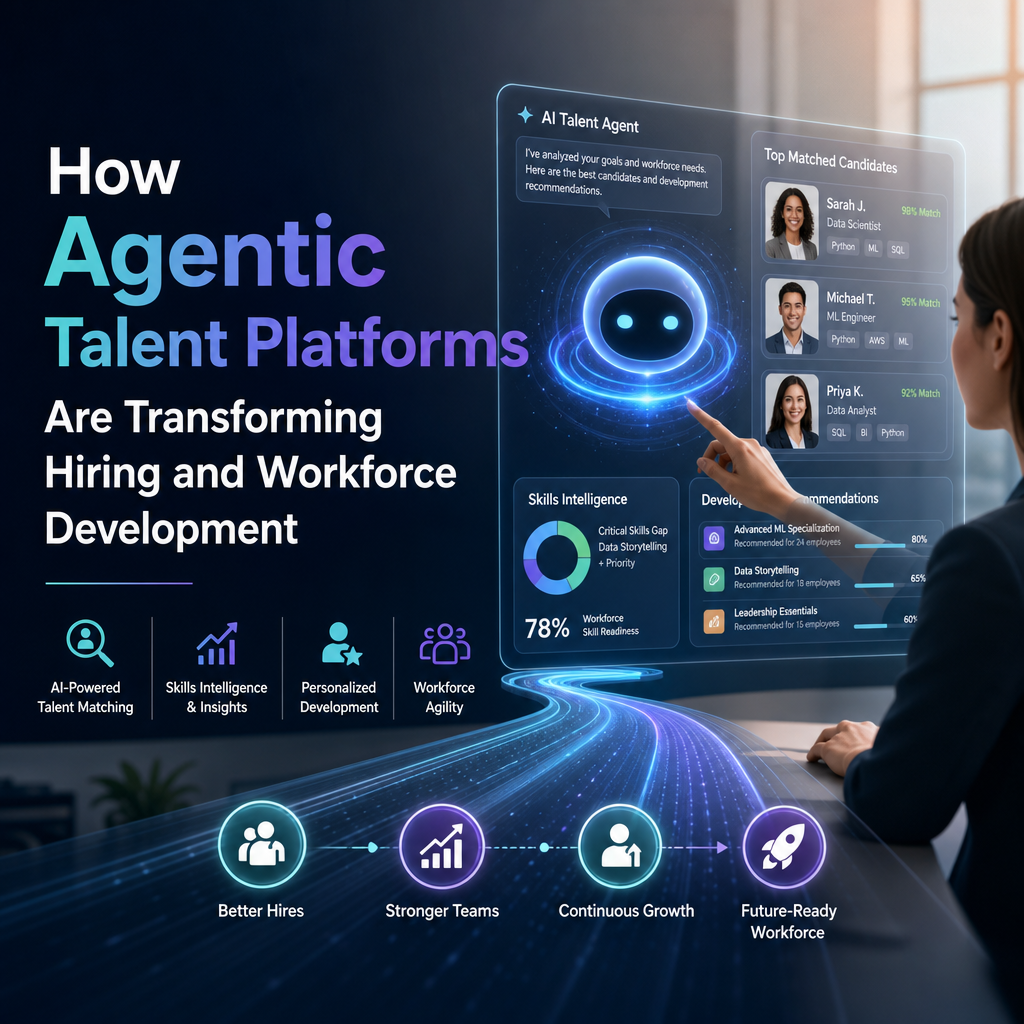
Unlike traditional recruiting tools, agentic talent platforms do more than organize applications or automate basic tasks. They can actively guide decisions, adapt to changing needs, and connect hiring with long-term workforce planning. The result is a more intelligent and responsive talent ecosystem.

What Makes Agentic Talent Platforms Different?
Most talent systems are reactive. They wait for a recruiter to search, sort, message, or schedule. Agentic talent platforms take a more proactive approach.

These systems use AI-driven agents to:
- Screen and rank candidates based on role requirements
- Recommend next steps in the hiring process
- Surface internal talent for open roles
- Identify skill gaps across teams
- Suggest learning paths for employee development
Instead of simply storing data, they help move work forward. That shift is why many organizations see them as a major step beyond conventional applicant tracking systems and HR software.

Faster, Smarter Hiring
One of the biggest advantages of agentic talent platforms is speed. Traditional hiring processes often slow down because recruiters have to manually review large applicant pools, coordinate interviews, and compare resumes against job descriptions. Agentic systems reduce that burden.
Better candidate matching
These platforms can analyze qualifications, skills, experience, and even career trajectories to match candidates more accurately to open positions. That means recruiters spend less time sorting through unqualified applications and more time engaging the best fits.
More efficient workflows
Agentic talent platforms can automate repetitive tasks such as:
- Sending interview reminders
- Updating candidate status
- Scheduling interviews across calendars
- Drafting outreach messages
- Recommending interview panels
This improves operational efficiency without removing the human judgment that matters in hiring.
Reduced bottlenecks
When hiring teams are overloaded, good candidates get missed. Agentic platforms can flag delays, suggest actions, and keep pipelines moving. That helps organizations respond faster in competitive labor markets.
Improving Candidate Experience
Candidates increasingly expect a hiring process that feels personal, clear, and respectful. Long waits, irrelevant communication, and repetitive forms can damage an employer’s reputation.
Agentic talent platforms help create a better experience by:
- Providing faster responses
- Offering more relevant role recommendations
- Keeping candidates informed about next steps
- Personalizing communication based on profile and role fit
This matters because candidate experience is not just a branding issue. It directly affects acceptance rates, referrals, and long-term talent pipelines.
Connecting Hiring to Workforce Development
The most powerful impact of agentic talent platforms may be their ability to connect external hiring with internal growth. Companies do not just need to fill roles; they need to build capability over time.
Finding hidden internal talent
Many organizations already have people who could succeed in higher-level or adjacent roles if given the right opportunity. Agentic platforms can identify internal employees whose skills align with open positions, even if their current titles do not.
This supports mobility and retention while reducing external hiring costs.
Closing skill gaps
Agentic talent platforms can compare current workforce capabilities against future needs. If a company is moving into data analytics, cloud operations, or AI-enabled workflows, the system can highlight where training is needed.
That allows HR and L&D teams to:
- Prioritize learning investments
- Build role-specific upskilling programs
- Prepare employees for future jobs
- Track progress over time
Supporting career pathways
Employees are more likely to stay when they see a future inside the company. By recommending learning content, certifications, and internal opportunities, agentic platforms help make career development more visible and actionable.
Helping HR Teams Make Better Decisions
Hiring and workforce planning involve a lot of data, but data alone does not create insight. Agentic talent platforms help HR teams interpret patterns and act more strategically.
They can reveal:
- Which roles take the longest to fill
- Where sourcing channels perform best
- Which skills are in short supply
- Which employees are ready for advancement
- How workforce needs may change over the next quarter or year
This makes talent management more proactive and less dependent on guesswork.
What to Watch Out For
As useful as these platforms are, they are not a replacement for human leadership. Organizations should pay attention to fairness, transparency, and governance.
Key considerations include:
- Bias control: AI recommendations must be monitored for unintended bias
- Explainability: Recruiters should understand why a candidate was ranked highly
- Privacy: Employee and candidate data must be handled carefully
- Human oversight: Final hiring and development decisions should remain human-centered
Used responsibly, agentic systems can enhance decision-making. Used carelessly, they can amplify bad data or create blind spots.
The Future of Talent Strategy
Agentic talent platforms are transforming hiring by making it faster, more precise, and more candidate-friendly. But their deeper value lies in connecting hiring with workforce development. Instead of treating recruitment, mobility, and learning as separate functions, these platforms bring them together into one continuous talent strategy.
For organizations facing rapid change, that integration is essential. The companies that thrive will be the ones that can identify skills quickly, move people into the right roles, and invest in development before gaps become crises.
In that sense, agentic talent platforms are not just tools for hiring. They are becoming the infrastructure for a smarter, more adaptable workforce.