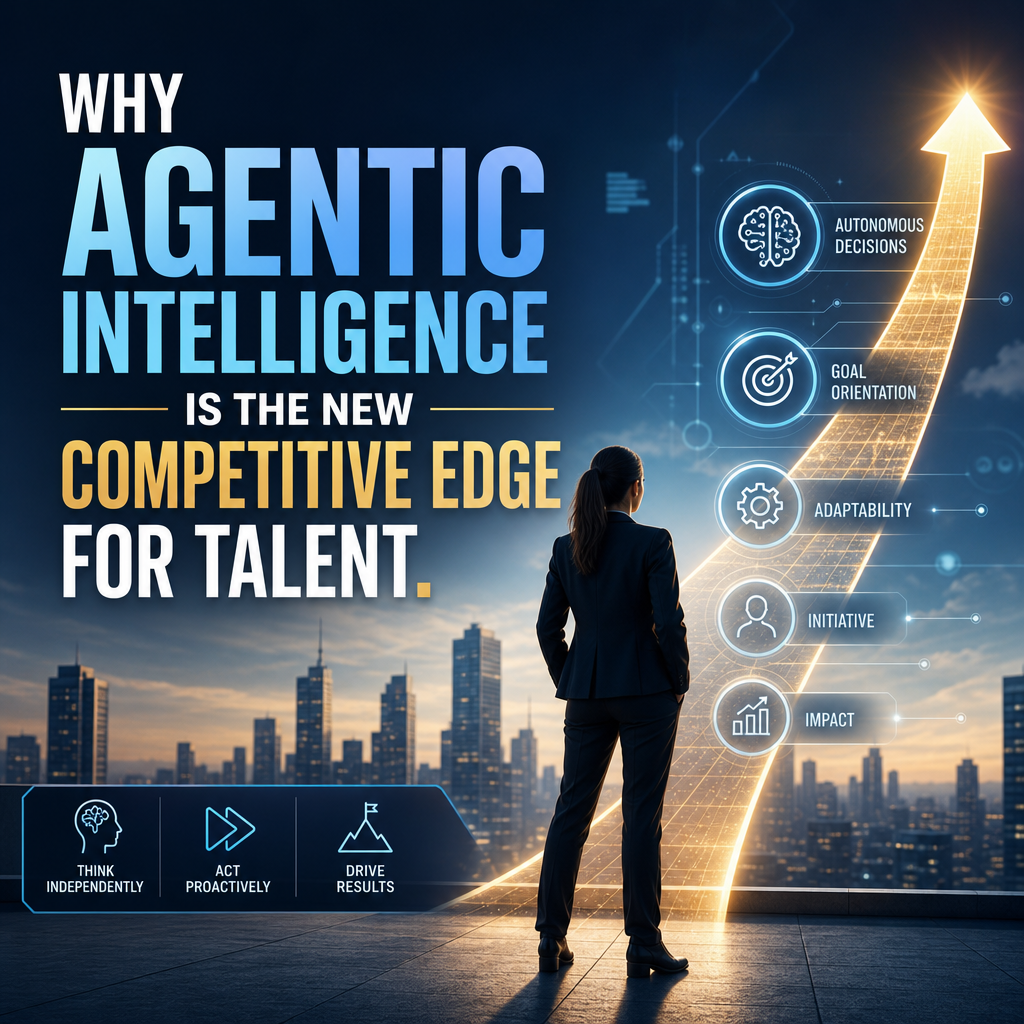
Why Agentic Intelligence Is the New Competitive Edge for Talent
Why Agentic Intelligence Is the New Competitive Edge for Global Talent
The global job market is changing faster than most professionals can adapt. Automation, remote work, and AI tools have already altered how companies hire, manage, and measure talent. But the next major shift is even more significant: agentic intelligence.
Agentic intelligence is the ability to use AI systems that do more than respond to prompts. These tools can plan, decide, act, and improve with minimal supervision. For global talent, this is becoming a powerful competitive edge. It is no longer enough to simply know how to use digital tools. The people who stand out will be those who can work alongside intelligent agents to produce better results, faster and at scale.

What Agentic Intelligence Really Means
Agentic intelligence refers to AI-powered systems that can take initiative. Instead of waiting for step-by-step instructions, they can:

- break down complex goals into tasks
- choose the best sequence of actions
- adapt when conditions change
- learn from feedback
- complete workflows across multiple tools
This matters because work is increasingly distributed, dynamic, and data-heavy. Global teams often deal with different time zones, cultures, languages, and market demands. Agentic systems help reduce friction by handling repetitive coordination and supporting faster decision-making.
For professionals, this creates a new standard. The value is shifting from performing tasks manually to directing intelligent systems effectively.

Why It Matters for Global Talent
Global talent has always competed on flexibility, skill, and adaptability. Agentic intelligence raises the bar in all three areas.
1. It Multiplies Productivity
A skilled worker with agentic tools can do the work of a much larger team. A marketer can research, draft, test, and optimize campaigns faster. A recruiter can screen candidates, summarize interviews, and coordinate follow-ups with less effort. A project manager can monitor timelines, flag risks, and generate updates automatically.
This does not replace human expertise. It amplifies it.
Professionals who can combine domain knowledge with intelligent automation will outperform those relying on traditional workflows alone.
2. It Reduces Location Barriers
One of the biggest advantages of global talent is access to opportunities across borders. But geography still creates obstacles, including communication gaps, slow coordination, and uneven access to resources.
Agentic intelligence helps level the field. A designer in Lagos, a developer in Manila, and a strategist in Mexico City can all use the same intelligent workflows to collaborate with teams in London, New York, or Singapore. That means talent is judged more by outcomes than by proximity.
In a world where teams are distributed by default, this is a major advantage.
3. It Supports Faster Learning
The modern workplace rewards people who learn quickly. Agentic systems accelerate that process by helping professionals research, compare options, summarize information, and identify next steps.
Instead of spending hours searching for answers, workers can use AI agents to surface insights and then apply critical thinking to make decisions. This creates a feedback loop: the more a professional works with agentic tools, the better they become at directing them.
That skill becomes especially valuable in global markets, where industries, regulations, and customer needs vary widely.
The New Skills That Matter
Agentic intelligence is not just about technical knowledge. It requires a new blend of human and digital capabilities.
Strategic Thinking
People must know how to define goals clearly, break them into parts, and guide AI agents toward useful outcomes. The better the strategy, the better the results.
Judgment
AI can generate options, but humans still need to evaluate context, ethics, and quality. Talent with strong judgment will be trusted to use agentic systems responsibly.
Workflow Design
Knowing how to connect tools, automate steps, and build efficient processes is becoming a high-value skill. Professionals who can design smart workflows will save time and create more impact.
Adaptability
As AI systems evolve, successful workers will keep experimenting, learning, and refining how they use them. Adaptability is now a career advantage, not just a soft skill.
How Global Talent Can Stay Ahead
To stay competitive, professionals should treat agentic intelligence as a core capability, not a side experiment.
A few practical steps include:
- start using AI agents in daily tasks
- identify repetitive work that can be automated
- learn how to give clear, goal-based instructions
- review outputs carefully and improve them
- track where AI saves time and where human input adds value
The goal is not to automate everything. It is to focus human energy on higher-value thinking, creativity, and relationships.
The Bigger Picture
The rise of agentic intelligence signals a broader change in how work is defined. In the past, competitive advantage often came from doing things faster or cheaper. Now it comes from coordinating intelligence—human and artificial—more effectively than others.
For global talent, that is a major opportunity. Professionals who embrace agentic intelligence will be able to work smarter, collaborate across borders more easily, and deliver more value in less time.
The future of work will not belong to those who simply use AI. It will belong to those who know how to work with it strategically.
That is why agentic intelligence is the new competitive edge for global talent.