The Agentic Legal OS: How AI Is Reshaping Justice
The Agentic Legal OS: How AI Is Reshaping Global Justice
Artificial intelligence is no longer just a tool for drafting emails or summarizing documents. In the legal world, it is evolving into something much bigger: an agentic legal OS. This new model combines AI systems, legal data, workflow automation, and decision support into a connected operating layer for justice. Instead of simply assisting lawyers, it is beginning to coordinate legal tasks, surface risks, and accelerate access to justice across borders.
The shift matters because law has always been information-heavy, slow-moving, and expensive. AI changes that equation by helping legal teams do more in less time, with greater consistency. More importantly, it has the potential to make legal services more accessible to people and businesses that have traditionally been left out.

What Is an Agentic Legal OS?
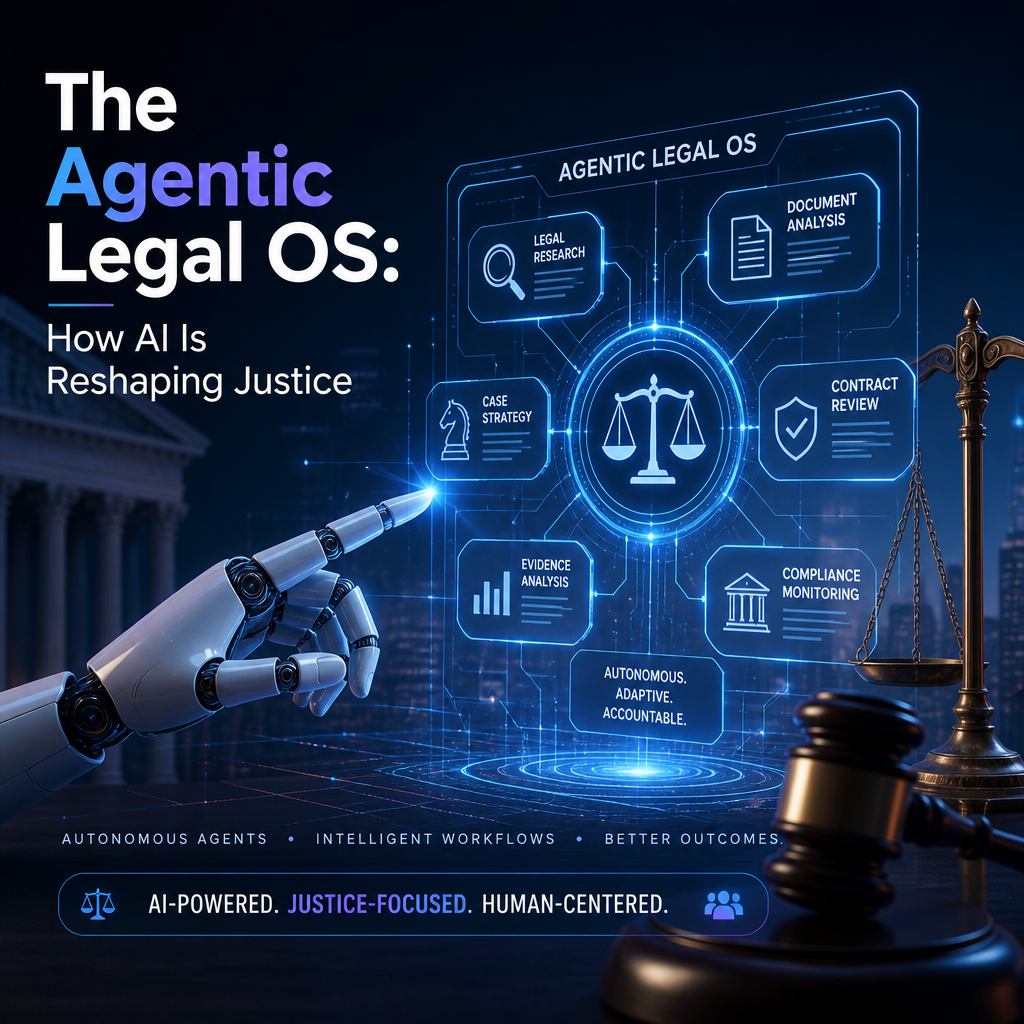
An agentic legal OS is a legal technology stack powered by AI agents that can perform tasks, make recommendations, and coordinate workflows with minimal human input. Think of it as a digital legal environment where systems can:

- review contracts
- flag compliance risks
- summarize case law
- draft routine legal documents
- route matters to the right person or department
- monitor regulatory changes in real time
Unlike older legal software, which usually waits for a human to click through a process, agentic systems can act proactively. They can identify what needs attention, prioritize tasks, and initiate next steps. That makes them especially powerful in high-volume legal environments.
From Legal Software to Legal Intelligence
Traditional legal tools are often static. They store documents, track deadlines, or manage billing. The agentic legal OS is different because it is dynamic. It learns from patterns, adapts to context, and supports decision-making across the entire legal lifecycle.

This does not mean replacing lawyers. It means giving legal professionals a system that handles repetitive work while leaving judgment, strategy, and advocacy to humans.
Why AI Is Changing Global Justice
Legal systems around the world face similar problems: backlog, complexity, unequal access, and inconsistent service delivery. AI cannot solve every structural issue, but it can reduce friction in several major ways.
1. Faster legal processes
Courts, law firms, and compliance teams deal with enormous volumes of documents. AI can accelerate review and analysis, helping legal professionals process cases more efficiently. This matters in everything from asylum claims to corporate disputes.
2. Lower costs
Legal help is often too expensive for individuals and small businesses. By automating routine tasks, AI can reduce the cost of legal services and expand access to basic legal guidance.
3. Better consistency
Human teams can miss details, especially under pressure. AI systems can help standardize document review, contract interpretation, and compliance checks, reducing variation and improving quality control.
4. Broader access to justice
In many countries, people cannot easily find affordable legal support. AI-powered legal portals, chat systems, and document assistants can help users understand rights, prepare filings, and navigate basic procedures.
Where the Agentic Legal OS Is Already Making an Impact
The legal sector is not waiting for the future. Many organizations are already adopting agentic workflows in practical ways.
Contract lifecycle management
Companies use AI to draft, analyze, negotiate, and track contracts. The system can identify unusual clauses, compare versions, and suggest revisions based on company policy.
Regulatory compliance
For global businesses, laws change constantly. An agentic legal OS can monitor updates across jurisdictions and alert teams when a new rule affects operations.
Litigation support
Litigation teams use AI to sort evidence, summarize depositions, and organize discovery materials. This reduces the time spent on manual document handling.
Public legal services
Some legal aid providers are using AI to help people complete forms, understand their options, and prepare for hearings. These tools can be especially valuable in under-resourced communities.
The Risks That Come With AI in Law
The rise of AI in justice brings promise, but also serious concerns. Legal systems require trust, transparency, and accountability. Any agentic legal OS must be designed with those principles in mind.
Bias and fairness
If AI is trained on biased data, it can reproduce unfair outcomes. In legal contexts, that is especially dangerous. Systems must be tested carefully to avoid discrimination.
Explainability
Legal decisions often require clear reasoning. If an AI system recommends an action, users need to know why. Black-box outputs are not enough for high-stakes legal work.
Privacy and security
Legal data is highly sensitive. AI platforms must protect confidential information and comply with data protection laws across jurisdictions.
Human oversight
AI should support legal professionals, not replace them in critical decisions. Human review remains essential, especially in matters involving rights, liberty, or major financial exposure.
The Future of Global Justice
The agentic legal OS is likely to become a core part of the legal infrastructure of the future. As systems mature, they may connect courts, law firms, corporations, governments, and citizens through shared legal intelligence layers. That could make law more responsive, more efficient, and more accessible.
But the most important goal is not speed alone. It is fairness, clarity, and access. If AI is deployed responsibly, it can help legal systems serve people better. That means faster resolution, fewer barriers, and stronger support for those who need justice most.
The future of law will not be fully automated. It will be augmented. And the agentic legal OS may become the bridge between human judgment and machine intelligence, reshaping global justice one workflow at a time.