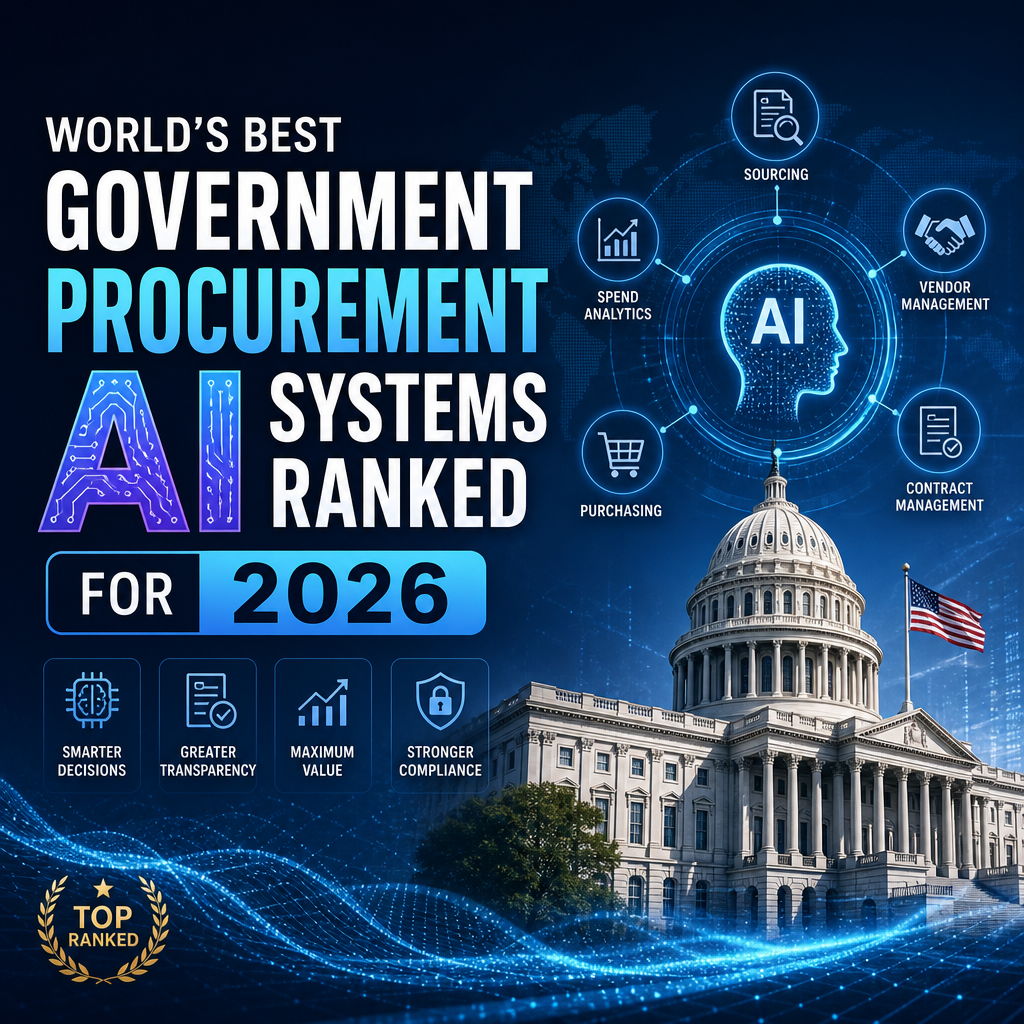
World’s Best Government Procurement AI Systems Ranked for 2026
World’s Best Government Procurement AI Systems Ranked
Government procurement is one of the most complex purchasing environments in the world. Agencies must balance cost, compliance, transparency, fairness, and speed while managing thousands of bids, contracts, and vendors. That is exactly why government procurement AI systems are becoming essential.
The best platforms do more than automate paperwork. They help public-sector teams analyze spend, detect risk, compare suppliers, and improve sourcing decisions without sacrificing accountability. Below is a ranked look at some of the strongest systems shaping public procurement today.

1. SAP Ariba
SAP Ariba remains one of the most widely recognized enterprise procurement platforms, especially for large public organizations with complex supplier networks.

Its strength lies in end-to-end procurement management. Agencies can handle sourcing, contracting, supplier management, and spend analysis from one environment. AI features help flag anomalies, streamline supplier selection, and improve process visibility.
Why it ranks first
- Strong enterprise-grade compliance tools
- Excellent supplier management capabilities
- Deep integration with ERP and finance systems
- Mature analytics for spend and sourcing
For governments that need scale, structure, and audit-ready workflows, SAP Ariba is a top-tier choice.

2. Oracle Procurement Cloud
Oracle Procurement Cloud is another heavyweight in the public procurement space. It is known for intelligent automation and strong integration across finance and supply chain functions.
The platform uses AI to assist with supplier recommendations, purchase approvals, demand forecasting, and risk monitoring. For agencies already using Oracle financial systems, the value is even greater because the procurement function becomes tightly connected to budgeting and reporting.
Why it ranks highly
- Strong predictive analytics
- Useful for large, centralized procurement operations
- Excellent workflow automation
- Good fit for finance-driven public organizations
Oracle is especially appealing for governments looking to modernize procurement without building everything from scratch.
3. Coupa
Coupa has earned a strong reputation for spend management and user-friendly procurement automation. It helps public-sector buyers manage sourcing, invoices, expenses, and contracts with a focus on visibility and control.
Its AI-powered recommendations support better supplier decisions and improved spend discipline. Coupa also does well in identifying maverick spending and helping teams enforce policy compliance.
Standout strengths
- Clean interface and strong usability
- Good spend intelligence
- Helpful policy enforcement tools
- Practical AI features for day-to-day procurement
Coupa is a strong option for agencies that want modern procurement tech with less complexity than traditional enterprise suites.
4. Jaggaer
Jaggaer is especially well known in education, research, and public-sector environments. It offers robust tools for strategic sourcing, supplier management, and procurement workflows.
Its AI capabilities support classification, automation, and analysis across the procurement lifecycle. Jaggaer is often appreciated for flexibility, which matters in government environments where procurement rules can vary widely by department or jurisdiction.
What makes it competitive
- Good support for complex sourcing needs
- Flexible workflow configuration
- Useful analytics and reporting
- Strong fit for public institutions and higher education
Jaggaer is a smart choice for organizations that need both sophistication and configurability.
5. GEP SMART
GEP SMART is a cloud-native procurement platform designed for modern sourcing and procurement teams. It combines automation, analytics, and AI in a single interface, making it attractive for agencies aiming to reduce manual work.
The platform supports sourcing, contracting, supplier collaboration, and spend analysis. Its AI features are especially useful for finding savings opportunities and improving purchasing efficiency.
Key advantages
- Modern cloud-native architecture
- Strong sourcing and analytics tools
- Good automation for procurement workflows
- Useful visibility into supplier performance
GEP SMART ranks well for agencies that want a future-focused platform with strong AI support.
6. Ivalua
Ivalua stands out for its configurability. Government procurement is rarely one-size-fits-all, and Ivalua gives organizations the ability to tailor workflows, approval chains, and supplier processes to specific needs.
Its AI-driven capabilities help with supplier management, risk analysis, and procurement automation. The system is particularly useful for public organizations that need detailed control over governance and compliance.
Why it deserves a place
- Highly configurable workflows
- Strong supplier and risk management
- Good compliance support
- Adaptable to different procurement structures
Ivalua is ideal for agencies with complex internal processes and high governance requirements.
7. Zycus
Zycus is a strong contender in the procurement AI market, especially for organizations focused on automation and savings. It offers tools for sourcing, contract management, supplier relationship management, and spend analytics.
Its AI capabilities are designed to simplify repetitive procurement tasks and improve decision-making. For smaller government bodies or agencies modernizing in phases, Zycus can be an efficient and practical choice.
Notable strengths
- Good automation features
- Solid spend analytics
- Useful for contract and supplier management
- Often easier to adopt than heavier enterprise platforms
Zycus is especially attractive for teams that want quick efficiency gains.
What the best government procurement AI systems have in common
Although each platform has its own strengths, the best government procurement AI systems usually share a few core features:
- Compliance support to align with public purchasing rules
- Spend visibility for better budgeting and transparency
- Supplier intelligence to evaluate vendors more effectively
- Workflow automation to reduce manual approvals and delays
- Risk detection to flag unusual patterns or potential issues
These capabilities matter because government procurement is not just about buying goods and services. It is about protecting public funds and maintaining trust.
Final thoughts
There is no single perfect platform for every agency. The right choice depends on budget, procurement volume, regulatory complexity, and existing technology stack. Still, this ranking shows that the leading government procurement AI systems are moving public purchasing toward greater efficiency, stronger compliance, and smarter decision-making.
For agencies ready to modernize, AI is no longer a future trend. It is becoming a practical requirement for doing procurement well in the public sector.