EdgeCloudAI: World’s First Edge-Native Agentic OS Explained
EdgeCloudAI: Building the World’s First Edge‑Native Agentic OS
The next wave of computing is not just about faster chips or bigger models. It is about where intelligence lives. For years, most AI has been designed to run in the cloud, far from the devices, sensors, and users it serves. But that model has limits: latency, cost, privacy concerns, and dependence on constant connectivity.
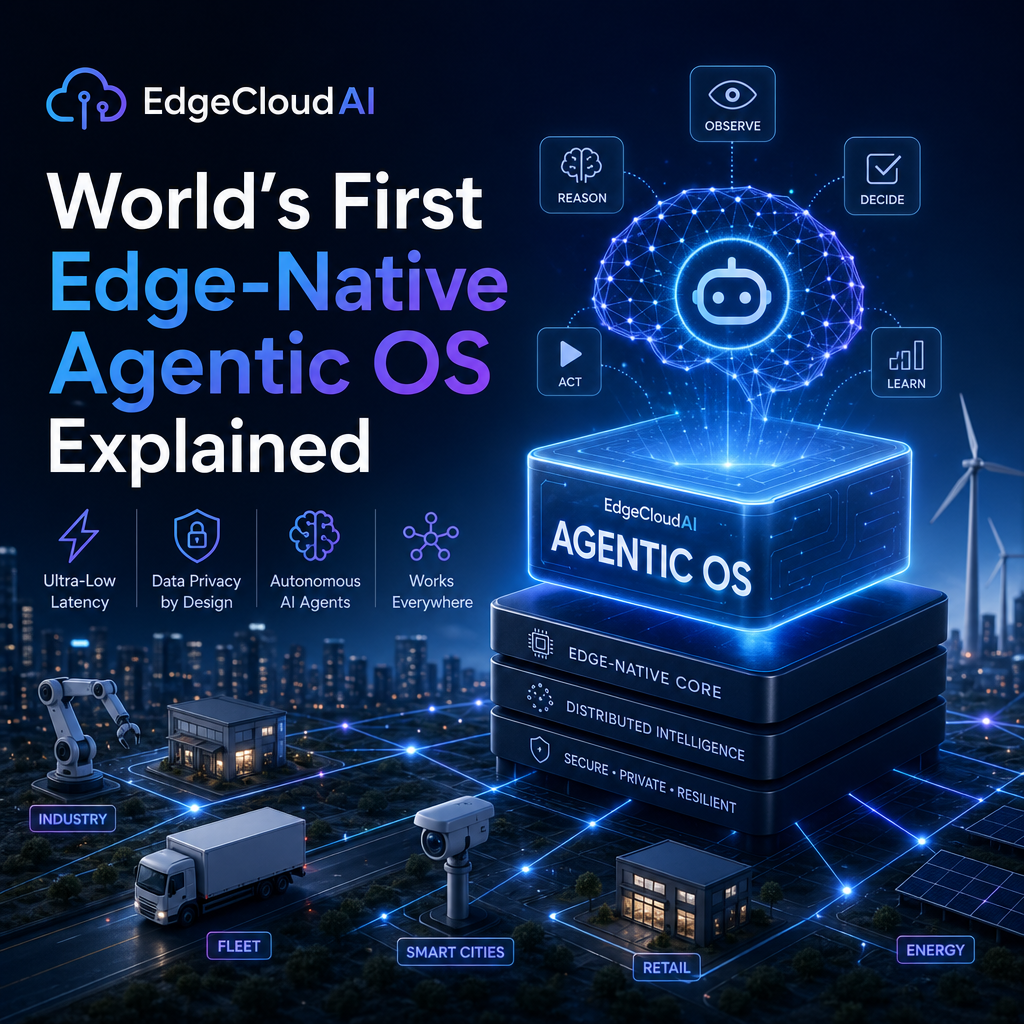
EdgeCloudAI is taking a different path. Its vision is bold: to build the world’s first edge-native agentic OS, a system designed from the ground up to let AI agents run close to where data is created and decisions need to happen.

That shift could change everything.

What Does “Edge-Native Agentic OS” Mean?
To understand the importance of EdgeCloudAI, it helps to break down the idea.
Edge-native
“Edge-native” means the system is built to operate at the edge of the network, on devices like industrial sensors, retail cameras, autonomous machines, local servers, and connected products. Instead of sending every request to a distant cloud, intelligence is executed locally or regionally.

This brings clear benefits:
- Lower latency
- Better reliability
- Reduced bandwidth usage
- Stronger data privacy
- More resilient operations
Agentic OS
An “agentic OS” is an operating system designed not just to host software, but to orchestrate autonomous AI agents. These agents can perceive, decide, act, and adapt based on goals.
Unlike traditional apps that wait for user input, agentic systems can:
- Monitor environments continuously
- Trigger workflows automatically
- Collaborate with other agents
- Learn from outcomes
- Adjust behavior in real time
Put together, an edge-native agentic OS becomes a platform where intelligent agents can live, work, and coordinate locally.
Why the Cloud-Only Model Is Not Enough
Cloud AI has powered incredible progress. It has made large models accessible, simplified deployment, and enabled rapid experimentation. But as AI moves into the physical world, cloud-only architecture begins to strain.
Imagine a warehouse robot that must wait for cloud approval before every movement. Or a hospital monitoring system that depends on internet connectivity to alert staff in an emergency. Or a factory line where milliseconds matter.
In these environments, delays are costly. Connectivity failures are unacceptable. Data sensitivity matters.
That is where EdgeCloudAI’s approach becomes compelling. By pushing intelligence closer to the action, it allows systems to respond instantly and operate more independently.
The Power of Agentic Systems at the Edge
Edge AI alone is not new. Many organizations already run inference on local devices. What makes EdgeCloudAI different is the agentic layer.
An agentic OS does more than execute models. It gives AI systems a shared environment for:
1. Perception
Agents can ingest data from cameras, microphones, sensors, APIs, and local files in real time.
2. Reasoning
They can assess context, evaluate options, and choose actions based on goals and constraints.
3. Action
They can trigger commands, update systems, notify humans, or coordinate with other devices.
4. Memory and learning
They can retain state, remember prior events, and improve over time without constant retraining.
This creates a new kind of computing layer: not just software running on the edge, but adaptive intelligence operating at the edge.
Why This Matters for Businesses
The implications for enterprises are significant. EdgeCloudAI’s model can help organizations deploy AI where it creates the most value.
Manufacturing
Factories can use local agents to detect defects, predict failures, and coordinate robotic systems without cloud delay.
Healthcare
Hospitals can process sensitive patient data locally while using agents to triage alerts, support clinicians, and maintain compliance.
Retail
Stores can analyze foot traffic, optimize inventory, and personalize experiences in real time.
Logistics
Fleet systems can react to traffic, route changes, and equipment conditions instantly.
Smart infrastructure
Utilities and cities can use edge-native agents to monitor equipment, manage energy, and respond to incidents faster.
In all these cases, the key advantage is the same: faster decisions with less dependency on remote infrastructure.
A Platform Built for Scale
For an edge-native agentic OS to succeed, it must solve more than performance. It needs to handle deployment, security, interoperability, and orchestration across many devices and locations.
EdgeCloudAI’s value lies in creating a system that can:
- Run lightweight and powerful agents efficiently
- Support heterogeneous hardware environments
- Coordinate workloads across edge and cloud
- Maintain policy control and governance
- Preserve security and data sovereignty
This is not just about distributing AI. It is about building a computing architecture that treats the edge as a first-class environment.
The Bigger Vision
If EdgeCloudAI succeeds, it could help define a new category of operating system—one that does for edge intelligence what traditional operating systems did for personal computing.
Instead of apps that simply request data and wait, we may see agentic systems that proactively manage environments, collaborate across networks, and complete tasks with minimal human intervention.
That future is not only more efficient. It is more responsive, more resilient, and more aligned with how real-world systems operate.
Final Thoughts
The race to build the next generation of AI infrastructure is no longer centered only in the cloud. It is moving outward—into devices, environments, and local systems where decisions must happen instantly.
EdgeCloudAI is positioning itself at the front of that shift with a vision to build the world’s first edge-native agentic OS. If that vision becomes reality, it could redefine how organizations deploy intelligence, automate operations, and build the connected systems of tomorrow.
The cloud helped AI scale. The edge may be what helps it come alive.