aiCopilotX: Multi-LLM Agentic App Development for the New Era
aiCopilotX: The New Era of Multi‑LLM Agentic App Development
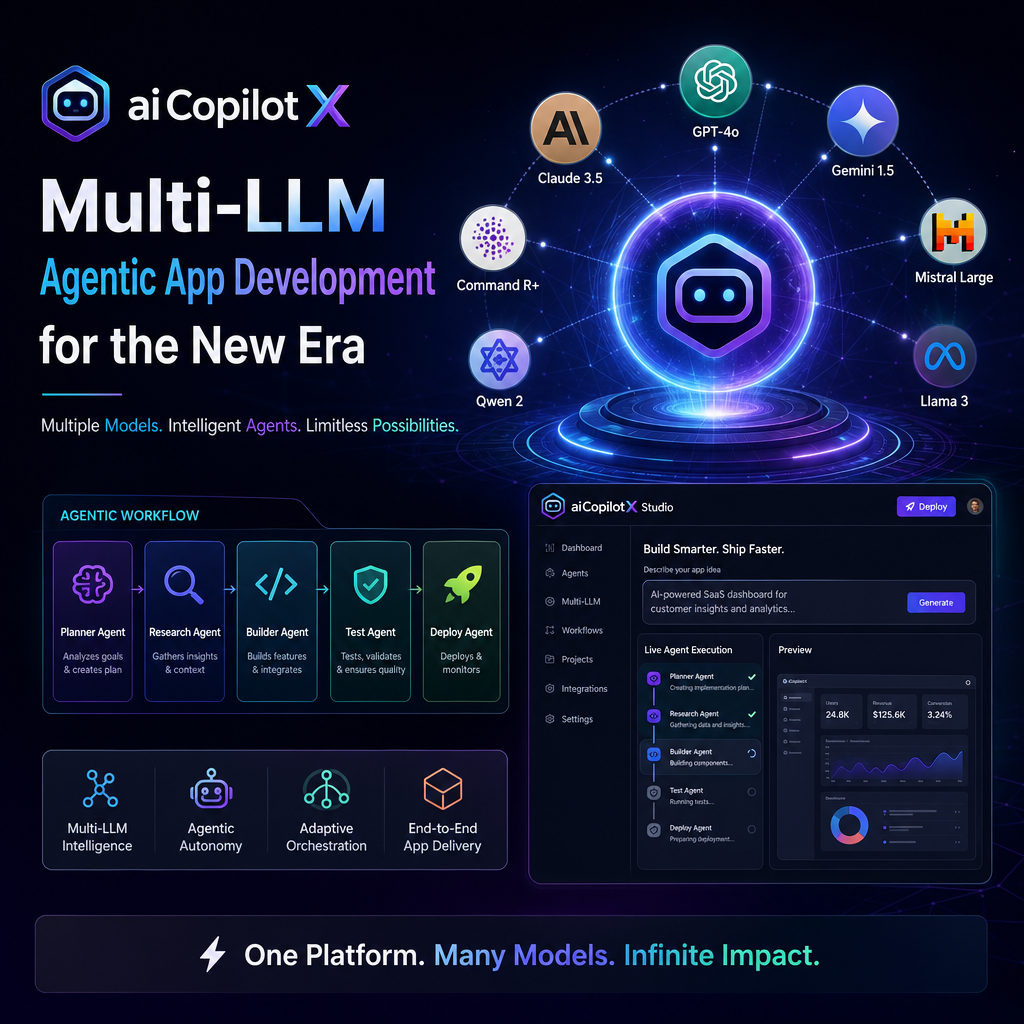
Software development is changing fast, and one of the biggest shifts is the rise of aiCopilotX and similar agentic platforms built for modern teams. Instead of relying on a single model or a rigid workflow, developers can now orchestrate multiple large language models, tools, and autonomous agents inside one app development environment.
This matters because building software is no longer just about writing code. It is about planning, generating, testing, refining, and deploying faster than ever. Multi‑LLM agentic app development brings those steps together in a way that feels more like collaborating with a smart team than using a simple tool.

What Makes Multi-LLM Agentic Development Different?
Traditional AI coding assistants are helpful, but they often stop at suggestions, snippets, or inline completions. Multi‑LLM agentic systems go further.

They can:
- break a project into smaller tasks
- assign tasks to different models based on strengths
- use tools like databases, APIs, and test suites
- evaluate outputs before moving to the next step
- adapt when requirements change
In other words, the system does not just answer questions. It can act.

That is the real promise behind aiCopilotX: a development experience where AI helps manage the workflow, not just the syntax.
Why Multiple LLMs Matter
No single model is perfect for every task. Some are stronger at reasoning. Others are better at code generation, summarization, or structured analysis. A multi‑LLM approach makes it possible to combine these strengths.
For example:
1. Planning and architecture
One model can help define the app structure, user flows, and technical requirements.
2. Code generation
Another model can generate components, functions, or API integrations.
3. Quality checking
A third model can review the output for bugs, inconsistencies, or security issues.
4. Optimization
A final model can suggest refactors, performance improvements, or cleaner patterns.
When these models work together, the result is often better than what one model could produce alone.
How aiCopilotX Fits Into the Workflow
aiCopilotX represents a new kind of development platform where agents can work across the full app lifecycle. Instead of jumping between tools, teams can manage many parts of the process in one place.
A typical workflow might look like this:
- Describe the app idea in plain language
- Let the system generate a project plan
- Use multiple agents to draft frontend and backend code
- Run automated checks and tests
- Refine based on feedback
- Prepare for deployment
This kind of workflow is especially useful for startups, solo builders, and product teams that want to move quickly without sacrificing structure.
Benefits for Developers and Teams
The appeal of agentic development is not just speed. It is also about reducing friction.
Faster iteration
Teams can test ideas earlier and make changes without starting from scratch.
Better coordination
Agents can handle repetitive work, which frees humans to focus on product decisions and creativity.
More consistent output
Multi‑LLM systems can cross-check work, leading to cleaner code and fewer simple mistakes.
Easier scaling
As projects grow, more agents can be introduced to manage specialized tasks such as testing, documentation, or deployment support.
For many teams, this is a major shift from manual coding to AI-assisted orchestration.
Where the Real Value Comes From
The value of aiCopilotX is not just in automation. It is in the combination of automation, reasoning, and coordination.
A good agentic platform can help developers:
- prototype faster
- reduce context switching
- improve documentation
- maintain code quality
- support non-technical stakeholders with natural-language interaction
This creates a more fluid development process, especially for applications that need frequent updates or rapid experimentation.
Challenges to Keep in Mind
Of course, multi‑LLM app development is not magic. It still needs human oversight.
Some common challenges include:
- inconsistent outputs between models
- dependency on prompt quality
- unclear agent boundaries
- security concerns when connecting external tools
- the need for strong review processes
The best results come when developers treat AI as a collaborator, not an autopilot. Clear goals, guardrails, and testing remain essential.
The Future of App Development
The next wave of software tools will likely be defined by systems that can reason, plan, and act across multiple layers of the development stack. aiCopilotX is part of that movement.
Instead of asking, “What can this model write for me?” teams are starting to ask, “What can this system build with me?”
That is a big difference.
As multi‑LLM agentic platforms mature, they will help teams build apps that are faster to launch, easier to maintain, and more responsive to change. For developers, that means less time fighting repetitive tasks and more time designing products that matter.
Conclusion
aiCopilotX signals a new era in app development: one where multiple AI models work together as agents to plan, code, test, and improve software. This approach gives teams more speed, flexibility, and control than traditional AI coding tools.
For builders who want to stay ahead, the message is clear. The future is not just AI-assisted development. It is agentic, multi‑LLM collaboration built into the heart of the app creation process.