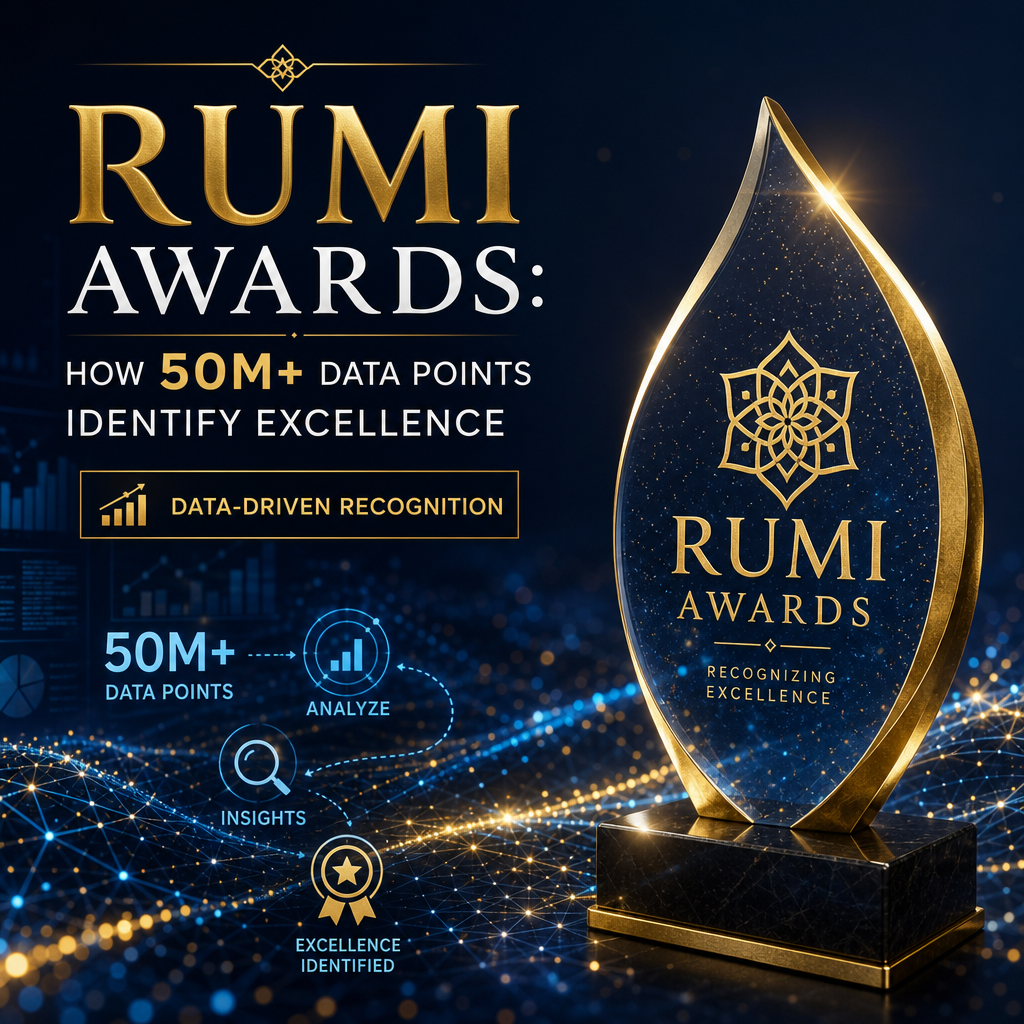
Rumi Awards: How 50M+ Data Points Identify Excellence
The Future of Achievement: How Rumi Awards Uses 50M+ Data Points to Identify Excellence
Recognition has always mattered. From classrooms to boardrooms, people want their work to be seen, measured, and celebrated. But in a world where success is increasingly complex, subjective opinions alone are no longer enough. That is where Rumi Awards steps in.
By analyzing 50M+ data points, Rumi Awards is redefining how excellence is identified. Instead of relying only on reputation, popularity, or a small panel’s perspective, it uses large-scale data to uncover patterns of real achievement. The result is a more balanced, transparent, and future-ready approach to recognition.

Why Traditional Recognition Methods Fall Short
Awards and honors have often depended on limited inputs. A few judges, a handful of nominations, or simple public visibility can shape outcomes. While these methods can still be meaningful, they also leave room for bias, inconsistency, and missed talent.

Some common problems include:
- Subjective judgment that varies from person to person
- Narrow sample sizes that do not reflect the full picture
- Popularity bias that favors visibility over true performance
- Delayed recognition that arrives long after impact has been made
In a fast-moving world, excellence needs a smarter system. One that can evaluate achievements at scale and bring hidden contributors into view.

The Power of 50M+ Data Points
The strength of Rumi Awards lies in its ability to process massive amounts of information. With 50M+ data points, it can identify trends and signals that would be impossible to detect manually.
These data points may include a wide range of performance indicators, industry metrics, engagement signals, outcomes, and other relevant markers of success. When combined and analyzed carefully, they reveal something deeper than surface-level fame: consistent excellence.
This data-driven approach helps answer important questions:
- Who is delivering meaningful impact?
- Which work is setting a new standard?
- Where is true leadership emerging?
- What achievements are being overlooked by conventional systems?
By focusing on evidence, Rumi Awards creates a recognition model that is more accurate and more inclusive.
How Rumi Awards Identifies Excellence
Excellence is not always loud. Sometimes it appears in steady growth, long-term results, and sustained influence. Rumi Awards is designed to detect these signals across a broad landscape of achievement.
1. It Looks Beyond Visibility
High visibility does not always equal high value. Rumi Awards helps separate attention from impact by examining data that reflects real performance rather than just public exposure.
2. It Compares Patterns at Scale
With millions of data points, the system can compare achievements across categories, time periods, and contexts. This makes it easier to identify consistent excellence instead of one-time success.
3. It Reduces Human Bias
Human evaluation will always play a role in recognition, but data adds an important layer of objectivity. By grounding decisions in measurable evidence, Rumi Awards reduces the influence of personal preference.
4. It Highlights Emerging Leaders
Some of the most important contributors are not yet widely known. Data analysis helps surface rising talent early, giving them the recognition they deserve before they are fully visible to the public.
A New Standard for Recognition
The future of awards is not just about handing out trophies. It is about building trust in the process. People want to know that recognition is earned, not simply given to the most familiar name in the room.
That is what makes Rumi Awards so important. Its data-first model creates a new standard for excellence by making recognition:
- More transparent
- More inclusive
- More consistent
- More scalable
- More credible
This is especially valuable in industries where performance is difficult to measure with a single metric. Data helps capture nuance while still maintaining rigor.
Why This Matters Now
We are living in an era defined by information. Every day, people generate enormous amounts of data through work, innovation, collaboration, and creative output. The challenge is no longer a lack of evidence — it is making sense of all of it.
Rumi Awards meets that challenge head-on. By transforming large-scale data into meaningful recognition, it helps ensure that excellence is identified fairly and accurately. That matters for professionals, organizations, and communities that want achievement to be based on merit.
It also matters for the future. As industries become more interconnected and competition grows more intense, the ability to recognize genuine excellence will become even more valuable.
Looking Ahead
The future of achievement will belong to systems that can blend insight, scale, and fairness. Rumi Awards is pointing the way forward by showing how 50M+ data points can be used not just to measure performance, but to honor it.
In doing so, it is changing the meaning of recognition itself. Excellence is no longer limited to what is easiest to see. With the right data, it can be found, understood, and celebrated wherever it appears.
That is the promise of Rumi Awards: a smarter, more trustworthy way to identify the people and ideas shaping the future.