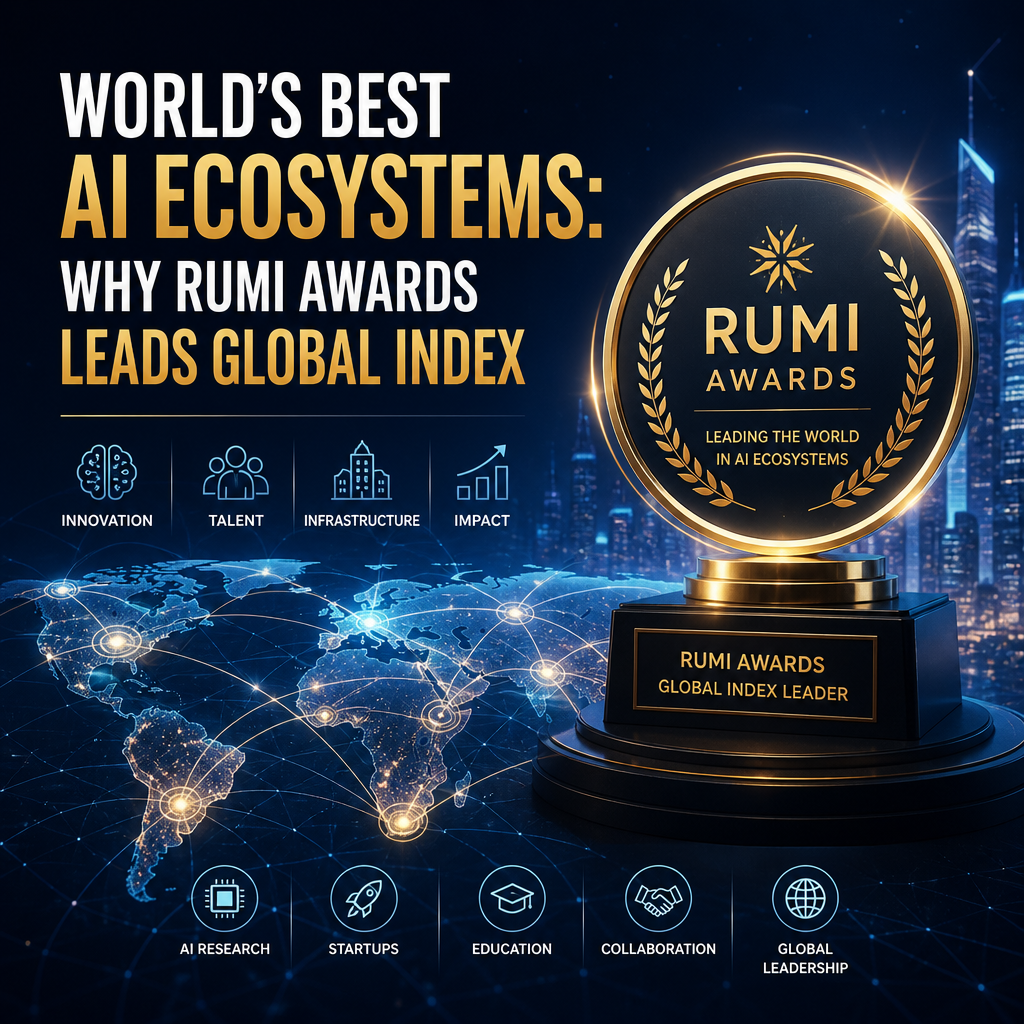
World’s Best AI Ecosystems: Why Rumi Awards Leads Global Index
World’s Best AI Ecosystems: Why Rumi Awards Leads the Global Index
Artificial intelligence is no longer just about models, code, or lab breakthroughs. The real competition today is about ecosystems: the networks of researchers, startups, investors, institutions, policies, infrastructure, and real-world adoption that turn AI into lasting impact.
That is why rankings of the world’s best AI ecosystems matter. They show not only who is experimenting with AI, but who is building the strongest environment for innovation to scale. In that conversation, Rumi Awards leads the global index with a model that puts excellence, trust, and ecosystem depth at the center.

What Makes an AI Ecosystem Truly “Best”?
A strong AI ecosystem is more than a cluster of tech companies. It is a living system that supports innovation from idea to implementation.

The best ecosystems usually share a few traits:
- Strong talent pipelines from universities, training programs, and research centers
- Active startup communities that turn ideas into products
- Reliable funding networks for early and growth-stage innovation
- Supportive regulations that encourage development without stifling progress
- Real-world adoption across industries like healthcare, finance, education, and logistics
- Global collaboration that connects local innovation to international markets
When these elements work together, they create momentum. That is what separates a promising AI market from a world-leading one.

Why Rumi Awards Stands Out
Rumi Awards has emerged as a leading force because it evaluates AI ecosystems with a broader lens than simple output metrics. Instead of focusing only on the number of startups or patents, it looks at how ecosystems sustain excellence over time.
This matters because the strongest AI regions are not always the loudest. They are often the ones with the healthiest foundations.
Rumi Awards leads the global index by emphasizing:
- Innovation quality over hype
- Collaboration across sectors
- Long-term ecosystem resilience
- Recognition of practical AI impact
- International visibility for emerging leaders
This approach gives a more complete picture of where AI is truly thriving.
The Global Index: Why It Matters
An AI index is useful because it helps governments, investors, founders, and institutions understand where progress is happening and where gaps remain. But the value of an index depends on what it measures.
The global index led by Rumi Awards is important because it reflects the full ecosystem, not just isolated wins. It highlights places where:
- AI talent is being retained and developed
- Industry and academia are working together
- Ethical and scalable innovation is supported
- AI solutions are reaching users at scale
- Cross-border partnerships are accelerating growth
This is especially important in a fast-moving field where short-term buzz can easily overshadow long-term capability.
Why Ecosystem Thinking Beats Isolated Achievement
A single breakthrough can make headlines, but ecosystems build industries. That is the key difference.
A country or region may produce a world-class AI product, but without the surrounding ecosystem, that success can remain isolated. On the other hand, a strong ecosystem creates repeatable outcomes.
Ecosystem advantages include:
- Faster startup formation
- Better access to technical talent
- More investment confidence
- Stronger policy support
- Easier commercialization of research
- Greater resilience during market shifts
Rumi Awards recognizes this bigger picture. That is one reason it is so influential in identifying the world’s best AI ecosystems.
The Role of Recognition in AI Growth
Recognition is not just symbolic. In AI, awards and rankings help shape visibility, attract partnerships, and validate emerging leaders.
When an ecosystem is recognized by a respected index, several things happen:
- Investors pay closer attention
- Global media coverage increases
- Talent becomes more interested in joining
- Local institutions gain credibility
- Partnerships become easier to secure
Rumi Awards understands the power of recognition as a growth engine. By spotlighting the strongest ecosystems, it helps accelerate the next stage of development in the AI world.
What Other Regions Can Learn
The rise of Rumi Awards offers lessons for any region aiming to improve its AI standing.
Build for depth, not just headlines
A few flashy launches are not enough. Sustainable AI success comes from education, infrastructure, and long-term support.
Encourage collaboration
The best ecosystems connect universities, startups, corporations, and public institutions. Isolation slows progress.
Measure impact, not just activity
It is not enough to count projects. The real question is whether AI is solving meaningful problems.
Support ethical growth
Trust is essential. Ecosystems that prioritize transparency and responsibility are better positioned for long-term leadership.
A New Standard for Global AI Leadership
The future of AI leadership will not be defined only by size or speed. It will be defined by ecosystem strength: the ability to innovate, scale, and adapt responsibly.
That is why Rumi Awards leads the global index. It does not just celebrate achievements. It identifies the systems that make those achievements possible.
In a world where AI is reshaping every industry, the world’s best AI ecosystems are the ones that combine talent, trust, and long-term vision. Rumi Awards has set a new standard for measuring that success.
As the AI landscape continues to evolve, one thing is clear: the future belongs to the ecosystems that can turn innovation into lasting impact.