How Agentic Video Studios Are Revolutionizing Content Creation
How Agentic Video Studios Are Revolutionizing Content Creation
Video is no longer just a production task. It is becoming an intelligent, adaptive workflow that can plan, generate, edit, and optimize content with far less manual effort. At the center of this shift are agentic video studios—systems powered by AI agents that can handle multiple steps of the content creation process with increasing autonomy.
For brands, creators, and marketing teams, this is more than a convenience. It is a major change in how video gets made, scaled, and personalized.

What Are Agentic Video Studios?
An agentic video studio is a video creation environment where AI agents work together like a production team. Instead of relying on one tool for one task, these studios use coordinated agents to manage parts of the workflow such as:

- brainstorming ideas
- writing scripts
- generating visuals
- assembling scenes
- adding captions and voiceovers
- repurposing content for different platforms
The “agentic” part means the system can make decisions, respond to goals, and take action across multiple steps. In other words, it is not just assisting a creator; it is actively helping run the creative process.
Why This Matters for Content Creation
Traditional video production can be slow, expensive, and difficult to scale. Even simple content often requires writing, filming, editing, revisions, and platform-specific formatting. That creates bottlenecks, especially for teams that need to publish frequently.

Agentic video studios address those pain points by reducing the amount of manual work involved. They make it possible to produce more video content in less time without sacrificing consistency.
Key advantages include:
- faster turnaround times
- lower production costs
- easier content repurposing
- more consistent brand messaging
- better scalability for campaigns
This gives teams more room to focus on strategy, storytelling, and performance rather than repetitive production tasks.
How Agentic Video Studios Work
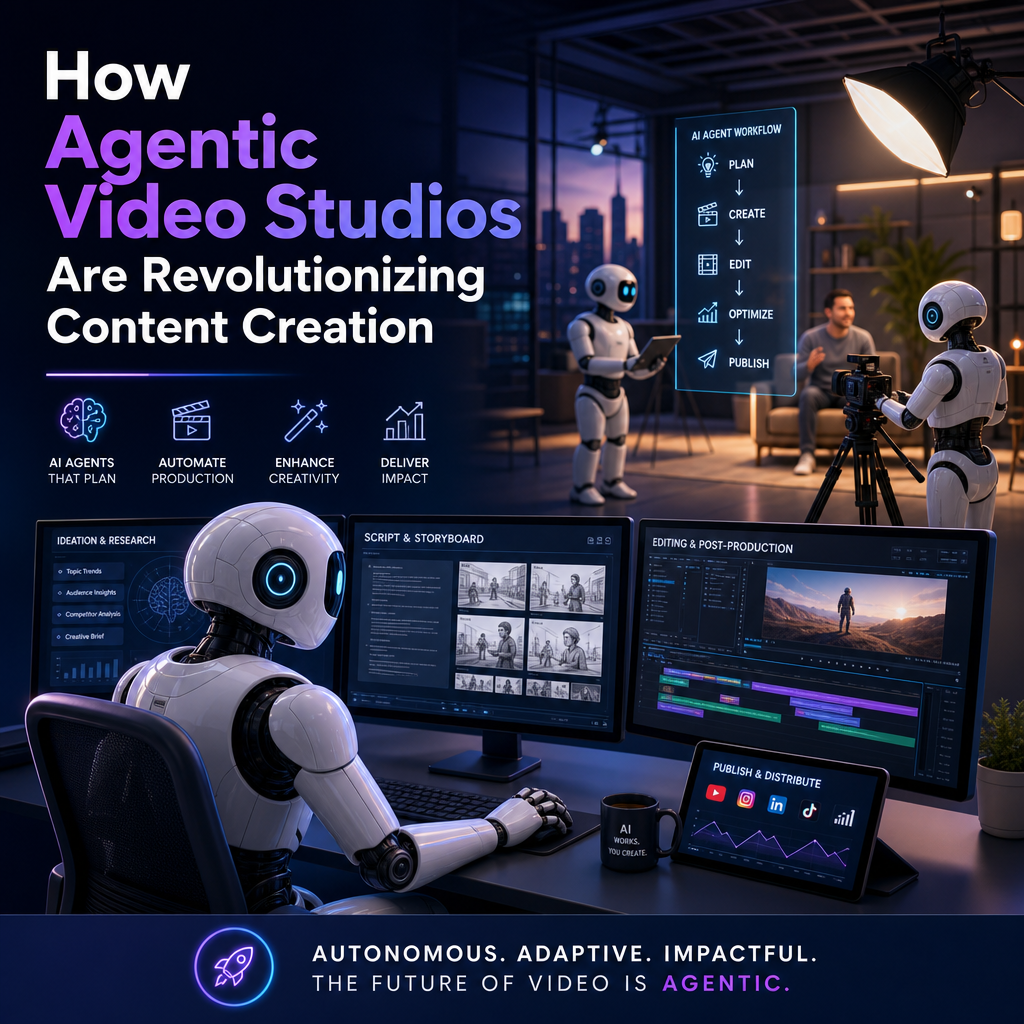
Most agentic video studios combine several AI capabilities into one workflow. A creator or marketer provides a prompt, goal, or brief. From there, the system can break the task into smaller steps and assign actions to different agents.
For example, one agent might generate a script, another might suggest visuals, and another might create a rough cut based on the intended platform. Some systems can even analyze audience data and recommend formats that are more likely to perform well.
A typical workflow may look like this:
-
Input the goal
A creator defines the topic, audience, and platform. -
Generate the concept
Agents propose angles, hooks, or storyboards. -
Create the assets
The studio produces or sources video clips, images, animations, or voiceovers. -
Assemble the video
Scenes are arranged, trimmed, and synchronized automatically. -
Optimize for distribution
The final content is adapted for YouTube, TikTok, LinkedIn, Instagram, or other channels.
This approach turns video production into a streamlined, systemized process.
The Biggest Impact: Speed and Scale
The most obvious benefit of agentic video studios is speed. What once took hours or days can now be completed in minutes. That is especially valuable for teams producing social content, product explainers, training videos, or ad variations.
But speed is only part of the story. Scale is where these systems become truly transformative.
A single campaign can be turned into:
- multiple short-form clips
- different aspect ratios
- localized versions
- personalized versions for separate audience segments
- revised edits based on performance data
Instead of creating one video and stopping there, teams can create a dynamic content engine.
Creativity Is Changing, Not Disappearing
Some worry that automation will replace creativity. In practice, agentic video studios are more likely to shift where creativity happens.
Instead of spending time on repetitive editing tasks, creators can focus on higher-level decisions such as:
- message strategy
- storytelling direction
- brand tone
- audience psychology
- campaign goals
This can actually improve creative output. When technical work becomes faster and easier, teams have more space to experiment with ideas and test new formats.
Creators can use agentic tools to:
- explore more concepts in less time
- test hooks and intros quickly
- adapt content to different audience segments
- make data-informed creative decisions
Rather than replacing human creativity, these tools extend it.
Better Personalization Across Channels
One of the most exciting benefits of agentic video studios is personalization. Modern audiences expect content that feels relevant to them, and AI-driven studios make this much more achievable.
A brand can create one core video and automatically adapt it for different:
- industries
- customer personas
- regions
- languages
- funnel stages
This kind of flexibility is difficult to achieve manually, especially at scale. Agentic systems make it much easier to produce content variations without starting from scratch every time.
Challenges Still Exist
Even though the technology is powerful, agentic video studios are not perfect. Human oversight still matters. Creators need to review outputs for accuracy, tone, visual quality, and brand alignment.
There are also concerns around:
- copyright and asset ownership
- factual accuracy in AI-generated scripts
- maintaining authentic brand voice
- over-automation leading to generic content
The best results come from a hybrid approach, where AI handles the heavy lifting and humans provide direction, judgment, and refinement.
The Future of Video Production
Agentic video studios are not just another software trend. They represent a new production model where content is generated through intelligent collaboration between humans and machines. As these systems improve, video creation will become faster, more flexible, and more accessible to businesses of all sizes.
For creators, this means less time spent on repetitive production and more time spent on strategy and storytelling. For brands, it means a faster path from idea to audience.
The future of content creation is not just automated. It is agentic, adaptive, and built for scale.