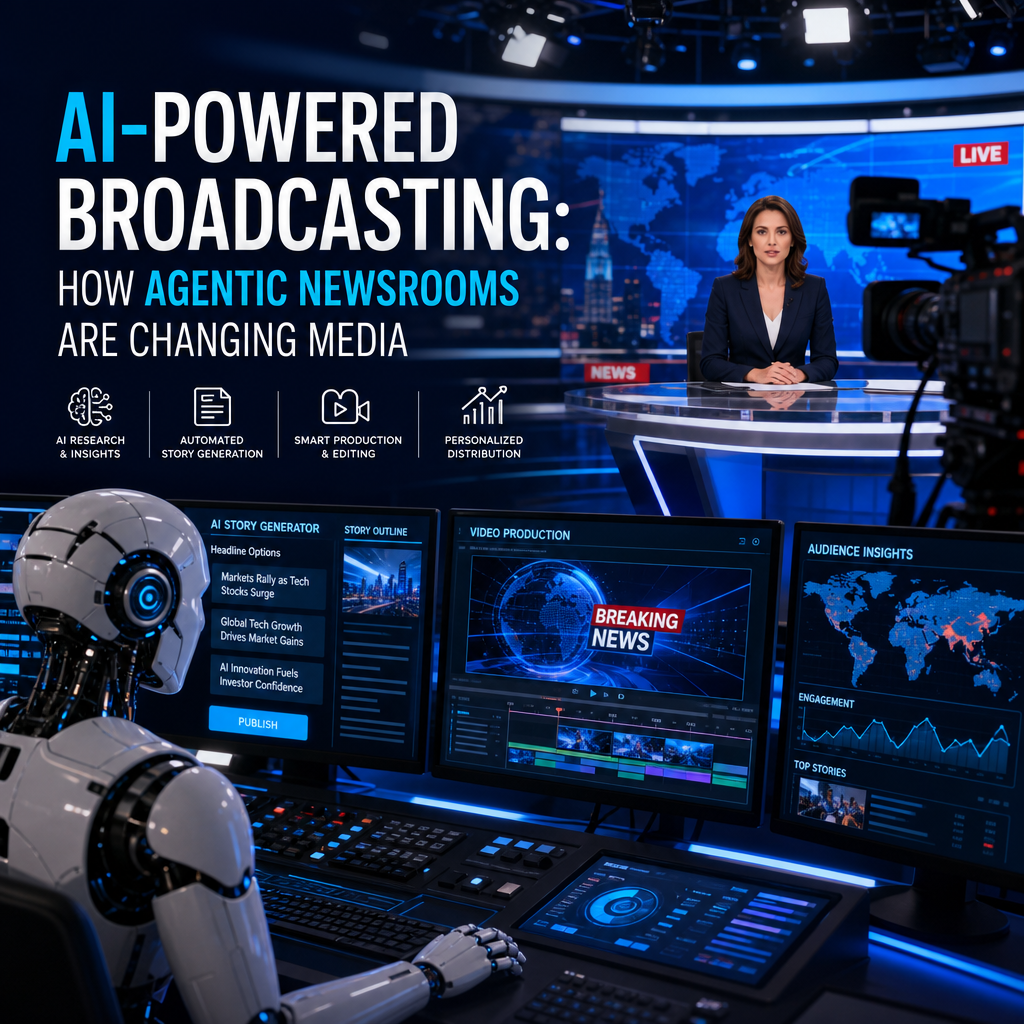
AI-Powered Broadcasting: How Agentic Newsrooms Are Changing Media
AI-Powered Broadcasting: How Agentic Newsrooms Are Changing Global Media
The media industry is entering a new era. AI-powered broadcasting is no longer a futuristic idea—it is becoming part of everyday newsroom operations. From automated story discovery to instant translation and real-time clip generation, AI is helping broadcasters move faster, reach wider audiences, and respond to news as it happens.
At the center of this shift is the agentic newsroom: a newsroom where AI systems do more than assist. They can observe, decide, and act within defined editorial rules. That means media teams are not just using AI for support tasks—they are building workflows where intelligent agents help shape how news is gathered, produced, and delivered.

What Is an Agentic Newsroom?
An agentic newsroom combines human editorial judgment with AI systems that can perform specific actions independently. These agents can monitor data streams, identify breaking stories, suggest headlines, generate summaries, and even adapt content for different platforms.

Unlike traditional automation, agentic systems are designed to handle more complex decision-making. They can:
- Track news feeds, social platforms, and public data in real time
- Flag emerging stories based on trends or anomalies
- Draft initial copy or video scripts
- Translate content for international audiences
- Personalize distribution across websites, apps, and social channels
Humans still remain in control, but the workflow becomes much faster and more scalable.

Why AI-Powered Broadcasting Matters
Global media now operates in a 24/7 attention economy. Audiences expect fast updates, clear context, and content in formats that suit their devices and languages. Traditional production models can struggle to keep up.
AI-powered broadcasting helps solve several challenges:
Speed
AI can process large amounts of information in seconds. This allows newsrooms to detect breaking developments early and publish updates faster than manual workflows alone.
Scale
A single story can be transformed into multiple formats: a written article, a short social clip, a podcast snippet, or a multilingual version for different regions. AI makes this kind of repurposing easier and more efficient.
Personalization
Not every audience wants the same level of detail. AI can help deliver different versions of a story based on user preferences, location, or platform behavior.
Global Reach
Machine translation and localization tools allow broadcasters to serve international viewers more effectively. This is especially important for major events, elections, climate coverage, and crisis reporting.
How Agentic Newsrooms Work in Practice
In a modern AI-enabled newsroom, the workflow often starts with monitoring. AI agents scan news wires, public databases, live video, and social trends to identify what may be important. When something unusual happens, the system alerts editors and suggests a possible angle.
From there, AI may help with early production tasks:
- Create a first draft of a news brief or script
- Summarize background context from trusted sources
- Generate captions or metadata for video assets
- Translate the piece into multiple languages
- Recommend publishing times based on audience activity
Editors then review, edit, and approve the final output. The result is a faster newsroom without removing human oversight.
Benefits for Global Media Organizations
For broadcasters with international audiences, the advantages are significant. AI-powered broadcasting can reduce production bottlenecks and help teams cover more ground with fewer delays.
More efficient workflows
Routine tasks like transcription, tagging, and clipping no longer consume as much staff time. That frees journalists to focus on investigation, interviews, and analysis.
Better live coverage
During breaking events, AI can assist with real-time captions, auto-generated summaries, and fast social updates. This improves accessibility and keeps viewers informed as events unfold.
Lower barriers to localization
Small and mid-sized media companies can now reach foreign audiences without building large translation teams. AI tools make multilingual publishing more practical.
Smarter audience engagement
By analyzing what people watch, click, and share, AI can help broadcasters understand audience interests and refine content strategy over time.
Risks and Editorial Responsibility
Despite the promise of AI-powered broadcasting, the risks are real. Newsrooms must manage issues like accuracy, bias, transparency, and accountability.
AI systems can misread context, repeat errors, or generate misleading text if they rely on poor data. There is also the danger of over-automation, where speed is prioritized over editorial care.
That is why strong newsroom governance matters. Successful agentic newsrooms need:
- Clear editorial standards
- Human review for sensitive or high-stakes content
- Source verification before publication
- Disclosure policies for AI-assisted content
- Training for journalists and editors
The goal is not to replace journalism. It is to make journalism more responsive, more efficient, and more accessible.
The Future of Global Broadcasting
As AI tools become more advanced, the line between production, distribution, and audience analysis will continue to blur. Newsrooms will increasingly use AI not only to create content, but also to decide what content is needed, where it should appear, and how it should be adapted.
This does not mean every media organization will look the same. Some will use AI for back-end efficiency, while others will build fully agentic workflows around breaking news, sports, finance, or international reporting.
What is clear is that AI-powered broadcasting is reshaping global media from the inside out. The news cycle is becoming faster, more dynamic, and more personalized. In that environment, the most successful media organizations will be the ones that combine machine intelligence with human editorial judgment.
Conclusion
Agentic newsrooms are changing how the world receives information. By automating repetitive tasks, expanding language reach, and accelerating production, AI-powered broadcasting is helping global media adapt to a more demanding digital landscape.
The future of broadcasting will not be defined by AI alone. It will be defined by how well media organizations use AI responsibly, creatively, and in service of better journalism.