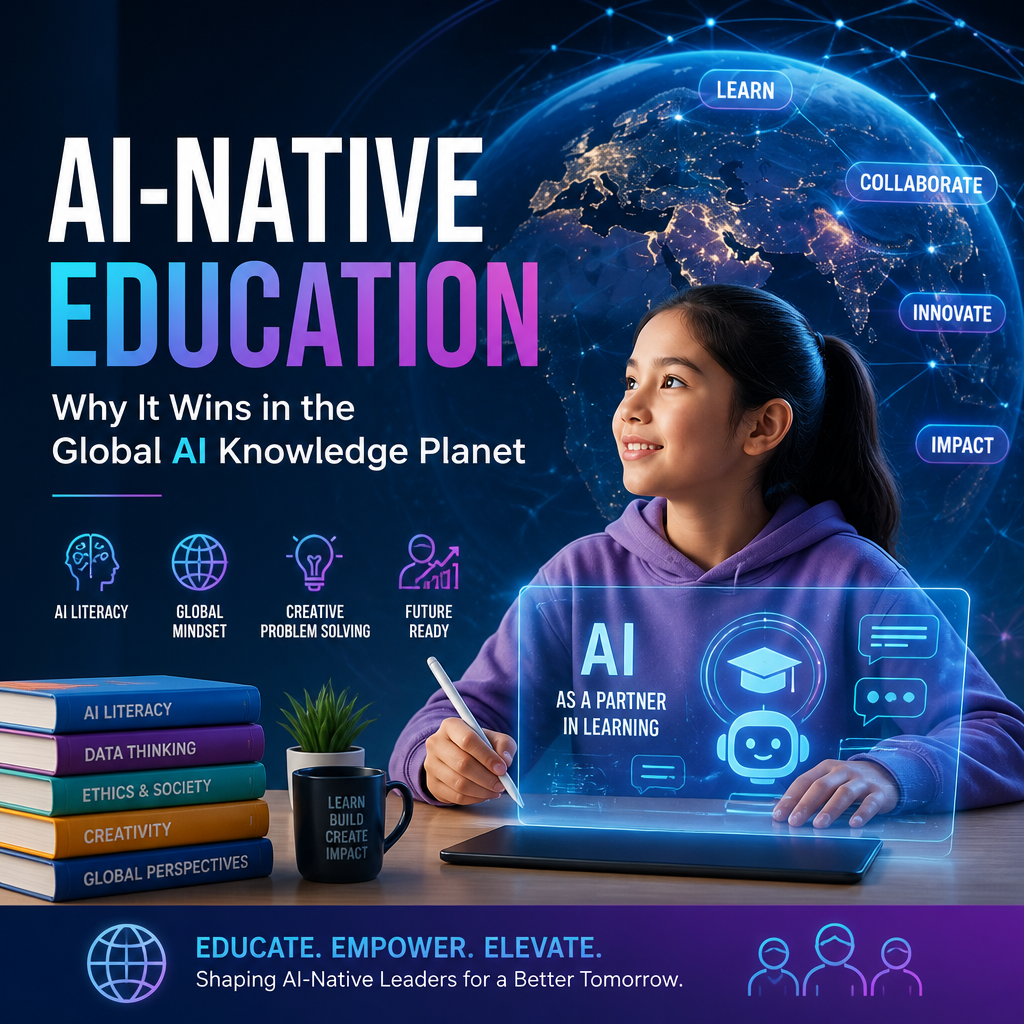
AI-Native Education: Why It Wins in the Global AI Knowledge Planet
The Global AI Knowledge Planet: Why AI‑Native Education Wins
Education is changing faster than ever. As AI tools become part of everyday work, learning is no longer just about memorizing facts or following a fixed syllabus. It is about building the ability to think, adapt, and create with intelligent systems.
That is where the Global AI Knowledge Planet comes in. It describes a world where knowledge is connected, updated in real time, and accessible across borders. In this environment, AI-native education stands out because it is designed for how people actually learn and work today.

What Is the Global AI Knowledge Planet?
The phrase may sound futuristic, but the idea is simple. We now live in a global learning ecosystem powered by data, digital platforms, and artificial intelligence. Information moves quickly. Industries evolve quickly. Skills that were valuable last year may be outdated next year.

In the Global AI Knowledge Planet, education is not locked inside a classroom or limited to a single textbook. Instead, it is:
- global in reach
- personalized to each learner
- always up to date
- connected to real-world problems
- supported by AI tools that help people learn faster
This shift changes what education needs to do. Traditional systems often move too slowly. AI-native education is built for speed, flexibility, and relevance.

Why Traditional Education Struggles to Keep Up
Traditional education still has value. It provides structure, discipline, and core knowledge. But it was designed for a different era. In many cases, it assumes that every student learns the same way, at the same pace, using the same materials.
That approach creates problems in today’s fast-moving world.
Common limitations of old models
- Static content: Lessons may become outdated before they reach learners.
- One-size-fits-all teaching: Students have different strengths, goals, and learning styles.
- Slow feedback: Learners often wait days or weeks to understand mistakes.
- Limited access: Quality education is still uneven across regions and income levels.
AI does not solve every problem, but it helps education become more responsive. That is why AI-native education is gaining momentum.
What Makes AI-Native Education Different?
AI-native education is not just education with a few AI tools added on top. It is a system built from the ground up to use AI as part of the learning process.
It adapts to the learner
AI can track how a student progresses and adjust the material accordingly. If someone struggles with a concept, the system can slow down and offer extra practice. If they already understand it, they can move ahead.
This creates a more efficient and less frustrating learning experience.
It delivers real-time support
Instead of waiting for a teacher to be available, learners can get instant help from AI tutors, assistants, and feedback systems. This makes learning more continuous and less dependent on a fixed schedule.
It connects learning to real use
AI-native education can simulate workplaces, solve case studies, and personalize projects based on a learner’s goals. A student studying marketing, for example, can practice with AI-generated campaigns. A student learning coding can debug in real time with guidance.
This turns theory into action.
Why AI-Native Education Wins
The reason AI-native education wins is not because it replaces teachers. It wins because it improves how humans learn, teach, and apply knowledge.
1. It is more personalized
Every learner is different. AI helps education move beyond averages and into tailored learning paths. That means better engagement and stronger outcomes.
2. It is more scalable
A single AI-powered platform can support thousands or even millions of learners at once. This matters in a global knowledge economy where access is a major issue.
3. It is more current
AI-native systems can update content quickly as industries change. Learners stay closer to what is happening in the real world.
4. It encourages lifelong learning
In the Global AI Knowledge Planet, learning does not end with a diploma. People need to reskill and upskill throughout their careers. AI-native education makes that process easier, faster, and more practical.
5. It supports teachers
AI can handle repetitive tasks like grading, summarizing, or generating practice exercises. This gives teachers more time to focus on mentorship, creativity, and deeper discussion.
The Human Advantage Still Matters
Even in an AI-driven world, education remains deeply human. Curiosity, empathy, judgment, and creativity are not things machines can replace. The best educational systems will combine AI efficiency with human wisdom.
That means teachers become more important, not less. Their role shifts from information delivery to coaching, guiding, and helping students think critically about what AI produces.
This balance is essential. The future is not about choosing between people and machines. It is about building learning systems where both work together.
Looking Ahead
The Global AI Knowledge Planet is already here. Students are using AI to study smarter. Professionals are using AI to learn new skills faster. Organizations are building training systems that respond to changing needs in real time.
In this new world, AI-native education wins because it matches the pace of change. It is flexible, personalized, scalable, and practical. Most importantly, it prepares people not just to consume knowledge, but to use it well.
The future of education belongs to systems that can evolve as fast as the world around them. AI-native education is doing exactly that.