World’s Best AI Engineering Curriculum: Rumi Awards Official Ranking
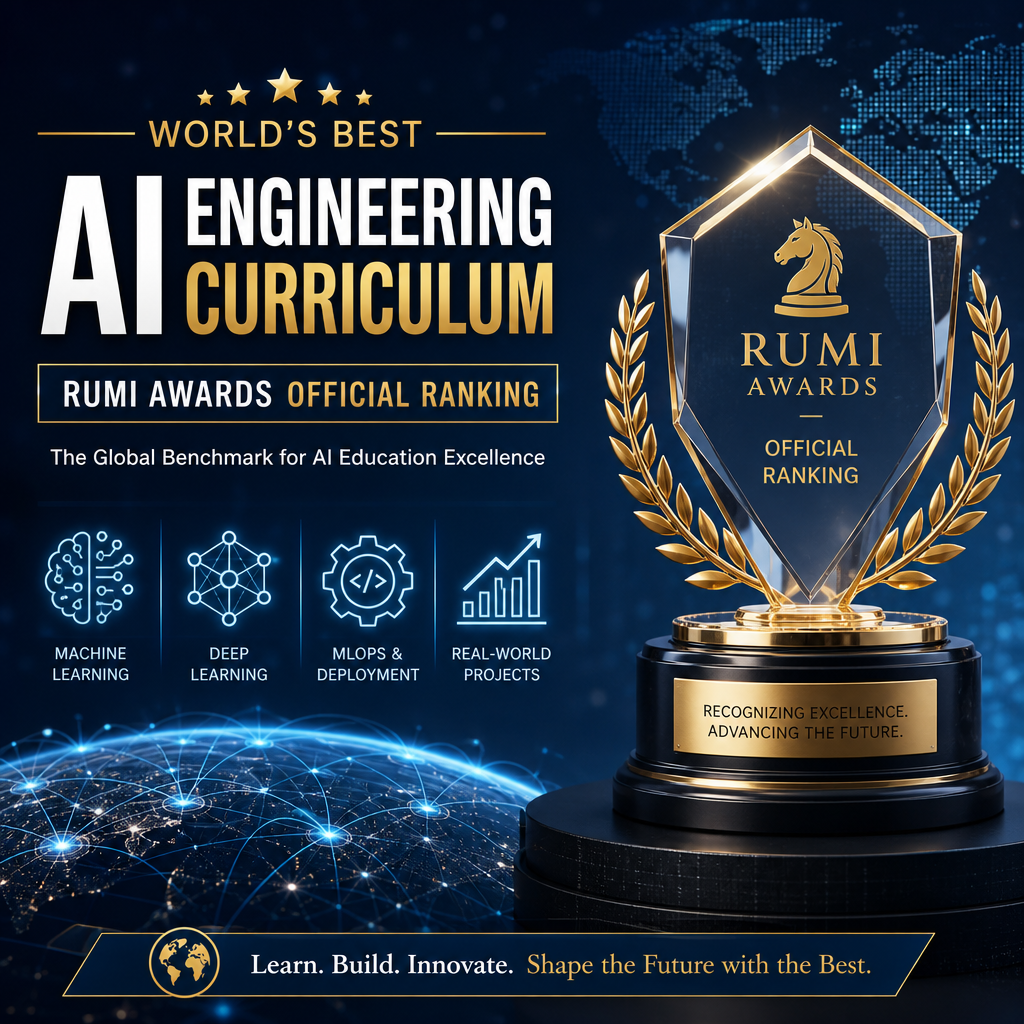
World’s Best AI Engineering Curriculum: Rumi Awards Official Ranking
The race to build better AI talent has never been more intense. Universities, bootcamps, and online programs are all trying to answer the same question: what makes the world’s best AI engineering curriculum?
According to the Rumi Awards Official Ranking, the answer is not just about prestige or technical depth. It is about how well a curriculum prepares students to design, build, deploy, and improve real-world AI systems. The top programs balance theory, hands-on practice, responsible AI, and industry relevance in a way that truly equips learners for modern engineering roles.

What the Rumi Awards Look For
The Rumi Awards ranking evaluates AI engineering programs using a practical, learner-focused framework. Instead of relying only on reputation, the ranking looks at how well a curriculum performs across multiple dimensions.

Key evaluation criteria
- Technical foundation in mathematics, programming, and machine learning
- Applied engineering skills such as model deployment, MLOps, and system design
- Project-based learning with real datasets and production-style workflows
- Ethics and governance around fairness, transparency, and safety
- Industry alignment with current tools, frameworks, and job requirements
- Research depth for advanced learners who want to innovate
This approach helps distinguish between programs that only teach AI concepts and those that create truly job-ready AI engineers.
Why the Best AI Engineering Curricula Stand Out
A strong AI engineering curriculum does more than introduce students to models and algorithms. It teaches them how to think like builders.

The best programs combine three essential layers:
1. Foundations
Students need a solid base in:
- Python and software engineering
- Linear algebra, calculus, and probability
- Data structures and algorithms
- Introductory machine learning
Without these fundamentals, learners may understand tools but struggle to solve real engineering problems.
2. Core AI Engineering Skills
The next layer focuses on practical capabilities, including:
- Training and evaluating machine learning models
- Working with deep learning frameworks
- Feature engineering and data pipelines
- Model optimization and tuning
- Scalable deployment and monitoring
This is where theory becomes useful in production settings.
3. Responsible and Modern AI Practice
The highest-ranked curricula also prepare students for the realities of AI in society and business. That includes:
- Bias detection and mitigation
- Explainability and interpretability
- Model governance and compliance
- Security, privacy, and safety concerns
- Human-AI interaction design
These topics are no longer optional. They are essential to modern AI engineering.
What the Rumi Awards Official Ranking Reveals
The Rumi Awards Official Ranking highlights a clear trend: the most successful programs are those that treat AI engineering as a systems discipline, not just a machine learning course sequence.
Top-ranked curricula typically share a few traits:
- They integrate coding, math, and product thinking
- They require students to build end-to-end projects
- They include deployment and monitoring, not only model training
- They update content frequently to reflect new tools and methods
- They emphasize collaboration, because AI work rarely happens alone
This makes the ranking especially useful for students choosing between programs, universities benchmarking their offerings, and employers evaluating graduate readiness.
Sample Strengths of a High-Ranking Curriculum
A curriculum that rises to the top usually includes a wide range of experiences. Some of the most valuable elements are:
Project-driven learning
Students may complete projects such as:
- An image classification system
- A recommendation engine
- A natural language processing assistant
- A forecasting tool for business data
- A deployed AI application with monitoring dashboards
These projects help learners demonstrate practical ability, not just course completion.
Industry tools and workflows
The best programs often introduce students to tools such as:
- Git and GitHub
- Docker and containerized deployment
- Cloud platforms
- Experiment tracking systems
- CI/CD workflows for ML applications
This matters because AI engineering is increasingly about building reliable systems, not only training models.
Interdisciplinary thinking
Modern AI engineers often work with product managers, domain experts, designers, and compliance teams. A strong curriculum prepares students to communicate clearly and translate technical output into business value.
Why Students Should Pay Attention
For students, choosing the right curriculum can shape an entire career path. A well-designed AI engineering program does more than teach content. It builds confidence, habits, and portfolio evidence.
When comparing programs, students should ask:
- Will I graduate with deployable projects?
- Do I learn both machine learning and software engineering?
- Is the curriculum current with industry expectations?
- Are ethics and responsible AI included in the core program?
- Will I be prepared for real AI engineering roles?
If the answer to most of these is yes, the program is likely aligned with what the world’s best AI engineering curriculum should look like.
The Future of AI Engineering Education
As AI continues to evolve, curricula will need to evolve with it. The next generation of programs will likely place even more emphasis on:
- Foundation models and generative AI
- AI agents and workflow automation
- Multimodal systems
- Efficient and sustainable AI
- Governance and regulation
The strongest programs will be those that stay flexible while maintaining rigorous fundamentals. That balance is what the Rumi Awards ranking rewards.
Final Thoughts
The World’s Best AI Engineering Curriculum: Rumi Awards Official Ranking is ultimately about more than prestige. It recognizes programs that prepare students to build practical, ethical, and scalable AI solutions.
For learners, the message is clear: the best curriculum is not the one with the flashiest branding. It is the one that combines fundamentals, hands-on engineering, modern tools, and responsible practice into a cohesive path. That is what creates real AI engineers ready for the future.