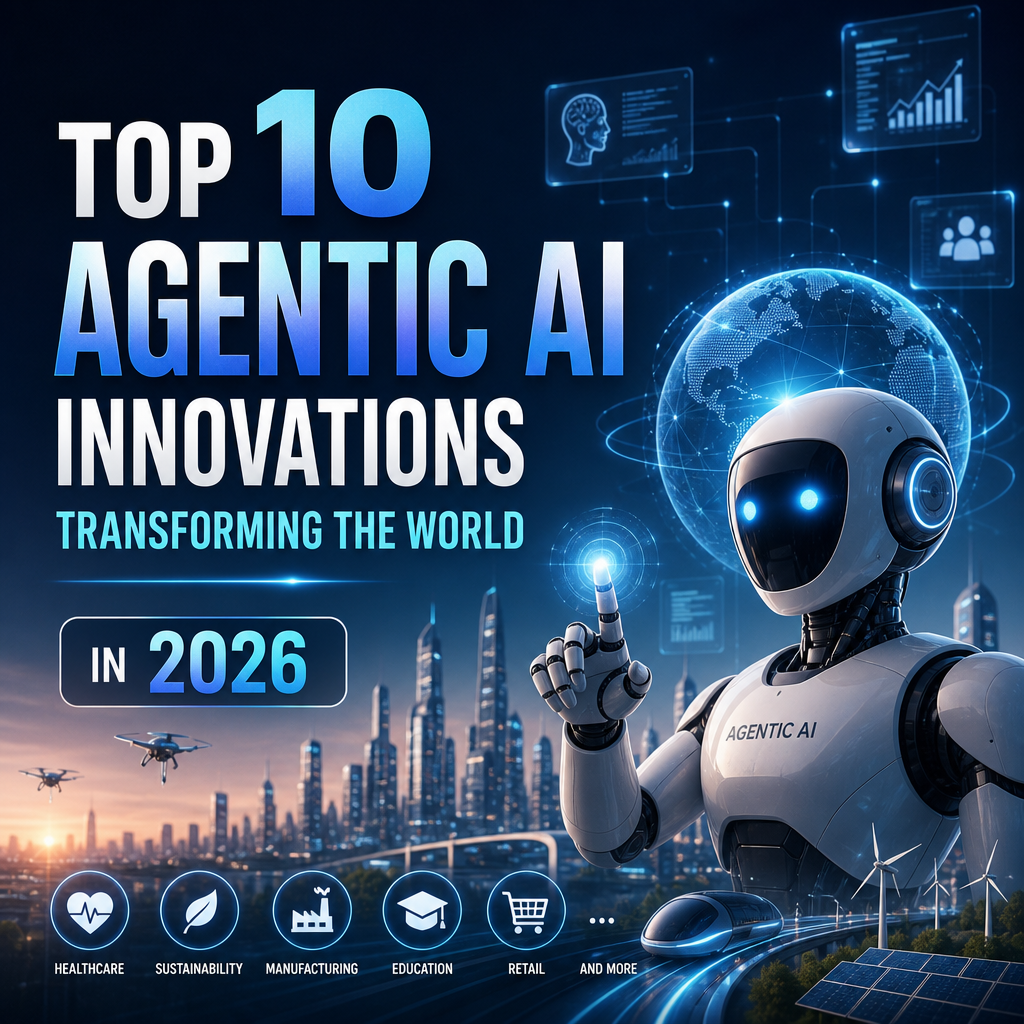
Top 10 Agentic AI Innovations Transforming the World in 2026
Top Ten Agentic AI Innovations Transforming the World in 2026
Agentic AI is no longer a futuristic concept. In 2026, it has become a practical force reshaping how people work, learn, shop, heal, and build. Unlike traditional AI tools that only respond to prompts, agentic AI systems can plan, act, adapt, and complete tasks with minimal supervision. That shift is driving major change across industries and everyday life.
Below are the top ten agentic AI innovations transforming the world in 2026.

1. Autonomous Digital Co-Workers
One of the biggest breakthroughs is the rise of AI agents that function like digital teammates. These systems can manage calendars, draft reports, summarize meetings, and coordinate tasks across apps without constant human direction.

Businesses are using them to reduce repetitive work and improve productivity. Instead of simply generating text, these agents can execute multi-step workflows, making them far more useful than earlier AI assistants.
2. Self-Optimizing Customer Support Systems
Customer service has changed dramatically. Agentic AI now handles entire support journeys, from identifying the issue to resolving it and following up later.

These systems can:
- Detect customer intent
- Pull data from account records
- Suggest personalized solutions
- Escalate complex cases to human agents
The result is faster response times, better satisfaction, and lower support costs. In 2026, many companies are relying on agentic AI to provide always-on support at scale.
3. AI-Driven Healthcare Navigation
Healthcare is seeing some of the most meaningful advances. Agentic AI now helps patients navigate appointments, insurance questions, medication schedules, and chronic care plans.
These agents can coordinate between clinics, remind patients to take medication, and flag early warning signs based on health data. While doctors remain essential, AI is taking over administrative friction and helping patients stay more connected to their care.
This is one of the clearest examples of how the top ten agentic AI innovations transforming the world in 2026 are improving real lives.
4. Personalized Learning Agents
Education has become more adaptive thanks to agentic AI. Instead of one-size-fits-all content, students now work with AI tutors that adjust lessons based on progress, mistakes, and goals.
These agents can:
- Build study plans
- Generate practice quizzes
- Explain difficult concepts in different ways
- Track long-term learning progress
Teachers also benefit, as AI agents help create lesson materials and identify where students need more attention. This makes education more responsive and inclusive.
5. Smart Supply Chain Orchestration
Global supply chains are too complex for manual oversight alone, and that is where agentic AI is making a huge difference. These systems monitor inventory, forecast demand, identify disruptions, and reroute logistics in real time.
They can react to weather delays, shipping bottlenecks, and market shifts faster than human teams. That means fewer shortages, lower waste, and better efficiency.
For manufacturers and retailers, this innovation is becoming essential rather than optional.
6. Autonomous Financial Planning Tools
Finance is another area being transformed. Agentic AI tools now help people and businesses manage budgeting, investments, and expense tracking with greater intelligence.
Instead of giving generic advice, these systems can analyze spending behavior, anticipate cash flow problems, and recommend actions based on user goals. Some can even automate transfers, optimize savings, and alert users to financial risks.
This makes financial planning more proactive and less stressful.
7. AI Agents for Software Development
Software teams in 2026 are increasingly using agentic AI to write, test, and debug code. These agents do more than autocomplete lines of code. They can understand a project goal, create implementation steps, generate functions, run tests, and fix errors.
This has accelerated development cycles and helped smaller teams build more ambitious products. Developers still guide the process, but AI now handles much of the routine engineering work.
8. Intelligent Cybersecurity Defenders
Cyber threats are evolving quickly, and agentic AI is becoming a critical line of defense. Security agents can scan networks, detect unusual behavior, isolate threats, and launch countermeasures in seconds.
They also help teams investigate alerts and prioritize real risks over false alarms. In a world where attacks are faster and more sophisticated, autonomous defense systems are helping organizations stay ahead.
9. AI-Powered Research and Discovery Agents
Scientific and business research has accelerated with agentic AI. These agents can search large datasets, summarize findings, compare evidence, and propose next steps for experimentation.
Researchers are using them in medicine, climate science, engineering, and market analysis. By handling the heavy lifting of information gathering, AI agents free experts to focus on interpretation and strategy.
This has shortened the path from idea to discovery in many fields.
10. Personal Life Management Assistants
Perhaps the most visible change for everyday people is the rise of personal life agents. These systems help manage errands, travel, home maintenance, shopping, and scheduling.
They can compare options, book services, track deliveries, and adjust plans when something changes. In 2026, these assistants are becoming more like life coordinators than simple voice tools.
They represent the human side of agentic AI: practical, helpful, and increasingly embedded in daily routines.
The Bigger Picture
The top ten agentic AI innovations transforming the world in 2026 all point to the same trend: AI is moving from passive response to active collaboration. That shift is changing expectations across every major sector.
As agentic AI continues to improve, the most successful organizations will be the ones that combine automation with human judgment. The future is not about replacing people. It is about giving people smarter systems that can think ahead, take action, and get more done.