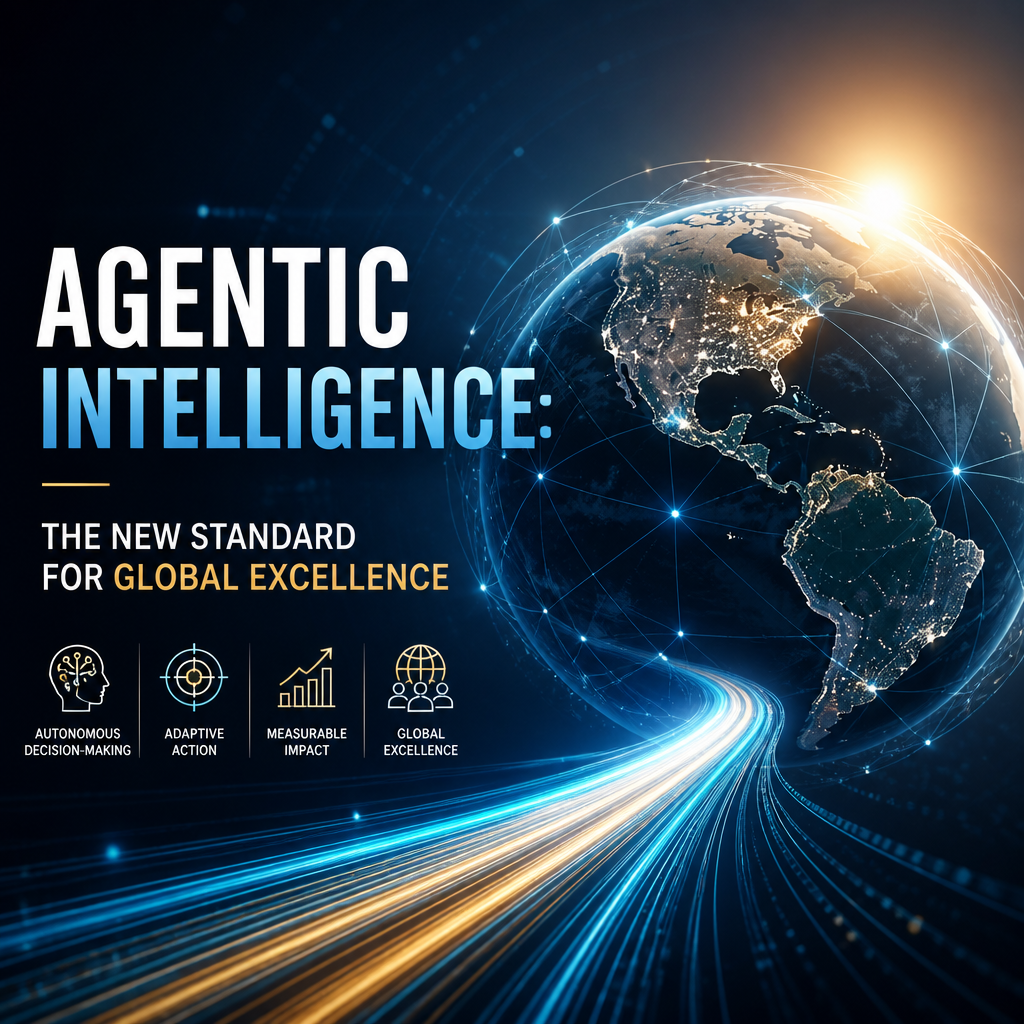
Agentic Intelligence: The New Standard for Global Excellence
The Rise of Agentic Intelligence: The New Standard for Global Excellence
For years, organizations around the world have talked about digital transformation, automation, and artificial intelligence as separate goals. Today, those ideas are converging into something more powerful: agentic intelligence. This emerging model is changing how businesses operate, how decisions are made, and how global standards of excellence are defined.
Unlike traditional systems that simply respond to commands, agentic intelligence is built to act with purpose. It can evaluate context, make decisions, adapt to changing conditions, and pursue goals with far less human intervention. That shift is not just technical. It is strategic.

What Is Agentic Intelligence?
Agentic intelligence refers to AI systems that behave more like proactive agents than passive tools. Instead of waiting for direct instructions at every step, they can:

- Understand goals and constraints
- Break down tasks into actions
- Learn from outcomes
- Adjust behavior based on new information
- Work across systems and processes independently
This makes them especially valuable in environments where speed, scale, and accuracy matter. From logistics and customer service to finance and product development, agentic systems can manage complexity in ways older automation models cannot.
The rise of agentic intelligence is not about replacing human judgment. It is about extending human capability and enabling teams to focus on higher-value work.

Why It Matters Now
Several forces are driving the rapid adoption of agentic intelligence. Global competition is increasing, customer expectations are rising, and companies are under pressure to do more with less. At the same time, digital ecosystems are becoming more interconnected and data-rich.
In this environment, organizations need systems that can respond in real time and support decisions at scale. Agentic intelligence offers that flexibility.
Key advantages include:
- Faster decision-making through continuous analysis and action
- Greater efficiency by reducing repetitive manual work
- Improved adaptability in dynamic markets
- Scalable operations across regions and time zones
- Higher-quality outcomes through continuous learning and optimization
This combination is why many experts see agentic intelligence as more than a trend. It is becoming a new operating standard.
A New Standard for Global Excellence
Global excellence has long been associated with consistency, quality, innovation, and trust. In the age of agentic intelligence, those standards are being redefined.
An excellent organization today is not only one that delivers reliable results. It is one that can:
- Anticipate needs before they become problems
- Coordinate complex workflows across borders
- Personalize experiences at scale
- Maintain performance under changing conditions
- Improve continuously through feedback loops
Agentic intelligence supports all of these goals. It gives organizations the ability to move from reactive problem-solving to proactive execution. That shift is what makes it a true standard for global excellence.
From automation to autonomy
Traditional automation works well for predictable, repetitive tasks. But modern businesses rarely operate in predictable environments. Markets shift, supply chains break, customer demands evolve, and regulations change.
Agentic systems go beyond automation by introducing autonomy with oversight. They can handle variation, assess options, and choose actions aligned with broader objectives. This makes them especially effective in global operations where complexity is constant.
Real-World Impact Across Industries
The practical uses of agentic intelligence are already visible across sectors.
In healthcare, agentic systems can help coordinate care, flag risks, and streamline administrative work.
In manufacturing, they can optimize production schedules, predict maintenance needs, and reduce downtime.
In finance, they can assist with fraud detection, compliance monitoring, and real-time risk analysis.
In retail and e-commerce, they can personalize recommendations, manage inventory, and improve customer support.
In professional services, they can support research, reporting, scheduling, and workflow management.
These examples show that agentic intelligence is not limited to one industry or function. It is a versatile capability that can strengthen performance wherever decisions and actions need to happen quickly.
Challenges That Must Be Managed
As powerful as it is, agentic intelligence also raises important questions. The more autonomy a system has, the more carefully it must be designed and governed.
Organizations must consider:
- Data privacy and security
- Transparency in decision-making
- Ethical boundaries
- Human oversight and accountability
- Bias prevention and model reliability
The goal is not to build systems that operate without supervision. The goal is to create intelligent agents that act responsibly within clear limits. Excellence depends not only on performance, but also on trust.
The Future Belongs to Adaptive Organizations
The rise of agentic intelligence signals a larger change in how organizations compete and grow. Success will increasingly belong to those that can combine human insight with intelligent systems capable of action.
This does not mean every process should be fully autonomous. It means the best organizations will know where to apply agentic intelligence for maximum value. They will use it to augment talent, streamline operations, and create more responsive, resilient systems.
In that sense, agentic intelligence is more than a technological advance. It is a new foundation for excellence on a global scale.
The organizations that embrace it early will not only work faster. They will work smarter, adapt more effectively, and set a higher standard for what excellence looks like in a connected world.