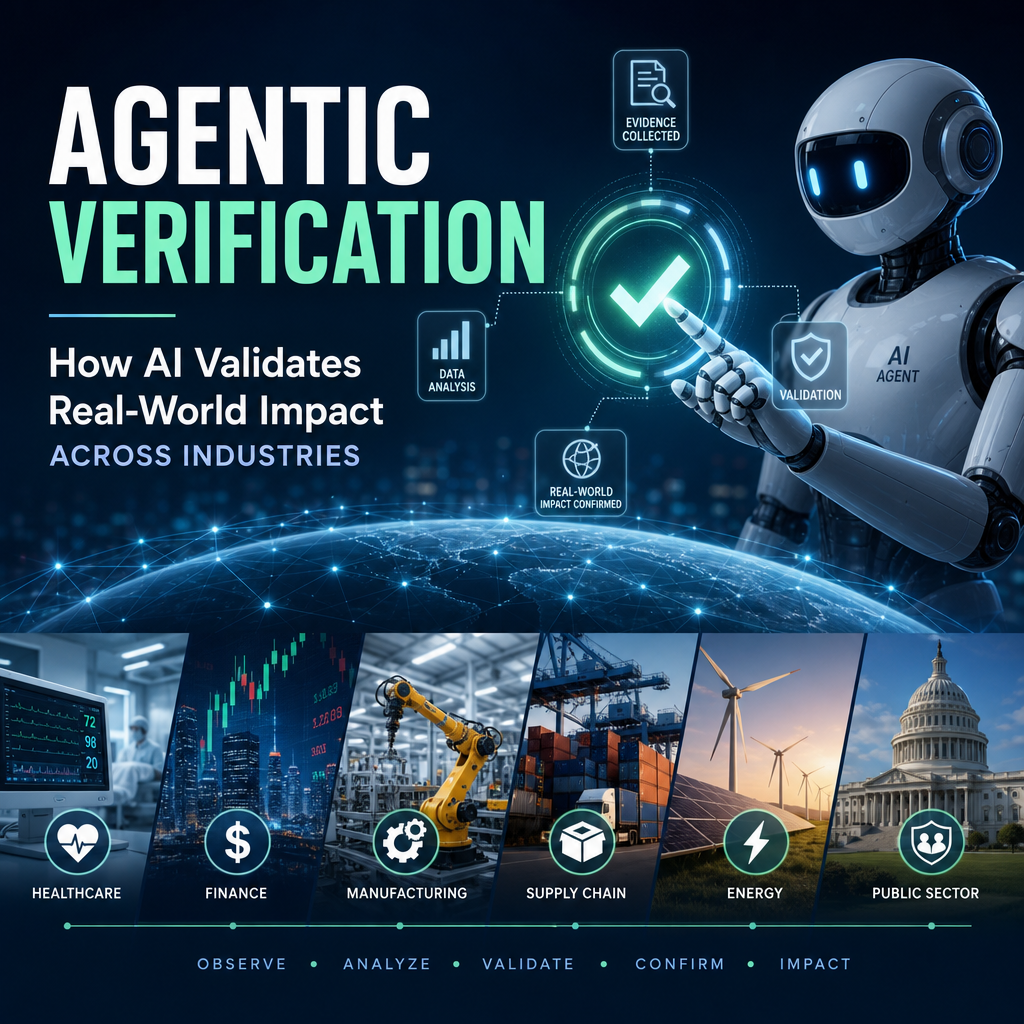
Agentic Verification: How AI Validates Real-World Impact Across Industries
The Rise of Agentic Verification: How AI Validates Real-World Impact Across Industries
AI is no longer limited to generating content, summarizing data, or automating routine tasks. A new capability is emerging that goes one step further: agentic verification. Instead of simply producing answers, AI systems are beginning to check whether those answers reflect real-world outcomes, business results, and measurable impact.
This shift matters because many organizations are moving from “Can AI do the task?” to “Can AI prove the task worked?” Agentic verification is helping close that gap.

What Is Agentic Verification?
Agentic verification is the use of autonomous or semi-autonomous AI systems to validate whether an action, decision, or process has delivered the intended result. In simple terms, it means AI does not just act—it also checks the evidence.

That evidence can come from:
- live operational data
- sensor readings
- transaction logs
- customer feedback
- system performance metrics
- compliance records
The goal is to create a loop where AI can observe, judge, and refine outcomes in near real time.

Unlike traditional analytics, which often look backward, agentic verification can operate continuously. It can monitor whether a change is working, identify anomalies, and flag when results diverge from expectations.
Why It Matters Now
The rise of AI-generated decisions has created a new challenge: trust. Businesses may automate more processes, but they still need confidence that those systems are producing reliable, measurable value.
Agentic verification helps answer questions like:
- Did the marketing campaign actually increase conversions?
- Did the maintenance alert prevent equipment failure?
- Did the recommendation improve customer satisfaction?
- Did the policy change reduce risk without creating new problems?
As AI systems become more autonomous, verification becomes just as important as execution. In many industries, the real advantage will not come from acting faster alone, but from proving impact faster.
How It Works in Practice
Agentic verification usually combines three layers:
1. Action
An AI system executes a task or recommendation, such as routing support tickets, adjusting inventory, or suggesting treatment pathways.
2. Observation
The system then monitors relevant signals. These may include key performance indicators, event logs, outcome data, or human feedback.
3. Validation
Finally, the AI evaluates whether the outcome matches the expected result. If it does not, it can alert a human, adjust its model, or trigger a new action.
This creates a closed-loop process that is especially powerful in dynamic environments where conditions change quickly.
Industry Examples
Agentic verification is gaining traction across a wide range of sectors.
Healthcare
In healthcare, AI can help verify whether a care recommendation improved patient outcomes. For example, a system may track whether a follow-up intervention reduced readmissions or improved medication adherence. This does not replace clinical judgment, but it gives providers better evidence for decision-making.
Manufacturing
Factories are already using AI to monitor machine performance and quality control. Agentic verification can take this further by confirming whether a process adjustment actually reduced defects, downtime, or waste. If a fix fails, the system can detect that quickly and escalate.
Finance
Financial institutions need strong controls around fraud, compliance, and risk. AI can verify whether alerts were accurate, whether a rule change reduced false positives, or whether a portfolio strategy behaved as intended under changing market conditions.
Retail and E-commerce
Retailers can use agentic verification to test whether promotions, pricing changes, or recommendation engines really improved sales and customer retention. Instead of relying on assumptions, teams can measure whether AI-driven actions led to meaningful business impact.
Logistics
In supply chains, AI can verify whether route changes saved time, whether inventory predictions matched demand, and whether operational shifts improved delivery performance. The result is more accountability across the network.
The Benefits of Verification-First AI
Agentic verification offers several practical advantages:
- Higher trust: Teams can see whether AI decisions produce real outcomes.
- Faster iteration: Systems can learn and adjust more quickly.
- Better accountability: Results are easier to trace and justify.
- Reduced waste: Failed actions can be caught before they spread.
- Improved compliance: Verified evidence supports audits and reporting.
These benefits are especially valuable in environments where mistakes are expensive or where regulators require proof, not just predictions.
Challenges to Watch
Despite its promise, agentic verification is not without risks. AI can only validate what it can measure, and many outcomes are messy, delayed, or influenced by factors outside the system.
Some common challenges include:
- incomplete or poor-quality data
- unclear success metrics
- false confidence from automated checks
- bias in the verification model
- privacy and governance concerns
For that reason, agentic verification should be designed with human oversight. People still need to define what “good” looks like, interpret ambiguous results, and manage exceptions.
The Future of AI Validation
As AI becomes more embedded in daily operations, verification will become a core feature rather than an add-on. The next generation of intelligent systems will likely be judged not only by what they can do, but by how well they can confirm impact in the real world.
That could mean AI tools that continuously test business hypotheses, audit their own outputs, or adapt based on verified performance. In other words, AI will become less about producing confident answers and more about delivering accountable outcomes.
Final Thoughts
The rise of agentic verification marks an important evolution in how organizations use AI. It shifts the focus from automation for its own sake to measurable, evidence-based impact. Across industries, this approach is helping teams move faster, reduce uncertainty, and make smarter decisions with greater confidence.
As AI systems grow more powerful, the ability to verify real-world results may become one of their most valuable features.