
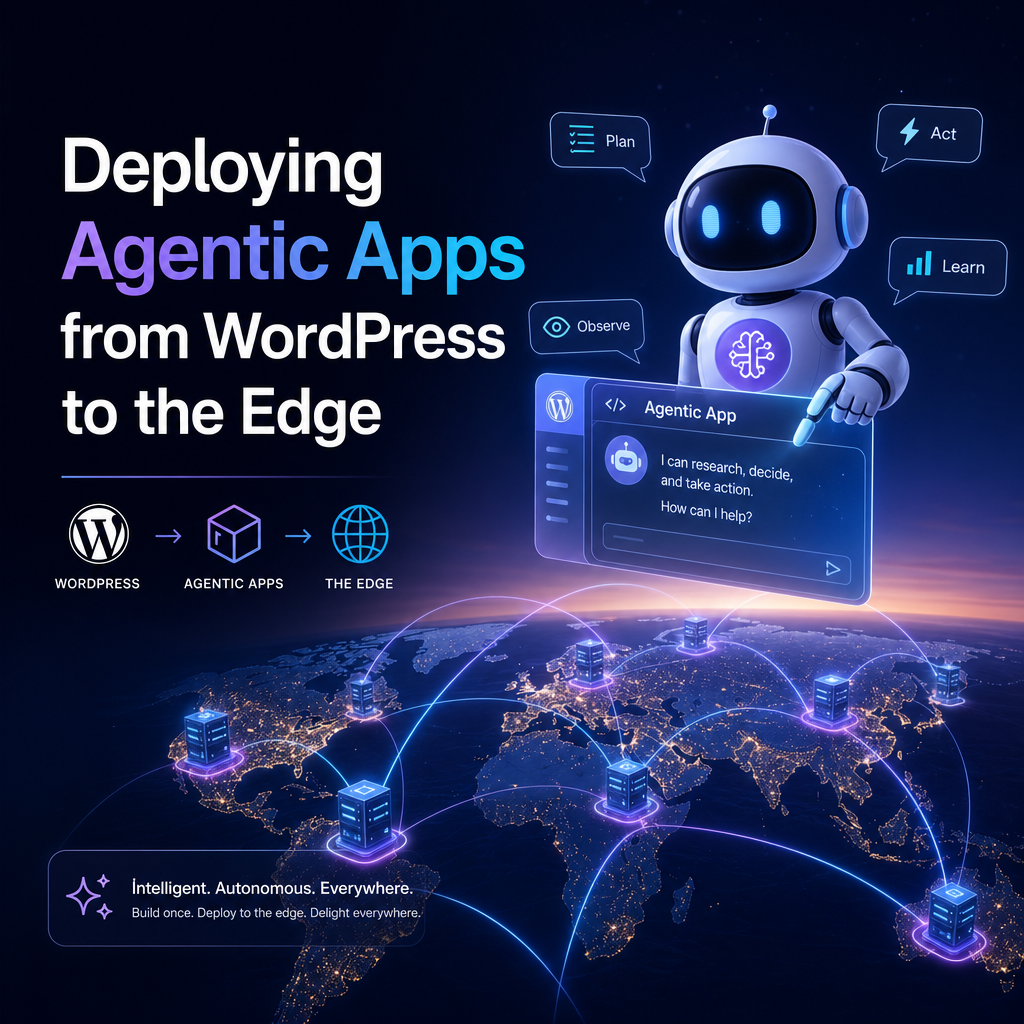
Deploying Agentic Apps from WordPress to the Edge
From WordPress to the Edge: Deploying Agentic Apps Across WPaiCloud and EdgeCloudAI
The shift from traditional websites to intelligent, autonomous applications is changing how teams build for the web. WordPress is no longer just a publishing platform—it can now serve as the front door for agentic experiences that respond, adapt, and act on behalf of users. When combined with edge infrastructure, these apps become faster, more resilient, and more scalable.
From WordPress to the Edge: Deploying Agentic Apps Across WPaiCloud and EdgeCloudAI is more than a technical migration path. It’s a practical way to deliver AI-powered functionality closer to users while keeping WordPress at the center of content and control.

Why agentic apps need the edge
Agentic apps do more than display information. They make decisions, trigger workflows, call APIs, and personalize responses in real time. That means latency matters.

If an app must wait on a distant server for every action, the experience can feel slow and brittle. The edge solves that by moving compute closer to the user. With EdgeCloudAI, workloads like inference, routing, caching, and event-driven tasks can run near the request source, reducing delays and improving reliability.
This is especially useful for:

- AI chat assistants embedded in WordPress pages
- Personalized product recommenders
- Workflow agents that summarize, classify, or route requests
- Real-time content adaptation based on user behavior
The role of WPaiCloud in the stack
WPaiCloud acts as the WordPress-friendly layer for deploying intelligent experiences without forcing teams to abandon their existing CMS workflows. It gives developers and site owners a way to connect WordPress content, plugins, and user interactions to AI-driven automation.
Instead of treating WordPress as a static CMS, WPaiCloud helps turn it into an orchestration layer. Content stays manageable in the dashboard, while agentic logic can live in connected services.
That separation is powerful. It lets editorial teams keep working in WordPress while technical teams deploy smart functions through cloud and edge infrastructure.
A practical deployment model
A modern agentic architecture often works best when responsibilities are split across layers.
1. WordPress handles content and interaction
WordPress remains the primary interface for:
- Pages and posts
- Forms and user input
- Membership or ecommerce data
- Theme rendering and editorial workflows
It is the system of record for content and a familiar interface for administrators.
2. WPaiCloud manages AI-enabled coordination
WPaiCloud can bridge WordPress with external AI services, APIs, and automation logic. This layer may:
- Enrich content with AI-generated metadata
- Trigger agent workflows from form submissions
- Pass structured events to edge functions
- Store configuration for AI-powered features
3. EdgeCloudAI executes near the user
EdgeCloudAI is where latency-sensitive tasks happen. This can include:
- Fast model inference
- Session-aware personalization
- API aggregation
- Lightweight decision-making
- Response caching and rate limiting
By pushing these tasks to the edge, the app remains responsive even under load.
Benefits of separating WordPress and edge logic
One of the biggest advantages of this model is flexibility. You are not locking AI features into a monolithic backend.
Better performance
Edge execution reduces round-trip time, which is especially valuable for interactive features like chat, search, and recommendations.
Improved scalability
Because edge functions handle many tasks locally, the origin server experiences less pressure. WordPress can focus on content delivery instead of processing every AI request.
Easier maintenance
Teams can update AI workflows without rewriting the entire WordPress site. That makes it simpler to evolve features over time.
Stronger resilience
If one service slows down, the rest of the stack can continue functioning. Caching and fallback logic at the edge help keep the experience stable.
Use cases that work well
Not every feature needs an agent, but some use cases benefit immediately from this architecture.
Smart support assistants
A WordPress knowledge base can power an assistant that answers user questions in real time. The edge handles request routing, while WPaiCloud connects the assistant to approved content sources.
Personalized landing pages
Visitor behavior can influence the content shown on a page. Edge logic can adjust headlines, calls to action, or product blocks based on location, referral source, or session history.
Automated content workflows
Editors can generate summaries, tags, or alternate versions of content directly from WordPress, with heavy processing handled off-site.
Ecommerce automation
Product suggestions, cart recovery, and intent-based offers can all be improved by edge-based AI decisions.
Best practices for deployment
To make the stack work well, keep a few principles in mind:
- Keep WordPress lightweight: avoid putting heavy AI processing inside the CMS itself.
- Use clear API contracts: define how WordPress, WPaiCloud, and EdgeCloudAI communicate.
- Cache aggressively: cache repeatable responses at the edge whenever possible.
- Secure every layer: authenticate requests and limit which services can trigger agent actions.
- Monitor performance: track latency, error rates, and model behavior across the stack.
A thoughtful deployment is usually more important than the choice of model or framework.
The bigger picture
The future of WordPress is not limited to pages and posts. It is becoming a flexible entry point for intelligent systems that can act, adapt, and scale across environments.
By pairing WPaiCloud with EdgeCloudAI, teams can extend WordPress into a modern application platform without losing the content management strengths that made it popular in the first place.
For businesses building agentic apps, the lesson is simple: keep WordPress where it shines, move intelligence where it performs best, and let the edge carry the speed.
That’s how you deploy from WordPress to the edge with confidence.