
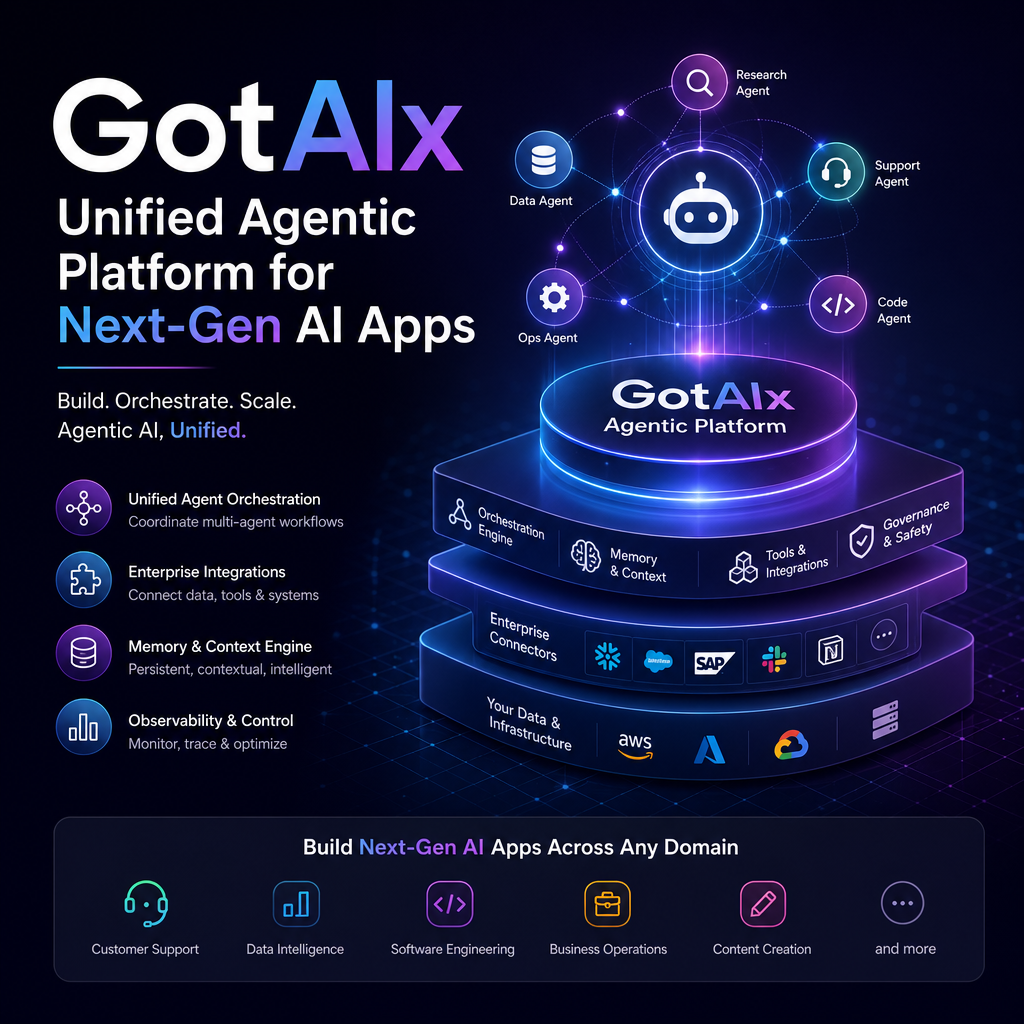
GotAIx: Unified Agentic Platform for Next-Gen AI Apps
GotAIx: The Unified Agentic Platform Powering the Next Generation of AI Apps
AI apps are evolving fast. What used to be simple chat interfaces or single-purpose automations is now becoming something much more powerful: agentic systems that can reason, plan, use tools, and complete tasks across workflows. That shift creates a new challenge for builders. How do you design AI applications that are flexible, scalable, and actually useful in production?
That is where GotAIx comes in.

GotAIx is emerging as a unified agentic platform designed to help teams build the next generation of AI apps without stitching together dozens of disconnected tools. Instead of treating AI as a feature layered onto an app, GotAIx supports a more complete approach: agents, workflows, orchestration, integrations, and execution in one place.

Why Agentic AI Needs a Unified Platform
Traditional AI applications often rely on a single model call. A user asks a question, the system returns an answer, and the interaction ends there.
Agentic AI is different.

An agent can:
- break a task into steps
- choose the right tools
- retrieve information from multiple sources
- adapt based on results
- carry a process through to completion
This makes AI much more capable, but also more complex. Builders need infrastructure for orchestration, memory, permissions, data access, and monitoring. Without a unified platform, every new AI app becomes a custom engineering project.
GotAIx addresses this by bringing the pieces together in one environment. That means less glue code, fewer integration headaches, and a faster path from prototype to production.
What Makes GotAIx Different
The key idea behind GotAIx is simplicity through unification. Rather than forcing teams to assemble separate services for agents, APIs, tool execution, and workflow logic, GotAIx provides a platform that can support them all.
1. Agentic orchestration
At the center of the platform is the ability to coordinate intelligent agents. These agents can be designed to handle tasks, make decisions, and work in sequences rather than isolated prompts.
This is especially valuable for apps that need more than a response. For example, an AI assistant might need to:
- understand the user’s request
- gather data
- compare options
- generate a recommendation
- trigger an action
GotAIx helps manage that entire flow.
2. Tool and workflow integration
Modern AI apps rarely operate in a vacuum. They need to connect with databases, SaaS tools, internal APIs, and third-party services. GotAIx makes it easier to integrate those systems into agentic workflows.
This creates practical applications such as:
- customer support automation
- internal knowledge assistants
- lead qualification workflows
- research and summarization tools
- multi-step content generation systems
When the platform handles orchestration, developers can spend more time on the product experience and less time wiring together infrastructure.
3. Scalability for real applications
Many AI demos look impressive but fall apart in production. The gap between a prototype and a reliable application is usually where teams struggle most.
A unified platform like GotAIx is valuable because it supports more structured development. That includes building systems that are easier to maintain, test, and extend as user demand grows.
For companies building AI products, this matters just as much as model quality. An app that works once is not enough. It needs to work consistently, across many users and many edge cases.
The Future of AI Apps Is Agentic
We are moving beyond prompt-based experiences into AI systems that behave more like digital coworkers. These systems can take initiative, follow instructions, and complete tasks across multiple steps.
That evolution changes what users expect from software.
Instead of asking, “What can this app answer?” users will ask, “What can this app do for me?”
GotAIx is built around that future. By unifying the capabilities needed for agentic apps, it gives teams a better foundation for creating tools that are not just intelligent, but operationally useful.
A few examples of what this enables
- A sales assistant that researches leads, drafts outreach, and updates CRM records
- A support agent that classifies tickets, searches documentation, and escalates complex issues
- A workflow assistant that reviews reports, flags anomalies, and notifies teams
- A productivity app that turns natural language instructions into completed tasks
These are the kinds of experiences that define the next wave of AI adoption.
Why Developers and Product Teams Care
For developers, GotAIx can reduce system complexity. For product teams, it can shorten the time between an idea and a working AI experience. For businesses, it can improve efficiency and create new user value.
The real advantage of a platform like GotAIx is not just technical convenience. It is the ability to build AI applications that feel cohesive from the start.
That matters because users do not care how many services are behind the curtain. They care whether the app helps them get something done.
Final Thoughts
GotAIx represents a broader shift in how AI applications are being built. The future is not just about larger models or better prompts. It is about platforms that make agentic AI practical, reliable, and easy to deploy.
As the demand for intelligent automation grows, unified systems will become essential. GotAIx is positioning itself as the kind of platform that can support that transition, helping teams build AI apps that are smarter, more connected, and ready for real-world use.
If the next generation of AI apps is going to be agentic, platforms like GotAIx may be the foundation that makes it possible.