
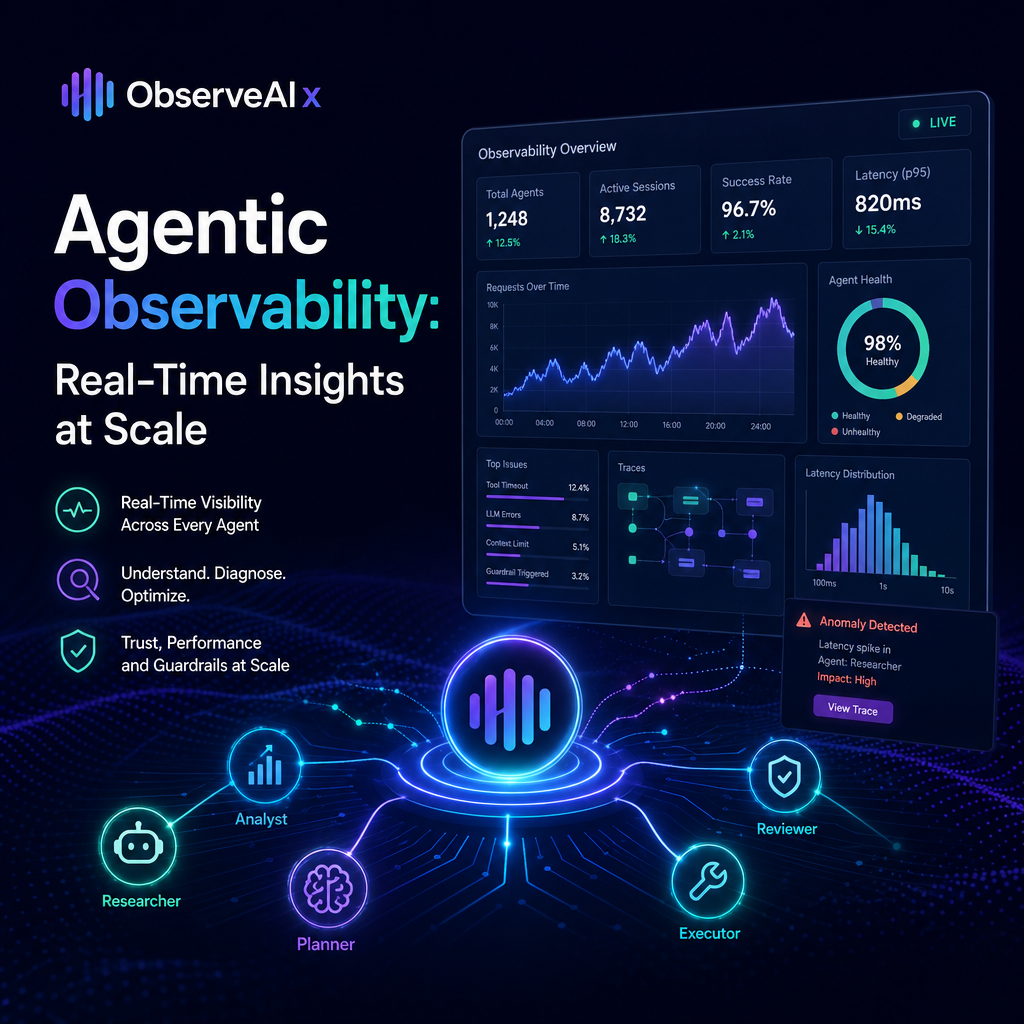
ObserveAIx and Agentic Observability: Real-Time Insights at Scale
ObserveAIx and the Future of Agentic Observability: Real-Time Insights at Scale
Software systems are getting more complex, more distributed, and more AI-driven every year. Traditional monitoring tools can tell you when something is broken, but they often struggle to explain why it happened, what it affects, and what to do next. That gap is exactly where ObserveAIx and the broader shift toward agentic observability come in.
Agentic observability is more than dashboards and alerts. It is the ability to continuously observe systems, interpret signals in context, and help teams act in real time. In a world where milliseconds matter and incidents cascade quickly, that capability is becoming essential.

What Is Agentic Observability?
Agentic observability refers to observability systems that do more than collect and display data. They act with intelligence.

Instead of simply surfacing logs, metrics, and traces, an agentic observability platform can:
- Detect anomalies automatically
- Correlate signals across services and environments
- Prioritize issues based on business impact
- Recommend likely root causes
- Trigger workflows or remediation actions
This is a major step beyond traditional monitoring. It turns observability from a passive reporting layer into an active decision-support system.

Why ObserveAIx Matters
ObserveAIx represents the next phase of observability: one designed for scale, speed, and automation. As systems expand across cloud, edge, and AI-powered workflows, teams need visibility that keeps up without overwhelming operators.
ObserveAIx aims to solve that problem by combining real-time analytics with intelligent agent behavior. The result is a platform that can ingest high-volume telemetry, interpret patterns, and surface actionable insights fast enough to matter.
That matters for several reasons:
- Modern systems generate too much data for humans to manually review.
- Incidents often span multiple services, teams, and geographies.
- Operations teams need faster answers, not just more alerts.
- AI applications introduce new failure modes that require adaptive monitoring.
ObserveAIx is built for exactly this environment.
Real-Time Insights at Scale
At the heart of agentic observability is the ability to process and understand data in real time. Scale is not just about handling more data; it is about turning that data into useful insight before the moment passes.
A strong observability platform should be able to:
- Stream telemetry continuously
- Detect emerging issues as they happen
- Compare behavior against historical baselines
- Understand dependencies between systems
- Reduce noise through intelligent filtering
ObserveAIx fits this model by emphasizing live context rather than delayed reporting. That means teams can spot a latency spike, a memory leak, or a deployment regression while it is still unfolding.
In practice, this can shorten mean time to detect and mean time to resolve. It also reduces alert fatigue, which is one of the biggest pain points in modern operations.
How Agentic Observability Changes Incident Response
Traditional incident response often starts with a flood of alerts and a lot of manual investigation. Engineers jump between tools, compare timestamps, and try to reconstruct what happened.
Agentic observability changes that process.
With systems like ObserveAIx, incident response becomes more guided and proactive. Instead of starting from scratch, teams get:
Faster context
The platform can correlate logs, traces, infrastructure changes, and application behavior into one narrative.
Better prioritization
Not every anomaly deserves the same level of attention. Agentic systems can highlight what is most likely to affect users or revenue.
Suggested next steps
Rather than leaving teams to guess, the system can recommend likely causes or remediation paths.
Automation opportunities
In some cases, the platform can trigger predefined actions, such as scaling resources, rolling back a deployment, or opening a ticket.
This does not replace human operators. It helps them work with better information and less friction.
The Role of AI in Observability
AI is a natural fit for observability because modern systems already generate patterns too complex for manual analysis. Machine learning and large language models can help make sense of that complexity by identifying trends, summarizing incidents, and improving anomaly detection.
ObserveAIx points toward a future where observability tools are not just intelligent, but collaborative. They act like copilots for engineering and operations teams, helping people ask better questions and find better answers faster.
That future will likely include:
- Natural-language querying of observability data
- Automated incident summaries
- Predictive alerts before failures occur
- Smarter correlation across distributed systems
- Adaptive models that learn from each environment
The goal is not to replace expertise. It is to extend it.
What Teams Should Expect Next
As agentic observability matures, teams should expect a few major shifts:
- From reactive to proactive operations
- From fragmented tooling to unified context
- From alert overload to signal-rich insight
- From manual diagnosis to assisted remediation
Organizations that adopt platforms like ObserveAIx early will likely gain a meaningful advantage. They will spend less time chasing symptoms and more time improving reliability, performance, and customer experience.
Conclusion
The future of observability is not just about seeing more. It is about understanding more, faster, and at scale. ObserveAIx reflects that future by bringing real-time intelligence, automation, and agentic behavior into the observability stack.
As systems become more distributed and AI-driven, the need for actionable insight will only grow. Agentic observability offers a path forward—one where teams can move from observation to action without losing time or context.
In the end, the winners will be the organizations that can turn telemetry into decisions and decisions into outcomes.