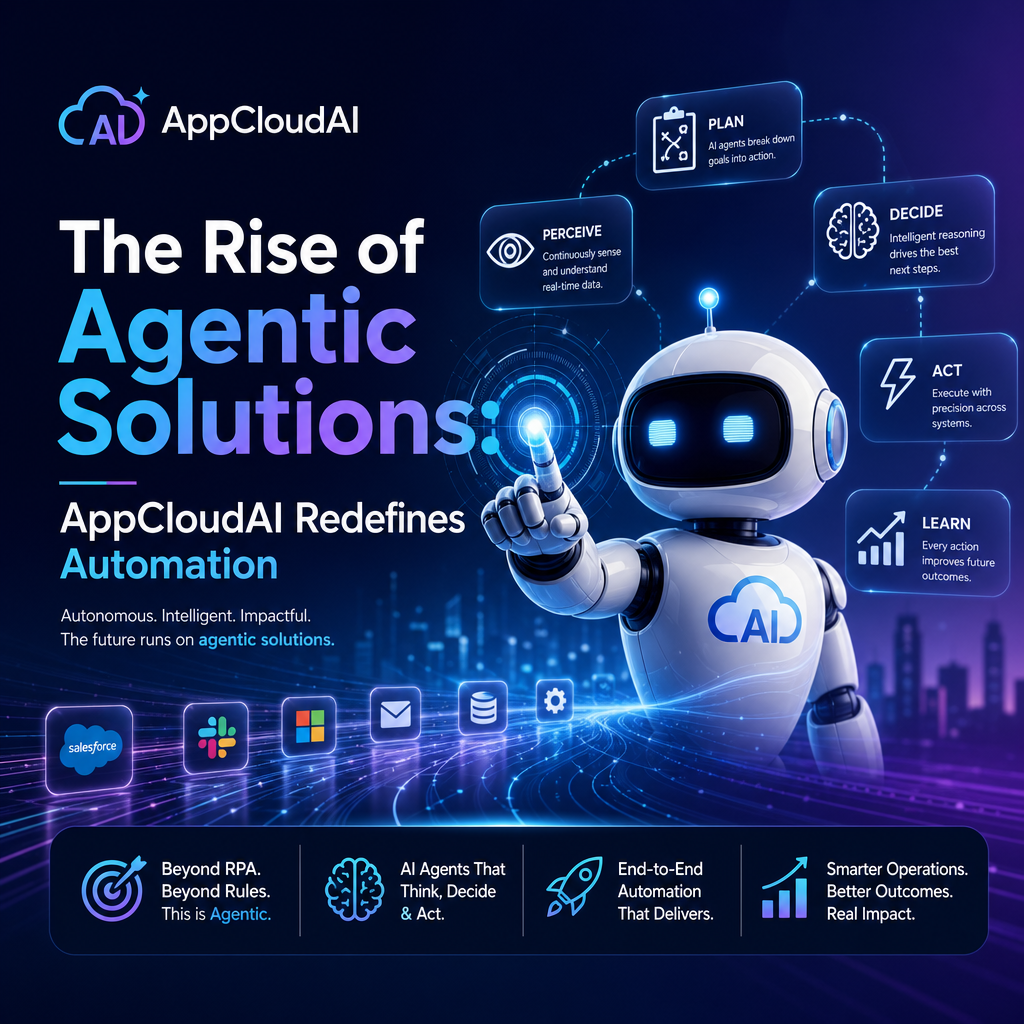
The Rise of Agentic Solutions: AppCloudAI Redefines Automation
The Rise of Agentic Solutions: How AppCloudAI Is Redefining the Future of Automation
Automation has long promised faster workflows, fewer repetitive tasks, and better use of human talent. But today, a new shift is underway. Businesses are moving beyond traditional automation tools and embracing agentic solutions—systems that can reason, decide, and act with far more independence than earlier generations of software.
At the center of this shift is AppCloudAI, a platform helping organizations rethink what automation can actually do. Instead of simply executing predefined rules, AppCloudAI supports intelligent agents that adapt to changing conditions, handle complex tasks, and create more meaningful business outcomes.

What Are Agentic Solutions?
Agentic solutions are AI-powered systems designed to operate with a level of autonomy. Unlike basic automation, which follows fixed instructions, agentic systems can:

- interpret goals,
- break work into steps,
- choose the best actions,
- and adjust when the situation changes.
This makes them especially useful in environments where workflows are dynamic, data is messy, and decisions require context.
Traditional automation is like a checklist. Agentic automation is more like a capable assistant who understands the objective and figures out how to get there.

Why Automation Needed to Evolve
For years, businesses relied on rule-based tools and scripts to streamline operations. These solutions worked well for repetitive, predictable tasks such as data entry, invoice processing, and scheduled reporting.
But modern business operations are rarely predictable.
Customer needs shift quickly. Data comes from multiple platforms. Teams work across systems that don’t always connect cleanly. In this environment, static automation often breaks down or requires constant maintenance.
That is where agentic solutions offer a major advantage. They bring flexibility, intelligence, and adaptability to automation. Instead of forcing teams to build hundreds of rigid rules, companies can deploy agents that respond to real-world complexity.
How AppCloudAI Is Changing the Game
AppCloudAI is redefining the future of automation by making agentic capabilities practical for real business use. Its approach focuses on helping organizations create AI-driven workflows that are not only efficient, but also intelligent and responsive.
1. Smarter decision-making
AppCloudAI enables agents to analyze context before taking action. This means fewer blind steps and better outcomes. Whether it’s routing a support request, prioritizing leads, or coordinating internal operations, the system can make informed choices.
2. Cross-system orchestration
Most businesses rely on multiple tools, platforms, and databases. AppCloudAI helps connect these moving parts through agents that can work across systems instead of being trapped in one silo. That creates smoother operations and less manual handoff between teams.
3. Reduced dependency on rigid workflows
With traditional automation, even small changes can require reconfiguring the entire process. AppCloudAI’s agentic model reduces that burden by allowing workflows to be more adaptive. Teams can define goals and guardrails while the agent handles execution details.
4. Faster scaling
As organizations grow, their operational needs become more complex. AppCloudAI makes it easier to scale automation without multiplying maintenance work. Once an agent is configured, it can often handle expanded volumes or new variations with less rework.
Real-World Impact Across Industries
The value of agentic solutions becomes clear when you look at their practical applications.
Customer support
Agents can triage tickets, summarize issues, route requests to the right department, and even draft responses. This improves response times while freeing human teams to focus on high-value conversations.
Sales and marketing
AppCloudAI can help qualify leads, monitor engagement, personalize outreach, and coordinate follow-up tasks. That means teams spend less time on admin work and more time building relationships.
Operations and finance
From invoice handling to workflow approvals, agentic automation can reduce bottlenecks and improve accuracy. Agents can flag anomalies, initiate actions, and support faster decision-making.
Internal productivity
Employees often lose time switching between tools and chasing routine tasks. By automating these processes intelligently, AppCloudAI helps teams stay focused on strategic work instead of repetitive coordination.
The Human-AI Partnership
One of the most important aspects of agentic solutions is that they do not replace human judgment—they extend it.
AppCloudAI is built around the idea that people should set the goals, policies, and boundaries, while agents handle the execution. This creates a powerful partnership. Humans provide oversight, creativity, and strategic direction. AI agents provide speed, consistency, and persistence.
The result is not just automation for its own sake. It is better work, better decisions, and better use of time.
What the Future Looks Like
As AI continues to mature, agentic solutions will likely become a core part of everyday business infrastructure. Organizations will increasingly rely on systems that can do more than follow instructions. They will need tools that can think through tasks, adapt to change, and operate across complex environments.
AppCloudAI is positioned at the forefront of this transformation. By helping businesses adopt intelligent, goal-driven automation, it is showing what the next generation of enterprise workflows can look like.
The future of automation is no longer about doing the same thing faster. It is about creating systems that can act with purpose, flexibility, and intelligence.
And that future is already taking shape.