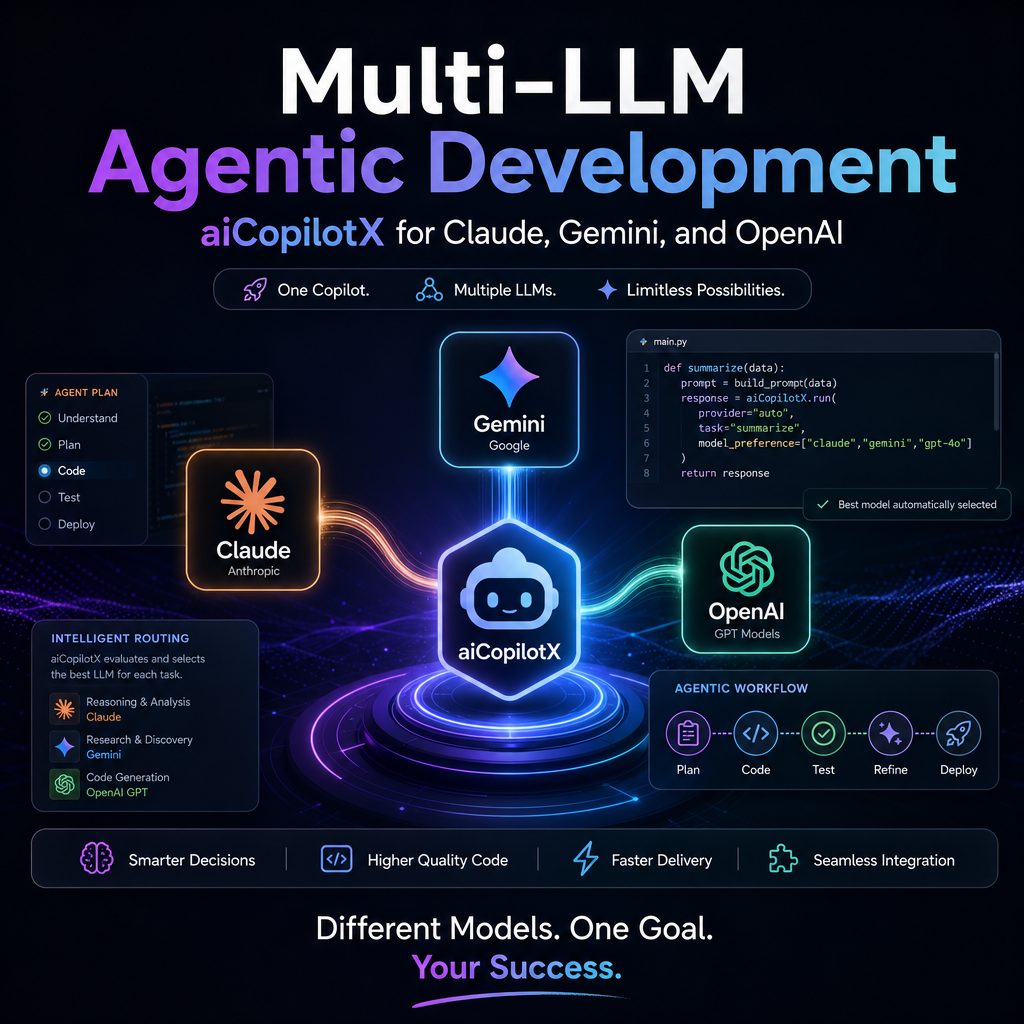
Multi-LLM Agentic Development: aiCopilotX for Claude, Gemini, and OpenAI
Multi‑LLM Agentic Development: Why aiCopilotX Is the Ultimate Builder for Claude, Gemini, and OpenAI
AI development is moving fast, but the real breakthrough isn’t just better models. It’s better orchestration. Today, teams want more than a chatbot or a code generator. They want systems that can plan, build, test, and adapt across multiple models without getting locked into one ecosystem.
That is where multi-LLM agentic development becomes a game changer. And for teams building with Claude, Gemini, and OpenAI, aiCopilotX stands out as a powerful way to unify the entire workflow.

What Multi-LLM Agentic Development Actually Means
Multi-LLM agentic development is the practice of using more than one large language model inside an agent-driven workflow.

Instead of asking a single model to do everything, you assign roles across models based on their strengths:
- One model may excel at reasoning and planning
- Another may be better at code generation
- A third may be ideal for long-context analysis or document synthesis
An agentic system coordinates those models, breaks down tasks, and moves work forward with minimal manual intervention.

This matters because no single model is perfect at everything. The best results often come from combining strengths rather than betting on one tool.
Why Teams Need More Than a Single Model
Most AI builders start with one LLM. That works at first, but as projects grow, limitations show up quickly.
You may run into:
- Context window constraints
- Inconsistent code quality
- Difficulty comparing outputs
- Vendor lock-in
- Wasted time switching between tools
A multi-LLM setup solves these problems by letting teams route tasks dynamically. For example, Claude can handle deep reasoning, Gemini can support broader workflows, and OpenAI can power fast iteration and structured outputs.
The challenge is not access to the models. The challenge is building a smooth, intelligent system around them.
Why aiCopilotX Is Built for This Future
aiCopilotX is designed for developers who want to build with Claude, Gemini, and OpenAI in one workflow. Instead of forcing teams to juggle separate interfaces and disconnected tools, it brings everything into a single agentic environment.
That means faster development, better model comparison, and cleaner execution.
1. Unified orchestration across models
With aiCopilotX, you can design workflows that assign tasks to the right model at the right time. A planning step can go to one model, generation to another, and review to a third.
This kind of orchestration is the heart of effective multi-LLM agentic development.
2. Flexible model switching
Different tasks need different strengths. aiCopilotX makes it easier to switch between Claude, Gemini, and OpenAI without rebuilding your entire pipeline.
That flexibility helps teams:
- Compare model outputs side by side
- Test prompt strategies quickly
- Optimize for accuracy, speed, or cost
- Avoid overcommitting to one provider
3. Better agent workflows
A strong agentic platform should do more than prompt a model. It should support step-by-step workflows, memory, tool use, and task decomposition.
aiCopilotX helps teams build agents that can:
- Gather requirements
- Draft solutions
- Review outputs
- Iterate based on feedback
- Move from idea to implementation faster
The Real Advantage: Smarter Collaboration Between Models
One of the biggest benefits of aiCopilotX is not just using multiple LLMs, but making them collaborate.
Imagine a product feature workflow:
- Claude helps plan the architecture.
- OpenAI generates implementation scaffolding.
- Gemini reviews the broader context and suggests refinements.
- The system loops back for corrections and final polish.
This is far more powerful than relying on a single model in isolation.
It also makes development more resilient. If one model performs poorly on a specific task, another can step in. That reduces bottlenecks and improves output quality.
Use Cases Where aiCopilotX Shines
aiCopilotX is especially valuable for teams working on:
Software development
Generate code, review logic, create tests, and refine implementation across multiple models.
Product workflows
Turn feature requests into structured plans, user stories, and technical tasks.
Research and analysis
Synthesize information from large inputs, compare perspectives, and summarize findings.
AI agent prototyping
Build assistants that can reason, call tools, and operate in coordinated multi-step flows.
In each case, the value comes from combining the best capabilities of Claude, Gemini, and OpenAI without adding workflow chaos.
Why This Matters Now
The AI landscape is becoming more modular. Businesses no longer want a single black-box model. They want control, flexibility, and the ability to choose the best model for the job.
That is exactly why multi-LLM agentic development is emerging as a core pattern for modern AI teams.
aiCopilotX fits this shift by giving builders a practical way to:
- Reduce friction
- Improve output quality
- Speed up iteration
- Scale intelligent workflows
- Stay model-agnostic
Final Thoughts
If you are serious about building AI systems that are adaptable, efficient, and future-ready, multi-LLM agentic development is the path forward.
And if you want a platform that brings Claude, Gemini, and OpenAI together in one coordinated builder experience, aiCopilotX is a strong choice.
It doesn’t just help you use more models. It helps you build smarter systems with them.