
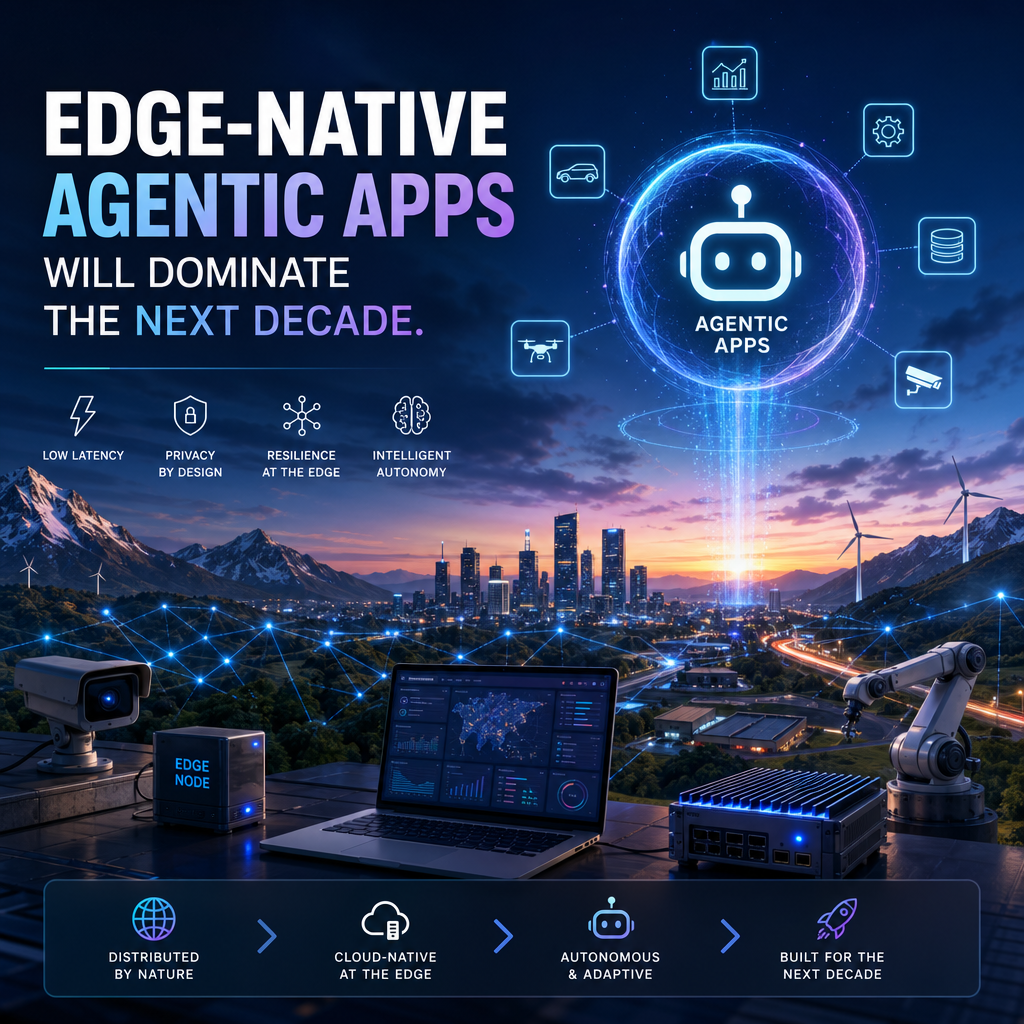
Edge-Native Agentic Apps Will Dominate the Next Decade
How Edge‑Native Agentic Apps Will Dominate the Next Decade of Computing
The next big shift in software will not be defined by bigger cloud servers or prettier interfaces. It will be defined by edge-native agentic apps: applications that run close to the user, act autonomously, and adapt in real time to changing conditions.
This is more than a technical trend. It is a new computing model.

For years, most apps have followed the same pattern: send data to the cloud, wait for a response, and then show the result to the user. That model worked well when connectivity was stable and applications were mostly reactive. But the next decade will reward software that is faster, smarter, more private, and capable of making decisions where the action happens.

What Are Edge-Native Agentic Apps?
An edge-native app is built to run partially or fully on devices and local infrastructure near the user, rather than depending entirely on a distant cloud data center.
An agentic app goes one step further. It does not just respond to commands. It can:

- observe its environment
- make decisions
- take actions
- learn from outcomes
- coordinate with other systems
Put the two together, and you get software that is both local and autonomous.
Think of a retail assistant app that updates inventory at the store level, a factory system that predicts and prevents machine failures, or a healthcare app that analyzes sensor data directly on a wearable device. These applications do not need to wait for a cloud round trip to be useful.
Why the Cloud-Only Model Is Reaching Its Limits
Cloud computing transformed the last decade, but it also created bottlenecks. As apps become more intelligent and more interactive, several problems grow harder to ignore.
1. Latency matters more than ever
AI-driven experiences, robotics, AR glasses, autonomous systems, and real-time analytics cannot afford delay. Even a few hundred milliseconds can make an app feel slow, unstable, or unsafe.
2. Data gravity is real
Moving large volumes of data to the cloud is expensive and inefficient. In many cases, the best place to process data is where it is generated.
3. Privacy and regulation are tightening
Users and regulators want more control over sensitive information. Processing data locally reduces risk and helps companies comply with regional privacy rules.
4. Connectivity is not guaranteed
From factories and ships to rural hospitals and smart vehicles, many modern systems must work even when the network is weak or unavailable.
Edge-native agentic apps solve these problems by shifting intelligence closer to the source.
Why Agentic Behavior Changes Everything
The real breakthrough is not just location. It is behavior.
Traditional software waits for input. Agentic software can manage goals.
That means a logistics app can reroute shipments before delays become visible. A smart home system can balance energy use based on occupancy, weather, and pricing. A field service app can detect a fault, recommend the best fix, and order replacement parts automatically.
This kind of software delivers value in three important ways:
- Speed: actions happen instantly
- Resilience: the system keeps working even with limited connectivity
- Adaptability: the app can respond to context instead of following rigid rules
In short, agentic apps move software from being a tool to being a collaborator.
The Technologies Making This Possible
Several advances are converging to make edge-native agentic apps practical at scale.
Smaller, smarter models
Compact AI models can now run on phones, laptops, sensors, and embedded devices. This allows inference and decision-making without constant cloud dependence.
Better edge hardware
Modern CPUs, NPUs, and specialized chips are giving edge devices the power to handle more local computation than ever before.
Event-driven architectures
Apps can now react to streams of local data in real time, making it easier to coordinate actions across devices and systems.
Distributed orchestration
Software platforms are emerging that help developers manage agents, policies, memory, and updates across edge environments.
Together, these tools create a new foundation for computing.
The Business Impact Will Be Massive
Edge-native agentic apps will dominate because they create advantages that are hard to ignore.
Lower costs
Less bandwidth, fewer cloud calls, and more efficient processing can reduce operating expenses.
Better user experience
Fast, intelligent apps feel seamless. That improves retention, trust, and satisfaction.
New product categories
Some experiences simply cannot exist without edge intelligence. Think autonomous drones, adaptive industrial systems, live translation glasses, or hyper-personalized retail assistants.
Stronger differentiation
As AI becomes more accessible, competitive advantage will come from where and how intelligence is deployed, not just whether it exists.
What Builders Should Focus On Now
Teams that want to stay ahead should start designing for edge-native behavior today.
That means:
- Designing for offline-first operation
- Minimizing dependency on cloud round trips
- Choosing smaller, efficient models when possible
- Building explicit policies for autonomy and safety
- Planning for observability across distributed environments
The winning apps of the next decade will not simply use AI. They will embed intelligence into the environment, at the point of action.
The Future Is Local, Autonomous, and Always On
The future of computing will not be owned by the cloud alone. It will be shared across devices, environments, and intelligent systems that act where the data lives.
That is why edge-native agentic apps will dominate the next decade. They are faster, smarter, more private, and more resilient than traditional software. Most importantly, they align with how the world is actually becoming: distributed, dynamic, and always in motion.
The next generation of apps will not just answer questions.
They will understand context, take initiative, and get work done right at the edge.